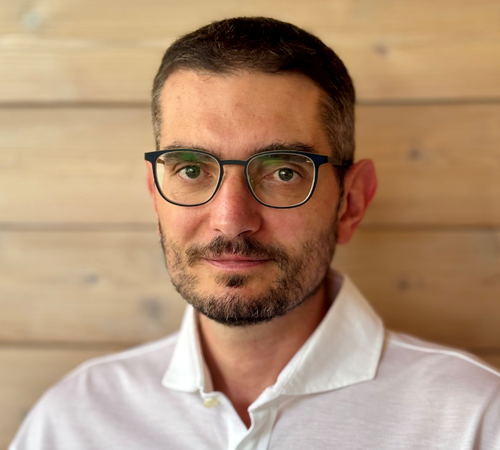
Andrea Vedaldi is Professor of Computer Vision and Machine Learning at the University of Oxford, where he co-leads the internationally renowned Visual Geometry Group. Concurrently, he serves as Research Scientist and Technical Lead at Meta, focusing on 3D computer vision and generative AI research. His research spans fundamental and applied aspects of computer vision and machine learning, with specializations in 3D reconstruction and generative models. He has made influential contributions recognized through major awards and leadership roles, including chairing the European Conference on Computer Vision. Awards & Honors: Royal Society Faraday Discovery Fellowship IEEE Thomas Huang Memorial Prize IEEE Mark Everingham Prize Two Best Paper Awards (CVPR) ACM Test of Time Award FREng (Fellow of Royal Academy of Engineering) ELLIS Fellow
Mislav Balković is an Associate Professor at Algebra University of Applied Sciences, where he has served as Director and Dean since 2000 and 2009, respectively. He drives strategic development for the Algebra Group and contributes to national education policy through roles in expert bodies like the National Council for Science, Higher Education and Technology, and the Accreditation Council of the Agency for Science and Higher Education. Education: PhD (2016) from Faculty of Electrical Engineering and Computing, University of Zagreb Bachelor’s and Master’s degrees from Faculty of Electrical Engineering and Computing, University of Zagreb Research Interests: Mislav’s work bridges Data Science with applications in labor market dynamics , education policy , qualification frameworks , and energy systems . His projects focus on smart grid optimization, digital identity protection, and AI-driven educational reforms. Publications Trends: His recent articles emphasize cross-disciplinary applications , including brain-computer interfaces for image generation, EU labor market analysis , and smart grid resilience . Earlier works explore blockchain-based academic credentials and data analytics in auditing . Grants and Projects: He has led ~50 EU and domestic projects , spanning smart tourist management , lean methodologies for screen creators , and ICT services for alternative communication . His policy work includes drafting laws on adult education and higher education reform. Leadership: Vice President of the Croatian Employers' Association in Education (HUP-UPO) and past President of the Sectoral Council for Electrical Engineering and Computing.
Damir Regvart is a lecturer at Algebra University of Applied Sciences , specializing in Cybersecurity , Network Protocols , and Cloud Computing . With a background in Electrical Engineering and a Master's in Electrical Engineering from the Faculty of Electrical Engineering and Computing in Zagreb (2002), he focuses on advanced network security protocols, Zero-touch technologies, and cloud infrastructure. Research Highlights : Zero Trust Architecture, Honeypot Deception Strategies, Machine Learning in Threat Detection, Microsoft Azure Security, and Infrastructure as Code hardening. Key Projects : Pan-European and national initiatives in network automation, cloud forensics, and IoT security. Recent Publications (2024-2025) explore cutting-edge topics like AI-driven security testing, forensic capabilities in cloud environments, and the intersection of SDN and cybersecurity. His work addresses vulnerabilities in cryptographic systems and the legal implications of digital signatures. Technology Focus : Zero-touch provisioning, Microsoft Sentinel automation, and RedFish/vSphere API integration.
Dario Bojanjac is an Assistant Professor at the Department of Wireless Communications, Faculty of Electrical Engineering and Computing, University of Zagreb. His research focuses on mathematical modeling of electromagnetic processes, numerical methods for Maxwell's equations, and applied mathematics techniques like asymptotic analysis. He holds a PhD in mathematics (2015) and electrical engineering (2009), with extensive visiting scholar experience at institutions such as École Polytechnique Fédérale de Lausanne (EPFL) and the University of Michigan. Education: PhD in Mathematics (2015), Faculty of Science, University of Zagreb PhD in Electrical Engineering (2009), Faculty of Electrical Engineering and Computing His research interests include electromagnetic wave scattering, homogenization of Maxwell's equations, and computational electromagnetism. Recent work explores ground-based SAR systems, deep learning applications in radar data analysis, and flood classification using multivariate approaches. He has received awards including the Swiss Government Excellence Scholarship and Croatian Government Fellowship. His projects include satellite electromagnetic field measurements and metamaterial-based invisibility cloak realization. He participates in lab initiatives like AOLAB2 and coordinates projects such as BODYSEN and HybridAccess. Awards: Swiss Government Excellence Scholarships CIME Foundation Fellowship European Science Foundation Fellowship Bojanjac has advised on multiple research projects and contributed to educational initiatives like the MILE interactive learning system. His lab collaborations include work on sensor systems and optical communication technologies.
Lucija Blašković serves as Assistant Professor at the Department of Information Science and Mathematics within the Faculty of Agriculture, University of Zagreb. She has maintained continuous affiliation with the university since 2003, progressing from Assistant to Postdoctoral Researcher (2015) and currently holding her assistant professorship since 2017. Her office is located in the 5th Pavilion, 3rd floor, room 65, with consultations held Wednesdays 11am-1pm. Her academic credentials include: PhD in Information and Communication Sciences from Faculty of Humanities and Social Sciences, University of Zagreb Master of Economics (mag. oecc) in Information Management from Faculty of Economics, University of Zagreb Master of Economics in Marketing from Faculty of Economics, University of Zagreb Dr. Blašković specializes in digital transformation of agricultural systems , with core expertise in E-business implementation , E-learning pedagogy , and information systems quality assurance . Her research bridges computational methodologies with agricultural education, examining data literacy frameworks, influencer marketing efficacy for agricultural products, and machine learning applications in farming systems. Analysis of her 15 most recent publications (2024-2015) reveals three dominant research trajectories: (1) Pandemic-driven digital adaptation in agricultural education and consumer behavior, (2) Computational methods (K-means, CNNs) for educational and agricultural data analysis, and (3) Strategic implementation of e-learning systems in agricultural higher education. Her work consistently applies technical solutions to domain-specific agricultural challenges. She has secured research leadership through competitive grants: "Mjesto i uloga informatike u razvitku poljodjelskih sustava: primjer Hrvatske" (2017-2019, MZOS-funded) as Project Coordinator "Mogućnosti i oblici primjene optimiziranja proizvodnje na obiteljskim poljoprivrednim gospodarstvima" (2017, University of Zagreb-funded) as Project Coordinator Her teaching portfolio spans communications systems, agricultural information systems, AutoCAD drafting, and e-commerce, reflecting her interdisciplinary approach to agricultural informatics education.
Domagoj Ševerdija is an Assistant Professor at the School of Applied Mathematics and Informatics at Josip Juraj Strossmayer University of Osijek, where he leads the Computer Science and Machine Learning Research Group. He holds a PhD in Electrical Engineering (2013) and a dual BS in Mathematics and Computer Science (2007) from the University of Osijek. His research spans computational linguistics, natural language processing, machine learning, and combinatorial optimization, with applications in bioinformatics, robotics, and energy systems. Recent work focuses on neural language models, domain adaptation techniques, and efficient algorithm design. Publications show strong interdisciplinary trends: computational linguistics (Croatian morphology, sentence embeddings), bioinformatics (cell typing, RNA splicing), and algorithm optimization (terrain guarding, matrix operations). Recent papers emphasize knowledge distillation, domain adaptation, and compressed representations. Awards: Best paper award in AIS - Artificial Intelligence Systems track (MIPRO 2023) Research funding includes: Computer-Assisted Corpus Linguistics (UNIOS, 2019-2020) Croatian Identity Network Framework (Adris Foundation, 2020-2021) Croatian Language in Global Cloud (Adris Foundation, 2019-2020) Leads the Computer Science and Machine Learning Research Group, coordinating projects in NLP, computational geometry, and AI applications.
Josip Lončar is an Assistant Professor at the Department of Radio Communications, Faculty of Electrical Engineering and Computing, University of Zagreb. His research focuses on high-frequency electronics, stability analysis of networks with non-Foster elements, and active/passive metasurfaces. He holds a PhD from the University of Zagreb (2017) and has collaborated with institutions such as the Radiation Laboratory at the University of Michigan and Fuzhou University. He teaches courses including 'Innovative Electromagnetic Systems' and 'Microwave Electronics'. Lončar has received awards including the Rektorova nagrada for biomedical engineering work and an Osijek City Scholarship (2009–2013). His research projects include 'Optical Communication Systems with Extended Resonant Gaps' (HRZZ-funded), 'Non-Foster Source-Load Networks' (EOARD-funded), and 'Metamaterial Structures for Electromagnetic Energy Guidance' (UKF-funded). He has contributed to advancements in CubeSat antenna design, attitude control systems, and active metasurface applications. Lončar’s work bridges theoretical electromagnetic analysis with practical implementations in aerospace and biomedical engineering.
Kristina Kovačević is a researcher and teaching collaborator at the Faculty of Economics, University of Osijek, where she has been employed since February 2020. She is affiliated with the Department of Quantitative Methods and Informatics and contributes to courses such as Statistics and Quantitative Methods for Business Decision-Making. Educated in Business Economics with a focus on Business Informatics Doctoral candidate in Business Economics in a digital environment at the University of Dubrovnik and University of Zagreb since November 2020 Her research interests center on Machine Learning and its applications in energy management, business process optimization, and economic trend prediction. She actively participates in the research project funded by the Croatian Science Foundation, titled "Methodological Framework for Efficient Energy Management Using Smart Data Analytics," which leverages techniques like neural networks, decision trees, and cluster analysis. Her work intersects Quantitative Methods in Business and Intelligent Data Analytics , emphasizing simulation models and business intelligence systems. While no scientific awards are explicitly mentioned in the provided text, her academic profile reflects engagement in both teaching and research, bridging theoretical and applied aspects of business economics through advanced data analysis methodologies.
Krešimir Fertalj is a Full Professor at the Department of Applied Computing, Faculty of Electrical Engineering and Computing, University of Zagreb. His work focuses on software development, project management, and data integration architectures. Research areas include ERP systems, agile methodologies, and hybrid wireless networks in maritime environments Developed tools for workflow modeling, business process automation, and mobile application frameworks Contributed to projects like Flora Croatica Database, CROFlora 2.0, and institutional GIS systems Teaching responsibilities cover structured programming techniques (UML), web service development, and software reliability analysis. Contact: Office D-369, Work 01 6129-918, Home 418
Ana Marija Filipas serves as a Lecturer at the Faculty of Economics and Business (EFRI) of the University of Rijeka, Croatia, where she delivers core quantitative coursework for undergraduate and graduate programs. Her institutional affiliation includes active teaching responsibilities within the Faculty's academic structure, with office hours maintained for student consultation in Chair 62/III. Her research and pedagogical expertise centers on econometric methodology and big data applications in business contexts. She systematically covers probability theory, mathematical statistics, linear regression modeling (including OLS derivation, categorical variables, and diagnostic testing for multicollinearity/heteroscedasticity), and advanced analytics techniques such as supervised/unsupervised learning, decision trees, association rule mining, and text mining. This bridges classical econometric frameworks with contemporary data science tools for economic analysis. Her scientific contributions manifest through curriculum development in quantitative disciplines, particularly the foundational 'Basics of Econometrics' course and the English-taught 'Big Data Analytics' program covering data preprocessing, model deployment, and ensemble methods. While specific research outputs aren't documented in the source material, her instructional focus demonstrates applied expertise in transforming complex statistical concepts into practical business analytics solutions.
Franko Šikić is a Researcher at the Department of Electronic Systems and Information Processing within the Faculty of Electrical Engineering and Computing (FER) at the University of Zagreb. His work bridges computer vision and practical retail applications, focusing on real-world problem solving through deep learning methodologies. His research concentrates on computer vision systems for retail environments and human-computer interaction, particularly in out-of-stock detection, price tag recognition, and gaze estimation. Key interests include applying convolutional neural networks to shelf monitoring challenges and developing attention-based architectures for unconstrained gaze prediction. Recent publications demonstrate a clear progression toward sophisticated retail analytics solutions, with increasing emphasis on multi-task learning for shelf image analysis. His 2025 gaze estimation work introduces novel cross-attention mechanisms, while retail publications consistently address practical constraints like variable lighting and occlusion in supermarket settings.
Jasmina Pivar is an Assistant Professor in the Department of Informatics at the Faculty of Economics - Zagreb (University of Zagreb). Her research focuses on business informatics, big data, machine learning, and smart cities, with applications in fraud detection, human resource management, and urban planning. Research Interests: She explores intersections of technology and economics, including patent analysis of emerging technologies, cluster-based financial strategies, and digital literacy trends. Her work addresses challenges in smart city development, churn management, and data-driven policy for the EU video game industry. Publications Trends: Over the past decade, her articles highlight big data adoption frameworks, fraud profiling techniques, and generational shifts in digital behavior. She frequently employs machine learning and cluster analysis for predictive modeling. Contact: Reach her at jpivar@efzg.hr or Room A507, Faculty of Economics - Zagreb.
Associate Professor Vinko Lešić is affiliated with the University of Zagreb's Faculty of Electrical Engineering and Computing (FER), specifically within the Department of Control and Computer Engineering. His research focuses on advanced control systems, smart grids, renewable energy integration, IoT applications in agriculture, and optimization algorithms. Notable projects include predictive climate control systems for buildings, precision pest detection using hyperspectral imaging, and energy-efficient street lighting solutions. He has contributed to over 50 peer-reviewed articles and led initiatives like the AgroSPARC project for climate-resilient agriculture. His work bridges theoretical control theory with practical applications in smart cities and sustainable energy systems. Research interests span Model Predictive Control (MPC), distributed energy management, and machine learning integration with industrial automation. He collaborates on EU-funded projects addressing climate change impacts on agriculture and urban infrastructure. Teaching responsibilities include courses on automation fundamentals and process control, emphasizing hands-on IoT and PLC implementations. Current activities include developing zone climate control living labs and resilient energy management systems for buildings and microgrids. Publications highlight innovations such as coalitional MPC for building zones, data-driven thermal modeling, and adaptive battery charging for electric vehicles. He advises projects on renewable energy integration and has pioneered sensor-based systems for crop health monitoring. Though no formal awards are listed, his extensive publication record and industry collaborations reflect his academic and applied contributions.
Boris Muha is a Professor in the Department of Mathematics at the University of Zagreb's Faculty of Science. His research focuses on fluid-structure interaction, mathematical modeling in biomechanics, and numerical analysis of partial differential equations. He has contributed extensively to the analysis of complex systems involving fluid dynamics, poroelasticity, and nonlinear structural mechanics. Key research areas include the mathematical analysis of fluid-structure interaction problems, computational methods for porous media, and the development of reduced-order models using deep learning. Recent work emphasizes rigorous derivation of reduced models, validation of solvers for fluid-poroelastic systems, and optimal design of bioartificial organ scaffolds. His publications from 2024–2025 highlight advancements in global weak solutions for fluid-structure systems, nonlinear geometric coupling, and applications to biomedical engineering. Notably, he explores self-propulsion mechanisms in viscous fluids and stability analysis of coupled systems. Awards and grants are not explicitly listed in the provided text. His advising and collaborations span interdisciplinary projects in computational fluid dynamics and mathematical biology, with active participation in international research networks.
Dr. Mario Bukal is an Assistant Professor at the University of Zagreb’s Faculty of Electrical Engineering and Computing, Department of Applied Mathematics. He specializes in Partial Differential Equations (PDEs), particularly evolution equations and systems, with current involvement in the Croatian Science Foundation-funded project Mathematical Analysis of Multi-Physics Problems Involving Thin and Composite Structures and Fluids (MAMPITCoStruFl) . His research focuses on fluid-structure interaction, nonlinear systems, and mathematical modeling. He has taught courses in Mathematics, Probability & Statistics, and Stochastic Processes at both undergraduate and PhD levels, including roles at Vienna University of Technology. Education & Positions: Holds a PhD and has taught at multiple institutions, including TU Wien. Research Interests: Nonlinear PDEs, fluid dynamics, quantum mechanics, and applied mathematical analysis. His recent publications emphasize rigorous derivation of reduced models for complex systems, entropy analysis in quantum diffusion, and numerical schemes for fourth/sixth-order equations. Bukal actively contributes to seminars and conferences on nonlinear analysis and differential equations.