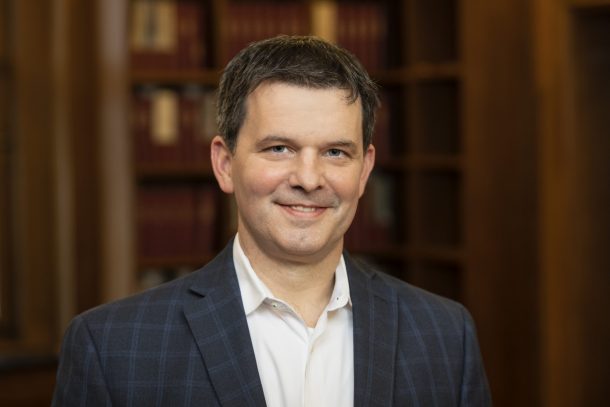
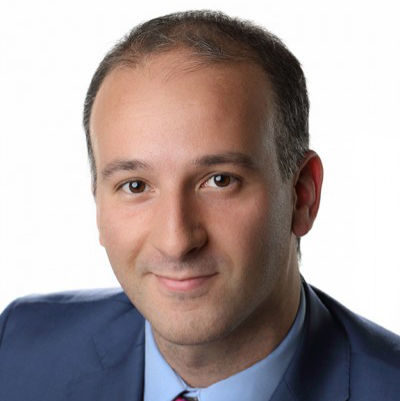
Jeffrey F. Brock is the Dean of the School of Engineering & Applied Science and the William S. Massey Professor of Mathematics at Yale University. He holds the Zhao and Ji Chair in Mathematics. His research focuses on low-dimensional geometry and topology, particularly hyperbolic geometry and its applications to data analysis. He completed his undergraduate studies at Yale and earned his Ph.D. from UC Berkeley. He held positions at Stanford, the University of Chicago, and Brown University, where he chaired the Mathematics Department from 2013 to 2017 and founded Brown’s Data Science Initiative in 2016. He joined Yale in 2018, serving as inaugural Dean of Science in the Faculty of Arts and Sciences until assuming his current role in 2022. He is a Guggenheim Fellow and Fellow of the American Mathematical Society. His research spans hyperbolic 3-manifolds, Teichmüller dynamics, and geometric methods in data science. Notable contributions include work on Thurston’s geometrization program, classification of hyperbolic manifolds, and applications of geometric topology to complex datasets. He co-authored foundational papers on ending laminations, Weil-Petersson geometry, and renormalized volume. His recent work bridges pure mathematics with applied challenges, such as algorithmic detection of medical imaging patterns. Awarded the Guggenheim Fellowship (2008) and AMS Fellow (2017), Brock has also led interdisciplinary initiatives at Brown and Yale. His administrative roles include overseeing engineering, natural sciences, and data science programs. Beyond academia, he co-founded the Vijay Iyer Trio, showcasing his passion for music performance and creativity.
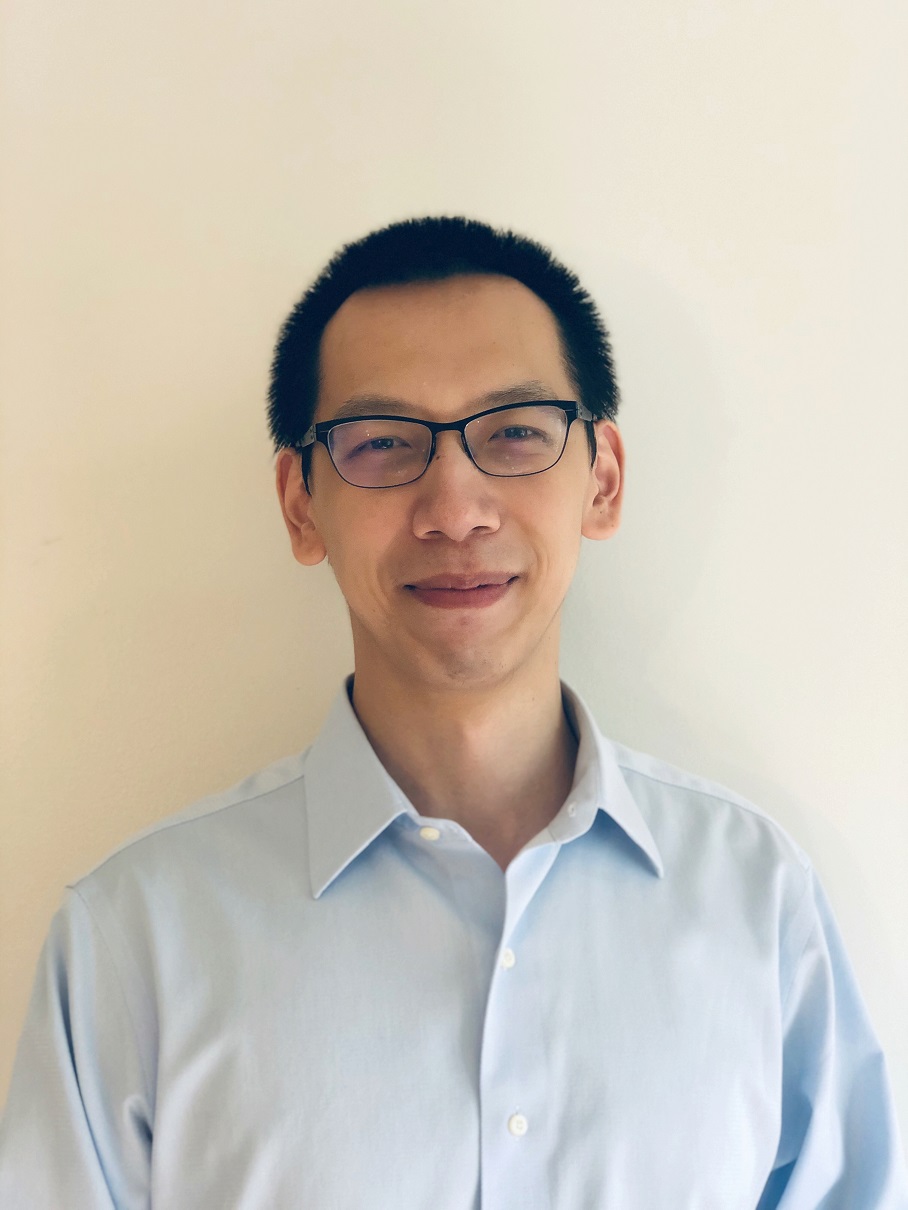
Xiaowei Jia is an Assistant Professor in the Department of Computer Science at the University of Pittsburgh. He holds a Ph.D. from the University of Minnesota (supervised by Prof. Vipin Kumar) and B.S./M.S. degrees from the University of Science and Technology of China (USTC) and SUNY Buffalo. His research focuses on integrating scientific theory with machine learning to address societal and environmental challenges, such as climate modeling, hydrology, and fairness in AI. Education: Ph.D., University of Minnesota (2020) M.S., State University of New York at Buffalo B.S., University of Science and Technology of China (USTC) Research Interests: Knowledge-Guided Machine Learning Spatiotemporal Data Mining Fairness in AI for Social Good Applications in Environmental Science and Healthcare Publications showcase his work on physics-integrated neural networks, spatiotemporal modeling (e.g., water temperature prediction), and fairness-aware algorithms. His work has been recognized with Best Paper awards at SIAM SDM (2022, 2023). Awards include the Best Applied Data Science Paper Award at SIAM SDM in 2022 and 2023. He teaches advanced machine learning courses, emphasizing theory integration with real-world applications.
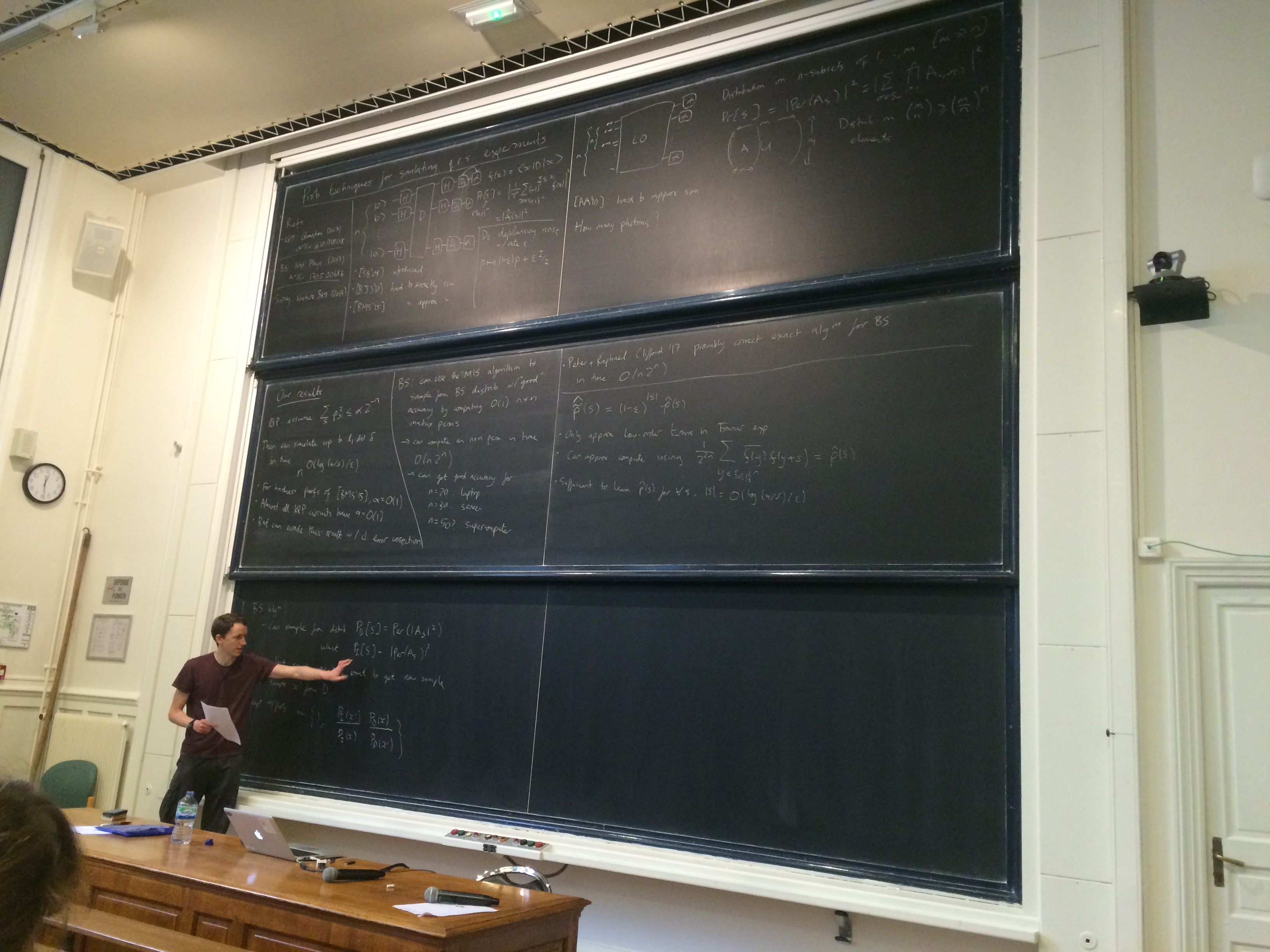
Ashley Montanaro is Professor of Quantum Computation in the School of Mathematics at the University of Bristol, and co-founder of the quantum software startup Phasecraft. He is a member of the Quantum Information Theory research group at Bristol. His research focuses on the theory of quantum computing, with particular interest in quantum algorithms, computational complexity, quantum query and communication complexity, and classical algorithms. His work spans both theoretical foundations and practical applications of quantum computing. Montanaro's research output shows significant trends toward quantum algorithms for optimization problems, quantum computational supremacy, and bridging theoretical advances with practical implementation challenges. His publications span foundational quantum information theory to applied quantum algorithms, demonstrating a versatile research program that connects computer science with quantum physics. Among his professional activities, Montanaro served on the QIP steering committee (2016-2018) and was an editor for the Quantum journal until 2019. He has been active in conference organization, serving on program committees for ITCS 2018, AQIS 2017 and 2015, QIP 2015, and TQC 2014 and 2013, reflecting his standing in the quantum computing research community. He has supervised numerous PhD students including Josh Blake, Jorja Kirk, Sheila Perez Garcia, Sami Boulebnane, Jan Lukas Bosse, Lana Mineh, Joao F. Doriguello, Chris Cade, Sam Pallister, and Stephen Piddock. His teaching includes Quantum Computation (MATHM0023) which he has taught since 2014 and Advanced Quantum Information Theory which he taught in 2015 and 2016. As co-founder of Phasecraft, Montanaro is actively translating theoretical quantum computing advances into practical software solutions, positioning him at the intersection of academic research and quantum technology commercialization.
Jan von Delft is a Professor (chair) at Ludwig-Maximilians-University (LMU) Munich, working in the Faculty of Physics within the Chair of Theoretical Solid State Physics. His research group consists of postdocs, PhD students, and master's students working on various aspects of strongly correlated electron systems, with physical space located at Theresienstr. 37 (Room A420) in Munich. von Delft's research focuses on correlated electron and spin systems, with particular interest in dynamical and transport properties, quantum impurity models, Hund metals, unconventional superconductors, quantum magnets, and quantum criticality. His methodological expertise includes many-body field theory, parquet formalism (FRG), DMFT, and tensor networks (NRG, DMRG, PEPS, XTRG, etc.). His work bridges theoretical concepts with computational approaches to understand complex quantum phenomena in condensed matter systems. He has developed a distinctive emphasis on real-frequency calculations and numerical methods for studying quantum critical phenomena. Analysis of von Delft's recent publications reveals a strong focus on developing and applying advanced computational methods to study strongly correlated electron systems. His group has made significant contributions to numerical renormalization group techniques, tensor network methods, and the parquet formalism for calculating real-frequency correlation functions. His research shows increasing sophistication in handling quantum criticality, particularly in heavy-fermion systems, and exploring unconventional superconductivity mechanisms. Notably, his group has developed specialized computational libraries like KeldyshQFT to make these advanced methods more accessible to the broader physics community. von Delft actively mentors a substantial research group consisting of one postdoc (Markus Scheb), eleven PhD students (Anxiang Ge, Sasha Kovalska, Mathias Pelz, Marc Ritter, Nepomuk Ritz, Changkai Zhang, Markus Frankenbacher, Felipe Picoli, Simone Fodera, Ming Huang), and two master's students (Ester Pages, Gianluca Grosso). His detailed Style Guide for scientific communication demonstrates his commitment to high-quality research presentation. The group appears well-funded with ongoing research activities spanning theoretical development, computational implementation, and physical interpretation of complex quantum phenomena.
Prof. Dr. Dennis Säring is a faculty member at the University of Applied Sciences Wedel , specifically affiliated with the School of Engineering. His academic and research activities focus on Deep Learning , Medical Image Analysis , and applications of Artificial Intelligence in healthcare and biomedical imaging. He has led seminars on Deep Learning topics and supervised student projects in Autonomous Driving at Audi's AADC 2018 competition. Research Highlights : Cardiovascular imaging, forensic age estimation via MRI, neural network-based bone segmentation, and cerebrovascular aneurysm analysis. Technical Expertise : Cardiac MRI, 3D/4D image processing, parametric mapping, and spatiotemporal data fusion. His recent publications (2018-2023) emphasize 3D MR segmentation for age assessment, CMR strain analysis in athletes, and T1/T2 mapping for myocarditis. Key collaborations include institutions like the University Medical Center Hamburg-Eppendorf and Wedler Hochschulbund, with funding for autonomous vehicle research. While no explicit scientific awards are listed, his work spans clinical cardiology, forensic radiology, and AI-driven medical diagnostics.
Marek Pycia serves as Professor of Organizational Economics at the University of Zurich and Co-Director of the Zurich Center for Market Design. His research has driven tangible policy impacts including the U.S. kidney-transplant voucher program and school system redesigns, with publications in premier journals like American Economic Review and Econometrica . His academic foundation includes a Ph.D. in Economics from the Massachusetts Institute of Technology (MIT), complemented by prior faculty roles at UCLA, Pennsylvania State University, and Leon Koźmiński Academy of Entrepreneurship and Management, plus a visiting fellowship at Princeton University. Professor Pycia specializes in Market Design and Mechanism Design , where he bridges theoretical microeconomics with real-world applications in healthcare allocation and educational systems. His work emphasizes strategyproofness , simplicity , and efficiency in matching markets, influencing both academic frameworks and practical policy implementations globally. Recent publications (2024-2025) reveal a concentrated focus on simplifying mechanism design for discrete environments, advancing double auction theory, and optimizing information structures in trade. These works consistently apply game-theoretic principles to solve complex allocation problems across healthcare, education, and financial markets. Key recognition includes: Research Fellow at the Centre for Economic Policy Research (CEPR) Editorial board membership at Theoretical Economics , Journal of Economic Theory , and Games and Economic Behavior While specific grant details remain unmentioned, his editorial leadership and center directorship indicate active research funding. He supervises graduate work through the University of Zurich’s economics programs, though no named students appear in the source text. The Zurich Center for Market Design, which he co-directs, functions as an interdisciplinary hub connecting theoretical research with practitioners in healthcare, education, and public policy to implement novel market mechanisms.
Prof. Marc Stamminger is a Professor of Visual Computing at FAU since 2002, leading the Chair of Computer Science 9 (Computer Graphics). His work focuses on algorithms for synthesizing and analyzing images through 3D modeling, LiDAR/Radar capture, and light simulation. He co-leads FAU Solar, applying 3D modeling for environmental lighting analysis under varying conditions. Stamminger has published over 250 papers, winning prestigious awards like the Siggraph Test-of-Time Award. He holds executive roles in Eurographics and is Vice Dean of FAU's Technical Faculty. Research interests span neural rendering , 3D reconstruction , radar imaging , and medical visualization . Recent work emphasizes radiance field rendering (e.g., VR-Splatting, INPC) and radar-based human motion tracking. His lab's FAU Solar project integrates large-scale 3D models with environmental lighting simulations. Publications trends highlight neural rendering optimizations , radar-MIMO systems , and agricultural digital twins . Key collaborations involve medical imaging (e.g., vocal fold reconstruction) and autonomous driving data generation. Awards: Siggraph Test-of-Time (2023?), 2× Siggraph Best-Of-Show Grants/Teams: FAU Solar Lab, Eurographics leadership, FAU Vice Dean Labs: Chair of Computer Science 9, FAU Solar Initiative
Prof. Dr. Markus Zimmermann leads the Chair of Product Development and Lightweight Design at the Technical University of Munich (TUM). With a background in mechanical engineering from TU Berlin and the University of Michigan, and a doctorate from MIT on solid-state singularities, he bridges academic rigor with industrial application. His career spans 12 years at BMW focusing on vehicle development before transitioning to academia. Specializes in solution space engineering for robust design Expert in additive manufacturing and systems engineering Develops methodologies for managing design complexity and uncertainty His research focuses on multidisciplinary design optimization and lightweight structures , particularly in robotics and automotive systems . His team applies digital twin frameworks and attribute dependency graphs to enhance design processes. Recent publications emphasize topology optimization in robotic systems and thermal management for medical X-ray sources. Key trends in his 2024-2025 publications include: Topological optimization for additive manufacturing and robotics Application of solution spaces to manage design uncertainty Development of compact X-ray systems for medical therapy Integration of digital twin technologies in industrial contexts
Peter Benner is a Professor and Director at the Max Planck Institute for Dynamics of Complex Technical Systems in Magdeburg, where he leads the Computational Methods in Systems and Control Theory group. He also holds an Honorarprofessor position for Mathematics at Otto-von-Guericke Universität Magdeburg since 2011. Benner has previously served as Managing Director of the Max Planck Institute during multiple periods (2013-2014, 2021-2022, and 2025-2026), demonstrating his leadership in the field. Benner's research focuses on Scientific Machine Learning, Numerical Linear and Multilinear Algebra, Model Order Reduction and Reduced-order Modeling, Numerical Methods in Systems and Control Theory, PDE Constrained Optimization, High-performance and Power-aware Computing, and Mathematical Software development. His work bridges theoretical mathematics with practical engineering applications, particularly addressing challenges in large-scale dynamical systems. Analysis of his recent publications reveals a strong emphasis on developing efficient computational methods for complex systems. Benner has pioneered approaches combining model order reduction with tensor methods to tackle high-dimensional problems in uncertainty quantification and PDE-constrained optimization. His work shows a consistent trend toward integrating data-driven techniques with traditional model-based approaches, particularly for nonlinear and parametric systems. Throughout his career, Benner has actively mentored students and collaborated with researchers worldwide, delivering numerous invited talks at prestigious institutions and conferences across Europe, North America, and Asia. His research has received significant funding, supporting the development of mathematical software and computational methods for industrial applications. Benner leads the Computational Methods in Systems and Control Theory department at the Max Planck Institute, which focuses on developing and implementing advanced numerical methods for large-scale dynamical systems. The group maintains strong connections with both theoretical mathematics and practical engineering applications, particularly in fluid dynamics, energy systems, and control theory.
Anders Rantzer is a Professor of Automatic Control at the Department of Control Engineering, Faculty of Engineering, Lund University, Sweden. He has held visiting positions at Caltech (2004–2005) and the University of Minnesota (2015–2016) as the Taylor Family Distinguished Visiting Professor. His academic journey began with a PhD from KTH Stockholm in 1991, followed by a postdoc at the Institute for Mathematics and its Applications (IMA), University of Minnesota. His research interests center on modeling, analysis, and synthesis of control systems , with a strong focus on scalability, adaptation, and applications in energy networks . He is particularly known for foundational work in positive systems and integral quadratic constraints (IQCs) . These theoretical frameworks are critical in analyzing stability and robustness of large-scale interconnected systems. His work bridges mathematical rigor with practical engineering applications, especially in sustainable energy and networked systems. The recent publications and lecture materials reflect a consistent trajectory in scalable and robust control, optimization, and distributed systems. Themes such as large-scale convex optimization , nonlinear and stochastic control , and network dynamics dominate his scholarly output, indicating a sustained commitment to advancing control theory for complex, real-world systems. Scientific honors include: Fellow of IEEE Member of the Royal Swedish Academy of Engineering Sciences (IVA) Chairman of the Swedish Scientific Council for Natural and Engineering Sciences Chairman of the Royal Physiographic Society of Lund Rantzer has supervised numerous students and contributed extensively to academic leadership and education. He has been involved in major national and international research initiatives such as WASP (Wallenberg AI, Autonomous Systems and Software Program) and ELLIIT. His work includes developing educational tools and courses in control, optimization, and machine learning. He leads and contributes to research projects on autonomous systems, cloud control, and smart energy networks. He is affiliated with the Control Lab at LTH and participates in collaborative efforts such as the Nordic University Hub on Industrial Internet of Things (HI2OT). His work integrates theoretical advances with practical implementations in robotics, biomedical systems, and industrial automation.
Dr. Ulrike Kuhl is a Researcher at the University of Bielefeld, serving as Project Coordinator for the AI Academy OWL at the Research Institute for Cognition and Robotics and as Scientific Project Coordinator within the Faculty of Engineering's Machine Learning Group. Her office is located at CITEC 2-412, and she can be reached at +49 521 106-12125. Dr. Kuhl's research spans several interconnected domains at the forefront of human-centered AI development: Explainable Artificial Intelligence (XAI) frameworks and their psychological impact Cognitive learning enhanced through AI technologies Counterfactual explanation methodologies and user behavior Human-AI interaction design principles Applications of machine learning in environmental monitoring and sports analytics Analysis of Dr. Kuhl's publication trajectory reveals a consistent focus on bridging the gap between sophisticated AI systems and human understanding. Her work particularly examines how different explanation types affect user trust and decision-making, with recent publications exploring counterfactual explanations in contexts ranging from water distribution networks to educational technology. She has developed experimental frameworks like the 'Alien Zoo' methodology for systematically studying explanation usability. Dr. Kuhl actively contributes to the Center for Cognitive Interaction Technology (CITEC) at the University of Bielefeld, an interdisciplinary hub where computer scientists, engineers, and cognitive scientists collaborate on next-generation interactive technologies. Through her coordination of the AI Academy OWL initiative, she facilitates regional collaboration between academic researchers and industry partners to advance artificial intelligence applications in the Ostwestfalen-Lippe region.
Vladimir Spokoiny is a Professor at the Departments of Mathematics and Economics of the Humboldt University of Berlin and Head of the Research Group "Stochastic Algorithms and Nonparametric Statistics" at the Weierstrass Institute for Applied Analysis and Stochastics (WIAS) in Berlin, Germany. His research spans multiple areas of statistics, machine learning, and financial mathematics, with significant contributions to nonparametric statistics, high-dimensional data analysis, and statistical methods in finance. Spokoiny received his M.Sc. in applied mathematics from the Moscow Institute of Railway Engineering in 1981 and his Ph.D. in mathematics from Lomonosov Moscow State University in 1988. He completed his Habilitation at Humboldt University in 1996. His academic career includes positions at the All-Union Institute of Railway Transport in Moscow, the Institute for Information Transmission Problems in Moscow, and the Institute for Applied Analysis and Statistics in Berlin before joining the Weierstrass Institute and Humboldt University where he has been a professor since 2002. Spokoiny's research focuses on adaptive nonparametric smoothing and hypothesis testing, high dimensional data analysis, statistical methods in finance, image analysis with applications to medicine, classification, and nonlinear time series. His work often addresses the challenges of nonstationarity in time series data and develops innovative methods for volatility estimation and risk management. He has made significant contributions to the development of adaptive weights smoothing procedures, which have applications in image processing, community detection, and manifold learning. His recent work has expanded into high-dimensional statistics, Bayesian inference, and optimization methods for machine learning, with publications demonstrating novel approaches to Gaussian approximation, Laplace methods, and statistical inference in non-Euclidean spaces. Spokoiny has supervised numerous PhD students including Oliver Reiss, Danilo Mercurio, Ying Chen, Elmar Diederichs, and Mstislav Elagin, whose research has focused on mathematical finance, time series analysis, and statistical methods. He serves as an Associate Editor for The Annals of Statistics (since 2004) and Statistics and Decisions (since 2002), and has previously served on the editorial board of the Journal of Statistical Planning and Inference. His professional activities include reviewing for major statistical journals including Annals of Statistics, Bernoulli, Econometrica, and Journal of American Statistical Association, as well as reviewing grant proposals for the National Science Foundation (USA), German Research Foundation, and Netherlands Organisation for Scientific Research. Spokoiny is a member of several professional societies including the International Statistical Institute, American Statistical Association, Institute of Mathematical Statistics, and Bernoulli Society. He is fluent in Russian (mother tongue), English, and German, and has good knowledge of French. His research group at WIAS focuses on developing novel statistical methodologies with applications across various scientific domains, particularly emphasizing adaptivity and robustness in complex data environments. The group's work has significant implications for financial risk management, medical imaging, and machine learning applications, with recent publications addressing fundamental questions in high-dimensional statistics and nonparametric inference.
Carlos Cinelli is an Assistant Professor in the Department of Statistics at the University of Washington, where he conducts research at the intersection of causal inference, statistical methodology, machine learning, and artificial intelligence. He is also a data science fellow at the eScience Institute and affiliate faculty of the Center for Statistics and the Social Sciences, demonstrating his interdisciplinary approach to causal methodology. Dr. Cinelli received his Ph.D. in Statistics from the University of California, Los Angeles, advised by Chad Hazlett and Judea Pearl, two prominent figures in causal inference. His research focuses on developing new causal and statistical methods for transparent and robust causal claims in empirical sciences, with particular attention to challenges faced by social and health scientists. His work spans theoretical developments in causal identification, sensitivity analysis frameworks, and practical software implementations that enable researchers to assess the robustness of their causal conclusions. Cinelli's research program addresses fundamental questions about how unobserved confounding affects causal estimates and develops tools to quantify how sensitive findings are to potential violations of causal assumptions. His work on omitted variable bias frameworks has been particularly influential across multiple disciplines. Through his publications, Cinelli has established himself as a leading researcher in causal inference methodology, with papers appearing in top journals across statistics, machine learning, epidemiology, and social sciences. His work demonstrates both theoretical rigor and practical relevance, often accompanied by open-source software implementations that make his methods accessible to applied researchers. Best paper award at SBE 2024 in Econometrics Royalty Research Fund (RRF) Award recipient NSF/MMS research support As an advisor, Cinelli has successfully guided PhD students like Nick Irons to dissertation completion. He actively seeks new students with strong interests in causal inference. His research is supported by multiple funding sources including the National Science Foundation and the University of Washington's Royalty Research Fund. Cinelli contributes to the academic community through editorial work for the Journal of Causal Inference and by developing widely used software packages like sensemakr for sensitivity analysis.
Dr. Emilio Ferrara is a Professor of Computer Science & Communication at the University of Southern California, holding appointments in the Viterbi School of Engineering, Annenberg School for Communication and Journalism, and Keck School of Medicine. He serves as Associate Director of Applied Data Science at USC, Research Team Leader at the USC Information Sciences Institute, and Principal Investigator at the USC/ISI Machine Intelligence and Data Science (MINDS) group. His educational background includes a PhD in Machine Learning and BSc & MSc in Computer Science. Ferrara's research focuses on the intersection of artificial intelligence and computational social science, specifically using AI to model and predict human behavior in techno-social systems. His work spans social networks, machine learning, and network science with applications to understanding communication dynamics in digital environments. Ferrara has published over 150 articles in prestigious venues including Proceedings of the National Academy of Sciences, Communications of the ACM, and Physical Review Letters. His research has been widely featured in major news outlets and examines topics ranging from social media manipulation to AI ethics and online behavior. His scientific achievements have been recognized with numerous awards: 2019 Viterbi Scientific Award 2018 DARPA Director's Fellowship 2016 DARPA Young Faculty Award 2016 Complex Systems Society Junior Scientific Award 2015 IBM Watson Big Data Influencer Ferrara's research is supported by major funding agencies including DARPA, IARPA, Air Force, and Office of Naval Research. He leads the HUMANS LAB (Humans & Machines + Networks & Social Systems) which has trained numerous PhD students who have gone on to successful careers in academia and industry. His work on social bots, election integrity, and AI ethics continues to shape understanding of digital social dynamics.
Elena Simperl is a Professor of Computer Science and Deputy Head of Department for Enterprise and Engagement at King's College London's Department of Informatics. She co-directs the King's Institute for Artificial Intelligence and serves as Director of Research for the Open Data Institute. As a Hans Fischer Senior Fellow at the Technical University of Munich's Institute for Advanced Study, she leads the Trustworthy Knowledge Graphs focus group and contributes to advancing human-centric AI research across European institutions. Professor Simperl obtained her doctoral degree in Computer Science from the Free University of Berlin and her diploma from the Technical University of Munich. Prior to joining King's, she held academic positions in Germany, Austria, and at the University of Southampton, and was a Turing Fellow. Her career trajectory demonstrates consistent leadership in bridging academic research with practical applications in data ecosystems. Her research sits at the critical intersection of AI and social computing, focusing on human-centric approaches to building sociotechnical systems that integrate data, algorithms, and human capabilities. She investigates how to make knowledge engineering more accessible, how to leverage collective intelligence for data quality improvement, and how to design participatory AI systems that address societal challenges like misinformation. Her work spans knowledge graphs, semantic technologies, crowdsourcing, and open data, with particular emphasis on the social dimensions of data-intensive systems and the governance frameworks needed for trustworthy AI deployment. Analysis of her recent publications reveals a strong evolution toward integrating large language models with traditional knowledge engineering practices while maintaining human oversight. There's a clear trajectory from foundational work on knowledge representation toward increasingly applied research addressing real-world challenges in media ecosystems, citizen science, and data governance, with growing attention to policy implications of AI technologies. Fellow of the British Computer Society Fellow of the Royal Society of Arts Hans Fischer Senior Fellow at TUM-IAS (2023) Ranked among top 100 most influential scholars in knowledge engineering of the last decade Included in Women in AI 2000 ranking Professor Simperl has led 14 major European and national research projects totaling millions in funding, including MediaFutures (a Horizon 2020 program tackling online misinformation), QROWD, ODINE, Data Pitch, and ACTION. She currently co-chairs the Croissant working group in ML Commons developing data standards for AI, and serves as president of the Semantic Web Science Association. Her research has directly influenced the development of data ecosystems supporting startups and citizen science initiatives across Europe, demonstrating exceptional ability to translate theoretical advances into practical impact. As Director of Research at the Open Data Institute, she oversees initiatives connecting data entrepreneurs with artists and civic organizations. Her leadership in the MediaFutures project established a data-driven innovation hub that supported 51 startups/SMEs and 43 artists through three open calls, creating a sustainable model for arts-technology collaborations addressing media challenges. Her work with the ODINE project helped create a European ecosystem for data-driven startups, demonstrating her commitment to building practical applications of open data principles.