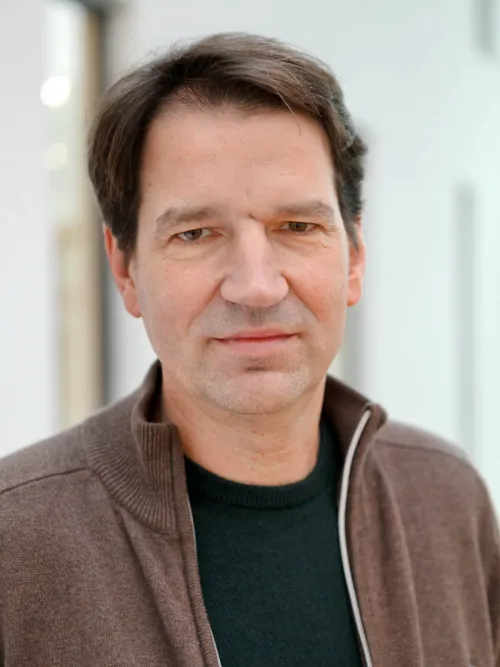
Professor Winfried Gerling at University of Applied Sciences Potsdam's Design Department specializes in Concept and Aesthetics of New Media. His research explores photography theory and practice, digital media environments, and intermedial design through projects like the Volkswagen Stiftung-funded research college SENSING: Zum Wissen sensibler Medien . As former Dean of the Design Department (2012-2014) and DFG Research Training Group member, he bridges academic leadership with media innovation. Education: Master of Fine Arts (Installation/Photography), Berlin University of the Arts (1994) Research: Screen image analysis, companion technologies, media forensics His publications since 2015 examine digital photography's epistemology, including Environmental Selfies (2022) and Screen-Images (2022). Current work focuses on: Post-photography screen image practices Automated visual documentation Media precarity and paradoxes Companion technology aesthetics Digital spatiality and temporality Self-documentation in crisis contexts Notable award: 1998 Europrix-Multimedia-Art nomination for Martin Luther CD-ROM . He co-founded multimedia produktionen in berlin (1996) and directed 30+ international exhibitions since 1991.
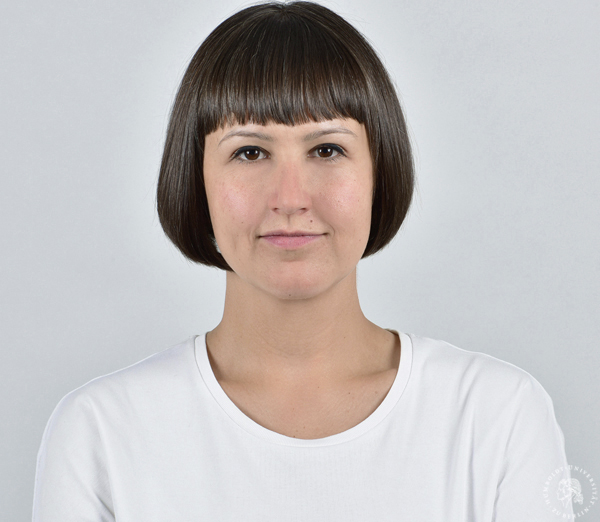
Dr. Luisa Feiersinger is a Research Associate at the Institute for Art and Visual History at Humboldt University of Berlin, where she also serves as Head of the Media Library. Her scholarly work focuses on the history and aesthetics of apparatus-based and popular image practices, with particular expertise in stereoscopic (3D) film analysis and moving image methodology. Her research interests include: History and aesthetics of stereoscopic film Methods of moving image analysis Collection arrangements and media practices Visual history and narrative structures in cinema Spatial representation in stereoscopic media Apparatus-based image practices Dr. Feiersinger's scholarly output demonstrates a consistent interdisciplinary approach that bridges film studies, art history, and visual culture. Her publications reveal a focus on how technical, aesthetic, and narrative elements interact in visual media, particularly in stereoscopic cinema. Her 2023 monograph represents a significant contribution to understanding stereoscopic film as an integral part of cinema history rather than a passing technical trend. She has developed specialized methodological frameworks for analyzing moving images that exist only in perception, addressing a significant gap in traditional art historical approaches. Dr. Feiersinger has established herself as a specialist in visual analysis methodologies, particularly for three-dimensional media. Her work on stereoscopic film protocols provides valuable resources for researchers studying dynamic visual phenomena. She has edited several interdisciplinary publications and published numerous scholarly essays examining stereoscopic techniques in films by directors such as Werner Herzog and Martin Scorsese, as well as analyzing spatial narratives in contemporary 3D cinema.
Antonio Masciullo is a researcher in the Department of Electrical and Information Technologies Engineering at the University of Campania Luigi Vanvitelli, specializing in microwave sensing, dielectric measurements, and biomedical instrumentation. His work spans multiple domains including structural health monitoring, neurological disorder detection, and water infrastructure diagnostics. His primary research interests encompass Microwave Sensing , Dielectric Measurements , Structural Health Monitoring , Biomedical Instrumentation , Radar Systems , and Signal Processing . Masciullo's work demonstrates a strong interdisciplinary approach, bridging electrical engineering principles with practical applications in healthcare, civil infrastructure, and environmental monitoring. Analysis of his recent publications (2021-2024) reveals a significant focus on EEG-based Alzheimer's disease detection, microwave-based skin diagnostics, and structural monitoring systems. His research shows consistent innovation in developing non-invasive sensing technologies with practical applications in medical diagnostics and infrastructure monitoring. The work often involves collaboration with multidisciplinary teams to address complex engineering challenges. Masciullo has made significant contributions to the fields of microwave sensing technology and biomedical instrumentation through his extensive publication record in high-impact journals and conference proceedings. His collaborative work spans multiple research domains, indicating strong interdisciplinary connections across engineering disciplines with applications in healthcare, civil infrastructure, and environmental monitoring systems.
Konstantin Sering is a researcher at the University of Tübingen within the Faculty of Philosophy, specifically working at the Seminar for Linguistics as part of the Quantitative Linguistics group. His academic journey bridges physics and psychology with computational linguistics, culminating in his 2023 PhD thesis on the PAULE (Predictive Articulatory speech synthesis Utilizing Lexical Embeddings) model. He maintains active collaborations with the Cognitive Modeling Group led by Martin V. Butz and the Quantitative Linguistics Group led by Harald Baayen. Sering's research interests center on the computational modeling of human speech production, with particular focus on the articulatory aspects of language. He approaches spoken language from the perspective of computer-aided modeling and simulation, extending the VocalTractLab model to produce spontaneous human speech. His work emphasizes the information-bearing nature of language over its meaning-bearing aspects, investigating how language signals contextual states and conditions. He combines artificial neural networks with predictive forward approaches to model vocal tract control parameters across multiple target spaces, including meaning and acoustic representations. Analysis of Sering's publication record reveals a consistent trajectory in articulatory speech synthesis and quantitative linguistics. His work demonstrates increasing sophistication in modeling the human speech apparatus, with recent publications focusing on improving the PAULE model through speech/non-speech classification, somatosensory feedback integration, and benchmarking methodologies. His research spans both theoretical computational linguistics and practical applications, with strong connections to cognitive science and psycholinguistics. The publications show interdisciplinary collaboration across linguistics, computer science, and cognitive psychology. Sering actively contributes to the academic community through teaching and software development. He has taught courses including Introduction to Psycholinguistics, Physics of Human Speech Production, and seminars on Predictive Articulatory Speech Synthesis. As software author and maintainer, he has developed several important tools for the field: Articubench (an articulatory speech synthesis benchmark), PAULE (his namesake speech synthesis model), create_vtl_corpus, and contributions to pyndl and other packages. His technical expertise spans Python, R, and specialized instrumentation for speech analysis. Based in room 188 at Keplerstr. 2 in Tübingen, Sering maintains an active research program with regular publications and software releases since 2013. His work environment benefits from the resources of the University of Tübingen's linguistics infrastructure and collaborative opportunities across disciplines.