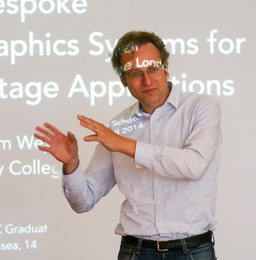
Tim Weyrich is Professor of Visual Computing (part-time) at University College London and Professor of Digital Reality at Friedrich-Alexander University Erlangen-Nürnberg. He leads the Digital Reality Lab and has affiliations with the Virtual Environments and Computer Graphics group at UCL, Eurographics, and the EPSRC Doctoral Training Centre (SEAHA). Previously, he held a Postdoctoral Teaching Fellowship at Princeton University. Research Interests: Content creation and computational photography Appearance modeling and fabrication Point-based graphics and cultural heritage analysis Digital humanities and 3D printing Article Trends: Recent work focuses on neural radiance fields (FruitNeRF++), 3D Gaussian splatting, mmWave radar inverse rendering, and texture anomaly detection. Applications span autonomous systems, cultural heritage, and medical imaging. Scientific Awards: Best Paper Honourable Mention (BMVC 2022) Best Student Paper Award (EG Workshop on GCH 2014) Honorable Mention (Eurographics 2011) Best Student Paper Honourable Mention (BMVC 2018) ACM SIGCHI Best Paper Honourable Mention (CHI 2013)
Lukas Engelmann is a Senior Lecturer at the University of Edinburgh , specifically within the Science, Technology and Innovation Studies department under the School of Social and Political Science . His research focuses on the history and sociology of biomedicine , with particular interest in epidemiological reasoning , visual cultures of disease , digital epidemiology , and decolonial approaches to medical history . The Epidemy Lab , which he founded, explores the historical development of epidemiology and its contemporary influence on data-driven public health and pandemic policy-making . Engelmann's work has been funded by prestigious grants including an ERC Starting Grant (2021-2025) for his research on the history of epidemiological reasoning, and support from the Wellcome Trust for projects examining the social dimensions of digital health . His book 'Mapping AIDS' (2018) established him as a leading scholar in medical visualization , while 'Sulphuric Utopias' (2020) with Christos Lynteris explores the technological history of maritime sanitation and its political implications. Recent publications emphasize the visual and data practices that have shaped epidemiology, including works on epidemic modeling during the COVID-19 pandemic , the history of plague mapping , and the ethical implications of digital phenotyping . He has also contributed to interdisciplinary discussions on syndemics , co-infection epistemology , and the commercialization of bacteriology in the early 20th century. His scientific contributions have earned recognition through editorial roles in journals like Big Data and Society , and collaborative projects such as 'Working with Diagrams' (2022) which investigates the epistemological role of visual tools in medical knowledge production. Scientific Awards and Funding: ERC Starting Grant (2021-2025) Wellcome Trust Institutional Support Fund British Academy/Leverhulme Small Research Grant Chancellor's Fellowship (University of Edinburgh) 'Sulphuric Utopias' listed in The Guardian's 30 Books to Understand the World (2020)
Keith Obadike is a Professor in the Department of Art at Cornell University's College of Architecture, Art, and Planning (AAP), where he also serves as Director of Undergraduate Studies. He is an acclaimed interdisciplinary artist and composer, known for his collaborative work with Mendi Obadike, which spans sound art, digital media, public installations, performance, and internet-based projects. His artistic and academic work critically engages with technology, race, history, and identity. Obadike earned a B.A. in Visual Art from North Carolina Central University and an M.F.A. in Sound Design from Yale University. Prior to joining Cornell, he taught at William Paterson University and held visiting positions at Princeton University, Columbia University, Northwestern University, and the Art Institute of Chicago. His research and creative practice focus on sound art, digital media, public art, performance, and collaborative practice , with strong interdisciplinary connections to Afrofuturism, data sonification, and social justice. He explores how sound and technology mediate racial identity, memory, and liberation, notably through the concept of acousmatic blackness , which he and Mendi developed to describe the racial perception of sound when its source is unseen. Obadike’s selected works include large-scale public sound installations such as Blues Speaker (for James Baldwin) , Free/Phase , Compass Song (Times Square Arts), and GuideStar (Space Needle, Seattle). His projects often use data sonification, archival research, and mythic storytelling, blending historical inquiry with futuristic vision. Notable series include the Opera-Masquerades , Americana Suites , and Numbers Station works, which transform databases of violence into sonic experiences. His honors include: Rockefeller New Media Arts Fellowship (2004) Louis Comfort Tiffany Biennial Award (2015) New York Foundation for the Arts Fellowship in Fiction New Music USA Creator Development Fund (2022) Obadike has received commissions and support from institutions such as the Vera List Center, Harlem Stage, Times Square Arts, the American Composers Orchestra, and the Cornell Mui Ho Center for Cities. He has exhibited and performed at The New Museum, The Whitney Museum of American Art, MoMA, and The Studio Museum in Harlem. His writings and publications include contributions to Studies into Darkness (2022), and artist books such as Four Electric Ghosts and Big House / Disclosure (both 2014). He has also released albums like Crosstalk (2008) and created internet artworks such as Blackness for Sale (2001) and The Interaction of Coloreds (2002), which are foundational in new media and critical race art. While specific advisees are not listed, his role as Director of Undergraduate Studies and Professor indicates active mentorship. His work is deeply collaborative, often co-created with Mendi Obadike, and supported by interdisciplinary teams and institutions.
Dr. Sam Ferguson is a Senior Lecturer at the School of Computer Science, University of Technology Sydney (UTS), with a multidisciplinary background in music performance, cognitive science, and psycho-acoustics. His research explores the intersection of sound, music, and human experience through creative coding, machine learning, and interactive systems. Key Research Areas: Sound and Music Computing, Human-Computer Interaction, Creative Coding, Cognitive Science, Installation Art, and Acoustics. Current Projects: ARC Linkage project on creative coding and multiplicitous media; industry collaborations on IoT-based audiovisual systems. Recent Publications: Focus on spatial audio complexity, gestural interaction with networked sound, music emotion recognition frameworks, and robotic performance through genre-based cultural platforms. Leadership Roles: Director of Teaching & Learning Engagement; former Deputy Head of School (Teaching and Learning); active in ACM Creativity and Cognition Steering Committee. Teaching: Courses like Digital Media Studio , Prototyping Physical Interaction , and Data Processing using R within UTS's interdisciplinary Software Development Studio.
Maurizio MUZZUPAPPA is a Full Professor at the Department of Mechanical, Energy and Management Engineering (University of Calabria) since 2018. His roles include Rector's Delegate for Technology Transfer, Academic Delegate for Education at DIMEG, and Head of the Physical Prototyping Laboratory at the MaTeRiA Center (UNICAL-CNISM collaboration). He supervises the Unical Racing Team in Formula SAE competitions and co-founded three university spin-offs: 3DResearch, Tech4Sea, and Q-BOT. As Scientific Director of projects like TECH4YOU (climate change adaptation technologies) and GROWN IN THE BLUE (Mediterranean reef conservation), he integrates research in industrial design, augmented reality, and underwater cultural heritage. He has authored over 200 publications (h-index 27) and holds 10 patents. His teaching includes Tools and Methods for Industrial Design and Formula SAE LAB . His research focuses on: Industrial design methodologies with parametric and sustainable approaches 3D prototyping and additive manufacturing User-Centered Design for product ergonomics Virtual/Augmented Reality applications in engineering and cultural heritage Underwater robotics and artifact restoration Recent publications highlight trends in AR for industrial maintenance, generative design tools, and mechatronic solutions for underwater heritage. He has supervised over 300 theses and 10 Ph.D. students while leading technology transfer initiatives.
Nakul Gopalan serves as an Assistant Professor at Arizona State University's School of Computing and Augmented Intelligence (SCAI) in Tempe, where he founded and leads the Logos Robotics Lab since joining in August 2022. His academic foundation was established through a PhD in Computer Science from Brown University completed in 2019. Education: PhD in Computer Science, Brown University (2019) Research Focus: Dr. Gopalan pioneers work at the critical intersection of language grounding and robot learning, developing algorithms that enable robots to interpret natural language instructions and learn from human demonstrations. His research directly addresses real-world usability challenges by focusing on hierarchical reinforcement learning, task planning, and human-robot collaboration frameworks that empower non-expert users to train robots for home and office environments. Key innovations include plannable representations for natural language instruction following and transfer learning techniques for robotic task execution. Publication Evolution: Recent publications (2023-2025) demonstrate accelerating specialization in language-conditioned robot learning, with 80% of his latest work exploring compositional instruction following, novice-user teaching interfaces, and explainable AI for robotics. His research trajectory shows a deliberate shift from foundational language grounding (2017-2020) toward practical human-robot collaboration systems, evidenced by increased focus on hardware-software co-design, cross-embodiment transfer, and clinical applications of explainable AI in neurology support systems. Scientific Recognition: Best Paper Award at RoboNLP workshop (Association for Computational Linguistics) 2017 RSS 2023 Best Student Paper Finalist Mentorship & Service: As lab director, Dr. Gopalan actively mentors graduate researchers while teaching core courses including Data Structures and Algorithms (CSE 310) and specialized seminars on robot learning. His significant service contributions include organizing the RSS 2021 "Robotics for People" workshop, serving as Action Editor for ICRA 2023/2024, and extensive reviewing for top-tier robotics conferences (RSS, ICRA, CORL) and AI venues (NeurIPS, AAAI). Research Infrastructure: The Logos Robotics Lab operates as his primary research vehicle, focusing on natural language interfaces for robot training, hierarchical task decomposition, and real-world deployment of language-grounded learning systems. Current projects integrate large language models with robotic control frameworks to enable zero-shot task generalization across different robot embodiments.
Suren Jayasuriya is an Associate Professor at Arizona State University's The GAME School, with joint appointments in the School of Electrical, Computer and Energy Engineering (ECEE) and the Department of Arts, Media and Engineering (AME). He is also an Affiliate Faculty Member at the Mary Lou Fulton College for Teaching and Learning Innovation. His lab, the Imaging Lyceum, focuses on transdisciplinary research bridging computational imaging, computer vision, sensors, and STEAM education. Education Ph.D. Electrical and Computer Engineering, Cornell University (2017) M.S. Electrical and Computer Engineering, Cornell University (2015) B.S. Mathematics, University of Pittsburgh (2012) B.A. Philosophy, University of Pittsburgh (2012) Research Focus Dr. Jayasuriya's work integrates optics, computational photography, and machine learning to develop novel imaging systems. His research spans: Computational cameras and light transport analysis Atmospheric turbulence modeling and video restoration Neural volumetric reconstruction for sonar/radar STEAM education frameworks for K-12 teachers Philosophical aspects of imaging and representation His lab emphasizes interdisciplinary collaboration across engineering, arts, and humanities. Publication Trends Recent publications demonstrate strong focus on computational imaging (45%), AI/ML applications (30%), and educational technology (25%). Dominant themes include turbulence mitigation in videos, neural rendering for sonar/radar, sensor fusion, and AI curriculum development for middle schools. Work frequently appears in top venues like CVPR, SIGGRAPH, and IEEE Transactions. Awards Image Electronics Technology Excellence Award (IIEEJ, 2021) Best Demo Awards: IEEE ICCP 2019, MIRU 2018 Best Paper Award: IEEE ICCP 2014 ASEE Diversity Paper Finalist (2020) Teaching Honors: Fulton Top 5% Award (2019, 2021), ASU Game Changing Faculty (2021) Teaching & Advising Teaches graduate/undergraduate courses including Machine Vision (EEE 515), Minds and Machines (AME 400), and thesis supervision. Leads NSF-funded projects on computational imaging education and AI teacher training. Mentors students through the Imaging Lyceum lab with projects spanning optics, philosophy, and educational technology. Lab & Collaborations Directs the Imaging Lyceum, emphasizing Aristotle-inspired collaborative research. The lab works on: computational cameras, STEAM education, sensor development, and philosophical inquiries into imaging. Collaborates with Carnegie Mellon Robotics Institute and international partners. Funded by NSF, NEH, and industrial partners for projects in sonar imaging, heat resiliency sensing, and educational AI.
Dr. Robert A. Goldberg is a Professor at the Jules Stein Eye Institute, University of California, Los Angeles (UCLA), holding the Bert O. Levy Endowed Chair in Orbital and Ophthalmic Plastic Surgery. His work spans orbital decompression , thyroid eye disease , facial aging quantification , and complications of hyaluronic acid fillers . Research Focus: Orbital and ophthalmic plastic surgery, tumor histopathology, AI applications in facial aging, filler-related blindness mechanisms. Clinical Expertise: Management of proptosis, asymmetric ptosis, orbital vascular malformations, and thyroid-associated orbitopathy. Recent Trends: Publications emphasize multimodal therapies (e.g., Teprotumumab + decompression), nonoperative oncology (Bleomycin palliation), and dynamic imaging techniques (high-resolution ultrasound, CT volumetry). Collaborations: Extensive work with Rootman DB on orbital anatomy, Douglas RS on thyroid eye disease, and Ugradar S on filler complications. Technical Innovations: Described techniques for autologous tarsus banking , orbital volume expansion , and endoscopic orbital approaches .
Markus Nornes is a Professor of Asian Cinema at the University of Michigan, affiliated with the School of Art & Design, Department of Film, Television and Media, and Department of Asian Languages and Cultures. His research focuses on Japanese and broader Asian cinema, documentary filmmaking, and film translation theory. He earned his Ph.D. from the University of Southern California in 1996 and has taught at Michigan since then. His work explores the political and ethical dimensions of nonfiction film, particularly in Japan's documentary history from the Meiji era through Hiroshima, and the evolution of screen translation. He advocates for 'abusive translation' to challenge conventional subtitling norms. Current projects include a critical biography of Adachi Masao and a multi-volume Japanese film theory translation collection. Recent publications include Brushed in Light (2021) on calligraphy in East Asian cinema, Hallyu 2.0 (2015) analyzing Korean media's digital expansion, and Forest of Pressure (2007) on Ogawa Shinsuke's collective. His Google Scholar profile reflects a career bridging film history, translation ethics, and transnational media studies. Faculty Research Grant for Taiwan Studies, Ministry of Education, Taiwan (2011) Visiting Professorship at Fudan University (2010) Edwin O. Reischauer Visiting Professor at Harvard (2008-2009) Japan Foundation Research Fellow (2004-2005) Fulbright Research Fellow (1999-2000) As a filmmaker, Nornes co-directed The Big House (2018) and When We're Together (2020), often collaborating with students. He has curated major film retrospectives at Yamagata International Documentary Film Festival and University of Michigan, specializing in Japanese and Asian nonfiction cinema. His digital humanities projects, such as the Ozu and the Poetics of Cinema online reprint, showcase his commitment to accessible film scholarship.
Dr. Zhi Chen is a Lecturer in Computing at the School of Mathematics, Physics and Computing, University of Southern Queensland, specializing in Artificial Intelligence and Machine Learning with applications spanning digital agriculture and healthcare systems. Education: Master of Information Technology (MIT), University of Queensland, 2018 PhD, University of Queensland, 2023 Research Focus: His work centers on zero-shot learning, domain adaptation, and multimodal systems, addressing core challenges in computer vision and deep learning. Current projects integrate AI with agricultural risk modeling and medical diagnostics, emphasizing real-world deployment of robust algorithms under data-scarce conditions. Publication Trends: Recent output (2022-2025) shows concentrated expertise in source-free domain adaptation and generalized zero-shot learning, with significant contributions to plant disease recognition (via mobile multimodal systems) and diabetes subgroup analysis. His work consistently appears in premier venues including AAAI, CVPR, and ACM MM, demonstrating methodological innovation applied to critical domains like climate-resilient agriculture and precision medicine. Supervision: Currently serves as Associate Supervisor for a doctoral candidate developing parametric insurance models for oyster farms to mitigate climate-related risks from king tides and extreme weather events. Awards: No scientific awards were documented in the provided materials.
Johannes Schöning is a Professor of Human-Computer Interaction (HCI) at the University of St. Gallen and leads the Ubiquitous Media Technology Lab . His research focuses on developing user interfaces that empower individuals and communities through data-driven decision-making, with interdisciplinary applications in geographic information science, public health, medical contexts, and extreme environments like space missions. He emphasizes methodological rigor from AI, computer graphics, and cognitive psychology. Organizes AlpCHI 2026 Chair of ACM Eugene Lawler Award Committee Editorial Board, AI Perspectives (Springer Nature) Research Trends : His publications from 2025–2024 reveal a focus on Mixed Reality (autoethnography, weight perception), Accessibility (visual impairment support), Environmental HCI (CO2 eco-feedback), and Geospatial Technologies (navigation externalities, map analytics). Interdisciplinary work appears in journals like Nature and PLOS ONE . Scientific Recognition : ACM Distinguished Member Best Paper & Accessibility Awards (Interact 2019, MobileHCI 2015) Junior Fellow, Gesellschaft für Informatik (2013) Academic Service : Active in conference leadership (SIGCHI Switzerland Chair 2021–2023, ISS 2016 Program Chair) and reviewing for top venues including ACM CHI , Ubicomp , and IEEE VR . Regular reviewer for European science foundations and DFG/BMBF proposals.
Dr. George C Tseng serves as Professor and Vice Chair for Research in the Department of Biostatistics at the University of Pittsburgh School of Public Health, with secondary appointments in Human Genetics and Computational and Systems Biology. His educational background includes a BS (1997) and MS (1999) in Mathematics from National Taiwan University and an ScD (2003) in Biostatistics from Harvard School of Public Health. Dr. Tseng's research focuses on developing statistical methodologies for genomic and bioinformatic applications to advance precision medicine. His work spans multiple high-impact areas including multi-omics data integration, machine learning for high-dimensional data, cluster analysis for disease subtyping, and statistical methods for experimental design in omics studies. His approach emphasizes close collaboration with biological and clinical researchers to ensure methodological relevance to real-world problems. His publication record demonstrates consistent contributions to top statistical and bioinformatics journals, with recent work focusing on congruence analysis between animal models and humans, outcome-guided clustering methods, and high-dimensional causal mediation analysis. Elected Fellow, American Statistical Association (2017) Statistician of the Year, ASA Pittsburgh Chapter (2017) Provost's Award for Excellence in PhD Mentoring, University of Pittsburgh (2019) Clinical Research Scholar (K12) Award, NIH (2007-2009) Elected Member, International Statistical Institute (2012) Dr. Tseng has successfully mentored over 25 PhD students who have secured positions in academia, industry, and government agencies. His laboratory has maintained continuous NIH funding as principal investigator since 2012, including current grants R01CA285337 (2025-2030) and R01LM014142 (2023-2026). The Tseng Lab operates as a collaborative research environment focused on translating statistical innovations into practical solutions for biological and medical challenges, with strong connections to multiple research centers and clinical departments at the University of Pittsburgh.
Mikael Johansson is a Professor at Kungliga Tekniska Högskolan (KTH), specializing in Control Technology . He teaches and coordinates courses such as Distributed Optimization (FEL3311) and various advanced-level degree projects in computer science, electrical engineering, and systems engineering. His research spans Control Systems , Machine Learning , and Optimization , with a focus on asynchronous algorithms, federated learning, and applications in energy systems and construction. His work includes 15 recent publications on topics like neural networks, distributed optimization, and battery technology. Notable areas of contribution are in asynchronous learning, federated learning with privacy constraints, and quasi-Newton methods for optimization. His research bridges theoretical advancements with practical applications in urban design, healthcare, and autonomous systems.
Professor David Abbink is a Full Professor of Haptic Human-Robot Interaction at Delft University of Technology, holding a joint appointment between the Department of Cognitive Robotics in the Faculty of Mechanical Engineering and Industrial Design Engineering since November 2023. He founded the Delft Haptics Lab and co-founded the Cognitive Robotics Department in 2017. Abbink leads the transdisciplinary research and innovation centre FRAIM, which was awarded the prestigious NWO Stevin Premie (Dutch Nobel Prize equivalent) in June 2024. Trained as a mechanical engineer specializing in biomechanics, Abbink's research focuses on human behavior adaptations when interacting with autonomous systems. He has published over a hundred scientific articles on human-robot interaction, haptics, shared control, tele-operation, driver assistance systems, and sensorimotor control. His research has been funded by industry partners (Nissan, Boeing, Renault), RVO (Brightsky project 2022-2026), and the Dutch Science Foundation NWO through personal grants (VENI 2010-2014, VIDI 2015-2019). Abbink's recent work centers on worker-robot relations as an academic focus, collaborating with organizations like Erasmus Medical Centre for nursing work, Schiphol and KLM for baggage handling, and KLM Engine Repair Services for maintenance work. He also serves as scientific director for the Centre for Meaningful Human Control, launched in October 2024. His work bridges engineering, social sciences, and practical applications to responsibly shape the future of work with emerging robotic capabilities. NWO Stevin Premie (2024) Best IEEE SMC journal paper on Cybernetics (2019) Top 25 scientific talents according to New Scientist (2015) Best teacher of Faculty 3mE (2013, 2014) Best teacher of Department of BioMechanical Engineering (seven consecutive years) Abbink has supervised over 110 MSc students and 11 PhD students. His educational contributions include developing the Master Programme in Robotics at TU Delft and receiving international recognition for his course 'The Human Controller.' He is also a prominent science communicator, featured on national television, radio, and major Dutch newspapers, and has delivered lectures at venues like The Royal Institution and Lowlands Festival. Despite his academic commitments, Abbink maintains a drummer persona, having recorded four albums and performed over 400 shows across three continents between 1999-2014.
Christopher Rycroft is a Professor and Associate Chair in the Department of Mathematics at the University of Wisconsin–Madison. He leads the Rycroft Group, which focuses on mathematical modeling and scientific computation for interdisciplinary applications in science and engineering. Prior to joining UW-Madison in summer 2022, he was a professor at Harvard University's School of Engineering and Applied Sciences from 2014-2022, and before that a Morrey Assistant Professor at UC Berkeley from 2010-2013. Professor Rycroft's research spans three main areas: numerical methods for material mechanics, data-driven discovery, and computational geometry. His group develops new computational methods while working directly with domain scientists. Key achievements include the development of the reference map technique for fluid-structure interaction, Voro++ software library for Voronoi tessellation, and novel approaches to understanding crumpling physics. His work combines traditional analysis and modeling with machine learning methods to extract scientific insights from complex data. The Rycroft Group's publication record demonstrates a strong trajectory of interdisciplinary research bridging mathematics, physics, materials science, and biology. Recent work has focused on fluid-structure interaction, computational geometry applications, mechanical metamaterials, and biological fluid dynamics. The group develops both theoretical frameworks and practical software tools that have found applications across diverse scientific domains from materials science to virology. Everett Mendelsohn Award for Excellence in Mentorship (2021) Professor Rycroft has advised numerous PhD and master's students who have gone on to postdoctoral positions at institutions including MIT, EPFL, and Cornell. His teaching includes advanced scientific computing courses that have quadrupled in enrollment during his tenure. He has secured research funding supporting his group's work on computational methods and interdisciplinary applications. The Rycroft Group consists of graduate students, postdocs, and collaborators with diverse backgrounds in applied mathematics, physics, engineering, and computer science. The group maintains active collaborations with researchers across multiple institutions and participates in centers such as the Harvard Quantitative Biology Initiative.