Radha VINOD is a Researcher at Singapore University of Technology and Design (SUTD), attached to the Future Digital Economies and Digital Societies initiative. She focuses on developing cloud platforms and systems, with expertise in Electrical and Computer Engineering. Currently responsible for advancing algorithmic and systems engineering in AI-related projects. Education: Master of Science in Electrical and Computer Engineering, University of California Santa Barbara (USA) Bachelor of Engineering in Electronics and Communication, Sri Krishna College of Engineering and Technology (India) Her research interests intersect AI ethics, cloud infrastructure, and algorithm design, particularly addressing societal impacts of AI on employment and labor markets. Recent work examines global AI impact assessments through collaborative publications. Maintains industry ties from 5 years of startup experience as an Algorithm and Systems Engineer.
Yichong ZHANG is a Professor of Economics and Associate Dean (Postgraduate Research) at the School of Economics (SOE), Singapore Management University (SMU). He holds a Ph.D. in Economics from Duke University (2016), an M.A. in Economics from Duke University (2011), and a B.S. in Finance and Banking from Zhejiang University (2008). His research interests focus on econometrics, particularly in high-dimensional data analysis, quantile regression, network models, and statistical inference. Notable contributions include advancements in covariate-adaptive randomizations, instrumental variable regressions, and spectral clustering methods. His work bridges theoretical econometrics with applied methodologies, addressing challenges in causal inference and structural estimation. Key achievements include a Best Paper Award at the 2021 Delhi Winter School (Econometric Society) for his work on clustered data. His research spans econometric theory, machine learning applications, and network analysis, with publications in top journals such as the Journal of Econometrics and Journal of Machine Learning Research . He advises graduate students including WANG Yiren, Dennis LIM Guo Wei, and XIA Ying. His research also explores production frontiers, latent community detection, and bootstrap inference techniques, reflecting a commitment to both methodological innovation and real-world economic problems.
Frank Stephan is a Professor at the National University of Singapore , jointly affiliated with the Department of Mathematics and the School of Computing . His primary office is located in Block S17 (Mathematics), and he maintains a secondary office in Block COM2 (Computing). He teaches advanced courses including Computational Complexity , Logic and Foundations of Mathematics , and Advanced Automata Theory . Stephan co-organizes the departmental Logic Seminar and maintains an extensive publication record in theoretical computer science. His research spans: Recursion Theory & Kolmogorov Complexity : Foundational computability and information theory. Learning Theory : Inductive inference and algorithmic learning models. Computational Complexity : Hardness, parameterization, and structural graph algorithms. Automata & Formal Languages : Automatic structures and language recognition complexity. Recent publications focus on combinatorial optimization in graphs, including dominating sets, geodetic monitoring, identifying codes, and parameterized complexity. His work frequently appears in top venues (e.g., STACS, ICALP, ISAAC) and journals (e.g., Discrete Mathematics , Theoretical Computer Science ). Stephan holds memberships in the European Association for Theoretical Computer Science , Deutsche Mathematiker-Vereinigung , and other academic societies. No awards or student advisees are documented.
Assoc Prof Kah Loon Ng is an Associate Professor in the Department of Mathematics at the National University of Singapore (NUS). His research interests span Applied Mathematics, Pure Mathematics, Applied Computing, and Theory of Computation. He is renowned for innovative teaching methods including story-telling approaches, mind maps, and differential learning strategies to engage students at all levels. His pedagogical innovations include screencast resources for tutorials and past exam questions, enhancing student accessibility to learning materials. In teaching, Prof Ng emphasizes fostering analytical skills, adaptability, and confidence in students. He employs interactive techniques like group discussions, conceptual teasers during lectures, and personalized attention to address varying student abilities. His approach integrates Information Technology strategically without over-reliance, ensuring dynamic classroom engagement. His teaching philosophy prioritizes creating a supportive environment where students can explore mathematics' practical applications across disciplines, challenging the misconception that mathematics is only for educators. Prof Ng’s research contributions include foundational work on graph orientation, firefighter problem generalizations, and disease modeling in dynamic networks. His publications reflect interdisciplinary applications, such as curriculum reform in data science education and advanced graph theory studies. His work bridges theoretical mathematics with real-world problem-solving, influencing both academic discourse and educational practices.
Jungpil Hahn is a Provost's Chair Professor at the National University of Singapore (NUS) School of Computing, where he holds multiple leadership positions including Vice-Dean of Communications, Director of the NUS Fintech Lab, Deputy Director of AI Singapore (AI Governance), and Deputy Director of the Centre for Technology, Robotics, Artificial Intelligence & the Law. Previously, he served as Head of the Department of Information Systems and Analytics from July 2015 to June 2021. Before joining NUS, he was an Assistant Professor at Purdue University's Krannert School of Management and a Visiting Assistant Professor at Carnegie Mellon University's Tepper School of Business. Ph.D. in Information & Decision Sciences, University of Minnesota (2003) M.B.A. in Business Administration, Yonsei University, Seoul (1998) B.B.A. in Business Administration, Yonsei University, Seoul (1998) Professor Hahn's research spans multiple cutting-edge domains, with a particular focus on organizational learning in digital contexts, open innovation, and the impact of emerging technologies on business processes. His work examines how organizations adapt to technological change, with special attention to decentralized autonomous organizations (DAOs), blockchain governance, and the effects of privacy-enhancing technologies on business analytics. He investigates the intersection of human behavior and technology, particularly in crowdsourcing platforms and software development teams, exploring how team composition, knowledge diversity, and organizational structures impact innovation outcomes. His research also addresses practical challenges in data science, including missing data problems and the impact of privacy technologies on firms' analytics capabilities. His recent publications reveal a strong trend toward studying decentralized organizational forms enabled by blockchain technology, with multiple papers examining DAOs and consensus mechanisms. There's also a clear focus on the practical challenges of implementing AI and data analytics in business settings, particularly around data quality issues and the impact of privacy technologies. His work bridges theoretical organizational science with practical business applications, often using simulation-based approaches to develop and test theories. Recipient of multiple Best Paper Awards at ICIS (2020-2023) AIS Distinguished Member (2022) Faculty Teaching Excellence Award at NUS School of Computing (2014) Best 2013 Published Paper Award from Academy of Management's OCIS Division Best Reviewer Award from INFORMS Information Systems Society (2009) Professor Hahn has successfully mentored numerous PhD students who have secured prestigious academic positions at institutions worldwide, including the University of Colorado, Georgia State University, and Central University of Finance and Economics. His research is supported by significant grants focused on digital transformation, blockchain applications, and AI governance. He serves as Senior Editor of MIS Quarterly and has previously served as Associate Editor of Information Systems Research, demonstrating his leadership in the academic community. His research projects often involve interdisciplinary collaboration with computer scientists, economists, and legal scholars. He leads the Garbage Can Lab (https://garbcan.com/), which conducts research on complex socio-technical systems using an 'organized anarchy' approach inspired by the Garbage Can Model of Organizational Choice. The lab brings together researchers from diverse backgrounds to tackle problems related to digital transformation, platform innovation, computational social science, and data science. Current projects include studying organizational learning in DAOs, AI-enabled organizational decision-making, interventions for crowdsourcing platforms, and the impact of privacy technologies on business analytics.
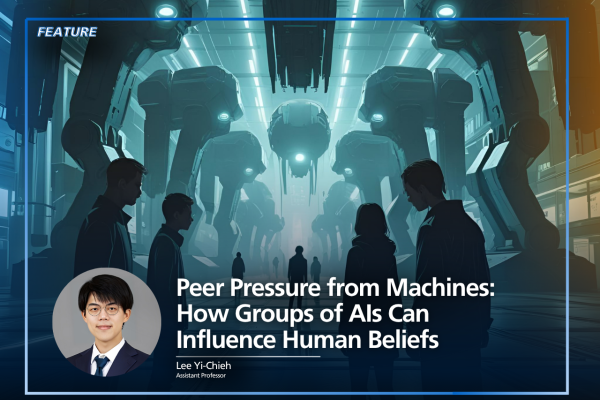
LEE Yi-Chieh is an Assistant Professor in the Department of Computer Science at NUS Computing, National University of Singapore. He holds a Ph.D. in Computer Science from the University of Illinois Urbana-Champaign (2021) and previously worked as a researcher at NTT, Japan. He leads the AI4SG (AI for Social Good) Lab, focusing on designing AI technologies to promote societal well-being. Ph.D., Computer Science, University of Illinois Urbana-Champaign, 2021 Researcher, NTT, Japan Assistant Professor, Department of Computer Science, NUS Computing His research lies at the intersection of human-computer interaction (HCI), computer-supported cooperative work (CSCW), and human-centered AI. He investigates how conversational agents can support mental health, reduce stigma, and encourage prosocial behaviors. His work emphasizes trust, ethics, and social impact in AI systems, particularly in healthcare and marginalized communities. He also explores multi-agent systems, AI literacy, and emotional reciprocity in human-AI relationships. The recent publications (2023–2025) reflect a strong trend toward AI for mental well-being, social influence in multi-agent environments, ethical challenges in AI companionship, and innovative applications of conversational agents in education, healthcare, and social services. The research combines qualitative and quantitative methods, often involving participatory design and cross-cultural studies. Notable scientific awards include: CSCW2022 Diversity & Inclusion Award Cornell-NUS Global Strategic Collaboration Award LEE Yi-Chieh is actively involved in advising and research grants through the AI4SG Lab. While specific students are not listed, his lab conducts impactful research in AI for social good, supported by institutional and international collaborations. He teaches courses such as CS3249 (User Interface Development) and CS5346 (Information Visualization), contributing to both undergraduate and graduate education. The AI4SG Lab is dedicated to creating socially responsible AI systems through interdisciplinary research, community engagement, and technology design that addresses real-world challenges in mental health, aging, inclusivity, and social justice.
Roger Zimmermann is a Full Professor at the School of Computing, National University of Singapore (NUS), where he is also a Co-PI at the Grab-NUS AI Lab and leads the Location AI project. He previously served as Deputy Director of the NUS Smart Systems Institute (SSI) and Co-Director of the Centre of Social Media Innovations for Communities (COSMIC), both funded by Singapore’s National Research Foundation (NRF). Before joining NUS, he was a Research Area Director and Research Assistant Professor at the University of Southern California (USC). Ph.D. in Computer Science, University of Southern California (1998) M.S. in Computer Science, University of Southern California (1994) His research focuses on multimedia systems , spatio-temporal data management , streaming media architectures (especially DASH), machine learning applications , AR/VR , and location-based services . He leads the Media Management Research Lab (MMRL) at NUS, which conducts cutting-edge work in distributed multimedia and intelligent systems. His work combines theoretical depth with real-world applications in urban computing, smart mobility, and immersive media. The recent publications reflect a strong trend toward multimodal learning , spatio-temporal AI , adaptive streaming , and urban intelligence . His team explores zero-shot learning, 3D scene understanding, traffic forecasting, and open-vocabulary audio-visual segmentation, often leveraging foundational models and deep neural architectures. There is a clear emphasis on real-time, scalable systems for smart cities and immersive experiences. Dr. Zimmermann has received numerous accolades, including: DASH-IF Excellence in DASH Award (multiple years) Best Paper Awards at ACM SIGSPATIAL, IEEE ICME, and ACM MMSys Silver Award at ACM MMSys 2020 Grand Challenge IEEE Communications Society Best Editor Award (2017) ACM Distinguished Member (2017) Top 1% Publons Reviewer in Computer Science (2018) He has advised numerous students and led major research initiatives funded by MOE, NRF, A*STAR, NSF, and industry partners like Seagate, Intel, and HP. He has served as General Chair for IEEE MIPR 2023, ACM Multimedia 2020, and IEEE ISM 2015, and as TPC Co-Chair for several top-tier conferences. His editorial roles include Associate Editor for IEEE Transactions on Multimedia (TMM), ACM TOMM, and IEEE OJ-COMS. He leads the Media Management Research Lab (MMRL) , which focuses on intelligent multimedia systems, spatiotemporal data mining, and immersive media technologies. The lab develops scalable solutions for real-world challenges in urban computing, smart transportation, and interactive media.
Yi Li is an Associate Professor at the College of Computing and Data Science (CCDS) , Nanyang Technological University (NTU) , focusing on the security, reliability, and sustainability of modern software systems. Their work bridges blockchain-based decentralized applications and software evolution management. Research Interests : Sustainability of evolving software systems, security/reliability of blockchain applications, semantic history slicing, and compositional analysis. Academic Roles : Associate Professor (2024–Present), Assistant Professor (2018–2024) at NTU, and research internships at Google and Microsoft Research . Scientific Awards : Distinguished Paper Award at NDSS'25 ACM SIGSOFT Distinguished Paper Award at ASE'23 Professional Activities : Co-Chair, Journal-First Track at FSE'25 and APSEC'25 Program Committee roles at ICSE, FSE, ASE, FM, and others (2016–2025) Organizing and reviewing for IEEE/ACM journals Key Publications : 2025: ICSE (SpecGen), FSE (invariant analysis), ISSTA 2024: INFOCOM (LightCross), ASE, ACM Computing Surveys 2023–2014: SPLC, ASE, FM, Dagstuhl Reports Student Advising : Chenguang Zhu (UT Austin, advisor Sarfraz Khurshid), Tai D. Nguyen (SMU, advisor Jun Sun).
Chung Piaw Teo is the Stephen Riady Professor and Executive Director of the Institute of Operations Research and Analytics (IORA) at the National University of Singapore (NUS) Business School. He has held significant academic roles including Head of Department, Acting Deputy Dean, Vice-Dean of Research and Ph.D. Programs, and Chair of the Ph.D. Committee at NUS. PhD in Operations Research from MIT (1996) Bachelor of Science (Honors) in Mathematics from NUS (1990) Research Interests: Optimisation Under Uncertainty Discrete Choice Modeling Social Choice Theory Inventory Theory Supply Chain Management Combinatorial Optimisation Operations Research Publications focus on stochastic optimization, supply chain resilience, and network design, with recent works spanning 2020–2015 in journals like Management Science , Operations Research , and Mathematical Programming . Key themes include urban logistics, risk mitigation, and decision analytics. Scientific Awards: Stephen Riady Professor (2024) Provost’s Chair (2014) Faculty Outstanding Researcher Awards (2014, 2006, 2003) Nominee for University Outstanding Researcher Award (2006) Grants & Leadership: Served on international committees (INFORMS, LANCHESTER Prize, Fudan Prize) and held visiting/fellow positions at MIT, Northwestern, and Sungkyunkwan University. Currently a department editor for Management Science and associate editor for multiple journals.
Kwok Hao Lee is an Assistant Professor (Presidential Young Professor) at the Department of Strategy and Policy , National University of Singapore (NUS) Business School. He holds a PhD from Princeton University and has held postdoctoral fellowships at Yale University’s Cowles Foundation and NUS. His research focuses on platform markets, smart cities, and empirical market design, particularly in transportation, housing, and e-commerce. Education: PhD in Economics, Princeton University (2017–2023) MA in Economics, Princeton University (2019–2023) MA in Social Sciences (Economics), University of Chicago (2017) BSc in Mathematics & Economics, Washington University in St. Louis (2016) Research Interests: Industrial organization, urban economics, transport economics, public housing policy, and algorithmic platform design. His work bridges theoretical models with empirical applications, addressing topics like platform self-preferencing, housing allocation mechanisms, and transit infrastructure impacts. Key Awards: Social Science and Humanities Research Fellowship (SSRC, Singapore) Teaching: Teaches courses on competitive strategy, digitization, AI, and urban policy at NUS. Recent courses include “Industry, Digitisation, and AI” and “Strategic Innovation for High Performance.” Labs/Teams: Collaborates with the Cowles Foundation (Yale) and NUS’s Department of Real Estate on urban and policy-related research. Co-organizes the annual NUS Industrial Organization Day.
Dr. Le Xu serves as a Lecturer in the Department of Strategy and Policy at the National University of Singapore (NUS) Business School. Her academic appointments include coordination of the Business Economics specialisation and teaching roles in economic strategy, global economy, and managerial economics courses since 2018. Bachelor of Science in Mathematics, Northwestern Polytechnical University (2000-2004) Master of Science, Northwestern Polytechnical University (2004-2007) PhD in Economics, University of Manchester (2007-2011) Dr. Xu's research spans Managerial Economics , Chinese and Southeast Asian Economies , and Behavioral Decision Theory . Her work examines economic strategy through game theory frameworks while investigating consumer behavior, gift-giving psychology, and intertemporal choices. Recent publications reveal a strong focus on framing effects, AI-human interaction in sales contexts, and memory mechanisms in social relationships. Her publication trends indicate a sophisticated integration of traditional economic modeling with behavioral insights, particularly examining how cognitive biases affect market decisions and social interactions. The research demonstrates methodological diversity spanning experimental economics, field studies, and theoretical modeling. 10 Years Award (2021) 5 Years Award (2016) Dr. Xu actively mentors students while serving on the NUS Social Committee (2018-2020) and as Business Economics Coordinator (2021-2025). Her teaching philosophy emphasizes real-world application through contemporary business cases and economic indicators. She has taught courses including Managerial Economics, Global Economy, and Economics of Strategy, consistently receiving high student evaluations for her interactive methods and supportive approach. As a media commentator, she provides economic analysis for ThinkChina, The Straits Times, and CNA, leveraging expertise in China's economy and business environment. Her sixth-edition Chinese textbook on Managerial Economics (co-authored with Prof. I.P.L. Png) demonstrates significant scholarly impact.
Dr. Yuting Zhu is an Assistant Professor at the Department of Marketing, NUS Business School, National University of Singapore. Her research bridges data-driven marketing strategy with machine learning and behavioral economics, supported by grants from Singapore’s Ministry of Education and the National Natural Science Foundation of China. She holds a PhD in Management from MIT (2022), an MA in Economics from the University of Rochester (2017), and dual degrees in Economics and Mathematics from Renmin University of China (2015). Research Interests: Data-Driven Salesforce Management Targeted Marketing and Matching Platforms Human-AI Interaction in Marketing Machine Learning and Game Theory Field Experiments in Real-World Platforms Recent Publications (2019–2025): Her work spans algorithm aversion in ridesharing platforms, group search theory, targeted marketing optimization, and platform design. She employs field experiments with 2 million customers and linear programming advances to solve large-scale marketing constraints. Collaborations: Co-authored studies with researchers like Huachen Lu (NUS), Xiaoyang Cao (NUS), and D. Simester (MIT) highlight cross-institutional partnerships.
Chaithanya Bandi is an Associate Professor at the National University of Singapore (NUS) in the Analytics and Operations Department of the NUS Business School, with a joint appointment in the Department of Mathematics. His research focuses on decision-making under uncertainty, robust optimization, and their applications in operations management, healthcare, e-commerce, and energy systems. He develops robust optimization models for queueing control, risk optimization, and mechanism design. Key research areas include robust queue inference, two-stage distributionally robust optimization, and multi-item auction mechanisms. He has contributed to operational challenges in healthcare (e.g., patient re-entry scheduling), energy systems (electricity generation optimization), and e-commerce (price optimization for fashion products). His work integrates theoretical advancements with practical implementations in large-scale systems. Recent publications emphasize adversarial evaluation of large language models, dynamic scheduling algorithms, and robust policies for uncertain environments. His methodologies often involve novel optimization frameworks and scalable computational approaches. Dr. Bandi holds a PhD in Operations Research and has collaborated with industry leaders like Flipkart and healthcare providers to apply his models in real-world settings. His contributions bridge theoretical rigor and practical applicability in complex operational systems.
Bin Ke is a Professor of Accounting and Provost’s Chair at the National University of Singapore (NUS) Business School since 2015. He holds the prestigious “Chang Jiang Scholar” title from China’s Ministry of Education and the Li Ka Shing Foundation. Previously, he held professorial roles at Pennsylvania State University (2009–2015) and Nanyang Technological University (2010–2015). His research focuses on accounting information’s role in business decisions, with emphasis on earnings management, institutional investors, and investor protection in emerging markets, particularly China. Education: Ph.D. in Accounting, Michigan State University (1999) M.S. in Sciences, Pennsylvania State University (1994) B.A. in Humanities & Social Sciences, Institute of International Relations, China (1989) Research interests include interdisciplinary approaches to complex business problems, such as financial reporting in emerging markets, digital transformation, and the intersection of accounting with machine learning. His work has been published in top journals like The Accounting Review , Journal of Accounting Research , and Journal of Accounting and Economics . Awards include the Chang Jiang Scholar designation. He has served on editorial boards of major journals, including The Accounting Review (2011–2014 as editor) and China Journal of Accounting Research . His labs and teams focus on leveraging technology and data science for accounting innovation, with recent projects involving AI-driven fraud detection and social media analysis in financial decision-making.
Jian Guo is an Associate Professor (with tenure) at Nanyang Technological University (NTU) in Singapore, affiliated with the School of Physical and Mathematical Sciences and holding a courtesy appointment in the College of Computing and Data Science. His research focuses on cryptography, particularly cryptanalysis, design and implementation of symmetric-key algorithms (hash functions, block ciphers, authenticated encryption), and privacy-preserving technologies. PhD in Mathematical Sciences (2007-2010), supervised by Huaxiong Wang, and BEng in Computer Engineering (2003-2006) with First Class Honors from NTU. Jian leads the Cryptanalysis Taskforce at NTU and has published extensively in cryptography. His work includes breaking the full Kravatte PRF design (FSE 2018 Best Paper) and improving related-key boomerang attacks against AES-256 (ACISP 2022 Best Paper). His research also targets cryptographic standards like SHA-3 and AES Hashing, evidenced by a 2021 eprint preimage attack publication. He has received multiple accolades including the NTU/SPMS Young Researcher Award (2021), Collaborative Research Award (2022), and Accelerating Creativity and Excellence Award (2020). He serves on the IACR Board of Directors (2020-present), chairs major conferences (Asiacrypt 2023, Asiacrypt 2021), and contributes to international standardization efforts (ISO/SC27/WG2, Singapore representative since 2017). As a Principal Investigator, he collaborates with industry partners like LatticeX Foundation (2022-2025) and previously PayPal Inc (2021-2023). He actively mentors PhD and postdoc candidates, with ongoing openings jointly advertised at Wuhan University (2025) and Tsinghua University (2024).