Rasmus Bjørk is a Professor at the Technical University of Denmark (DTU) in the Department of Energy Conversion and Storage. His research focuses on advanced materials for energy systems, particularly in magnetocaloric and elastocaloric cooling, magnetic materials, and additive manufacturing for functional devices. His work contributes to the UN Sustainable Development Goals, especially in affordable and clean energy. PhD Supervision: Active projects include energy storage using topological spin textures, magnetothermal waste heat harvesting, and bio-magnetometers. Key Research Areas: Magnetic refrigeration, energy harvesting, and freeze-casting of functional materials. Recent advancements include 3D-printed elastocaloric coolers and studies on magnetoresistive devices. His team develops novel techniques for optimizing magnetic systems and energy conversion processes. He has published over 160 articles and led projects on regenerator design, magnetic bearings, and sensor technologies. Collaborations span multiple countries and disciplines. Notable contributions include pioneering work on freeze-casting for biomaterials and the MagTense micromagnetic framework. His research bridges theoretical modeling and practical applications in sustainable energy solutions.
Seeram Ramakrishna is a Professor of Materials Engineering at the Department of Mechanical Engineering, National University of Singapore (NUS), affiliated with the College of Design and Engineering. He holds a PhD from the University of Cambridge and a TGMP from Harvard University. His research focuses on circular economy, nanotechnology, and sustainable materials engineering, with notable contributions to electrospinning, biomaterials, and energy storage systems. Key educational background includes: PhD in Materials Science (University of Cambridge) TGMP in Advanced Manufacturing (Harvard University) Research interests span cross-disciplinary areas such as: Development of eco-friendly nanocomposites Electrospun nanofiber applications in healthcare and energy Circular economy frameworks for sustainable materials Advanced manufacturing techniques for biomedical devices His publications highlight innovations in: High-efficiency solar steam generation via core-shell fibers Flexible wearable sensors for health monitoring Green synthesis of supercapacitor materials Plastic waste circularity through informatics-driven approaches Notable projects include books on circular economy fundamentals and biomaterials. His work bridges material science with environmental sustainability, addressing global challenges in energy, healthcare, and pollution control.
Professor Jacob Savir is a distinguished academic in the Department of Electrical and Computer Engineering at the New Jersey Institute of Technology . He specializes in testability, built-in self-test (BIST), and fault detection for digital and analog circuits. His work focuses on improving integrated circuit testing methodologies, including BIST pretesting, defect level analysis, and reliability optimization in safety-critical systems. His research interests span BIST architectures, delay fault analysis, analog circuit testing, and power-constrained test synthesis . He has contributed extensively to the development of testing algorithms for embedded memories, scan designs, and fault diagnosis in complex systems. Notable contributions include studies on the impact of BIST pretesting on IC defect levels and yield optimization. His work bridges theoretical advancements with practical applications in aerospace and industrial electronics. Despite no awards listed, his substantial citation count (1,897) and h-index (22) reflect his influential contributions to the field. Prof. Savir has collaborated on 114 research outputs since 1977, with a focus on enhancing circuit testability and reliability across domains like FPGA-based systems and embedded memory diagnostics. His research emphasizes both academic rigor and industrial relevance, addressing challenges in modern VLSI design and testing.
Antoni Forner-Cuenca is an Associate Professor at Eindhoven University of Technology's Department of Chemical Engineering and Chemistry, leading the Electrochemical Materials and Systems group. He holds a PhD from ETH Zurich (2016) and conducted postdoctoral research at MIT (2017-2018). His research focuses on advancing energy storage and conversion technologies, including redox flow batteries, fuel cells, and CO₂ reduction systems. He has received prestigious awards such as the NWO Veni Grant (2019), ERC Starting Grant (2022), and the ETH Zurich Medal (2017). Research interests include designing porous electrodes, optimizing electrochemical systems, and developing sustainable materials for large-scale energy storage. His group collaborates on projects like the Next-generation gas diffusion electrodes for CO₂ reduction and low-cost iron-air flow batteries. Key contributions involve non-solvent induced phase separation techniques and computational modeling for electrode optimization. Grants & Projects: Next-generation gas diffusion electrodes for electrochemical reduction of CO₂ to ethylene (2021-2025) CuGDEs - Copper-based gas diffusion electrodes for CO₂ reduction (2020-2027) Media Highlights: Featured in press coverage on eco-friendly redox flow batteries and lung-inspired electrode designs Invited expert commentary on energy storage innovations Labs/Teams: Leads the Electrochemical Materials and Systems group, focusing on interdisciplinary research at the interface of materials science and energy engineering.
Ricardo Martinez-Botas is a Professor of Turbomachinery and Associate Dean for Industry Partnerships at the Department of Mechanical Engineering, Imperial College London. He holds affiliations with the Electrochemical Science and Engineering, Energy Materials, Grantham Institute, Mechanics of Materials, and Network of Excellence in Air Quality. His academic career includes a DPhil from the Rolls Royce University Technology Center at the University of Oxford (1993) and an MEng in Aeronautical Engineering from Imperial College London. He also serves as a Visiting Professor at University Teknologi Malaysia. His research focuses on unsteady flow aerodynamics in turbochargers, supercritical CO2 systems, and thermal-fluids engineering. Notable contributions include advancements in turbine aerodynamics, pulsating flow control, and generative AI-driven design methodologies. He leads the Thermofluids Division and the Hybrid and Electric Vehicles Theme at the Energy Futures Lab. His work integrates computational fluid dynamics (CFD), experimental methods, and one-dimensional modeling for turbomachinery optimization. Key Awards: Dugald Clerk Prize (2011), ASME Turbomachinery Best Paper Awards (2010, 2009). Editorial Roles: Associate Editor of the Journal of Turbomachinery (ASME) and Journal of Mechanical Engineering Science (IMechE). Facility Leadership: Developed the TURBODYNA dynamic simulator for radial turbomachinery and commissioned a blowdown facility for dense gas vapor research. His research portfolio spans interdisciplinary topics like battery technology, organic Rankine cycle turbines, and sustainable automotive emissions control. He actively collaborates with industry partners to translate academic innovations into real-world applications, emphasizing energy efficiency, waste heat recovery, and low-carbon transportation solutions.
Martin D. F. Wong is the Edward C. Jordan Professor of Electrical and Computer Engineering and Executive Associate Dean of the College of Engineering at the University of Illinois. A pioneer in Electronic Design Automation (EDA) and VLSI circuit design, his work has significantly advanced chip design methodologies through algorithmic innovations. He holds over 450 publications and has been recognized with prestigious awards, including the ASP-DAC Most Frequent Author Award and the inaugural EDA Research Award from Synopsys. Wong’s research focuses on EDA, computational lithography, and 3D integrated circuits. He has mentored 48 PhD students, many of whom have excelled in academia and industry. His contributions include foundational frameworks like OpenILT (Inverse Lithography Technique) and Xplace (global placement). He is an IEEE Fellow and has served as a Distinguished Lecturer for the IEEE Circuits and Systems Society. Key Achievements: Recipient of six best-paper awards in chip design and routing optimization Developed GPU-accelerated tools for static timing analysis and global routing Advances in machine learning applications for EDA, including congestion prediction and hotspot detection Wong’s legacy combines technical innovation with mentorship, shaping the future of semiconductor design and manufacturing.
Sanjiv Sinha is a Professor in the Department of Mechanical Science and Engineering at the University of Illinois, serving as the Associate Head for Undergraduate Programs. He is also affiliated with the Micro and Nanotechnology Lab. His research focuses on thermal conductivity, nanomaterials, thermoelectrics, energy storage, and advanced manufacturing. Key contributions include innovations in thermochemical energy storage systems, nanowire thermal properties, and hybrid material fabrication techniques. Sinha has been recognized with prestigious awards including the DARPA Young Faculty Award (2011) and NSF CAREER Award (2010). His recent work spans hydrogel thermal characterization, nanoporous crystalline materials, and intracellular thermometry. Articles highlight interdisciplinary approaches to energy systems, environmental engineering, and biomedical applications. Ongoing projects include developing smart water management systems and advanced thermal interfaces for electronics cooling. Collaborations emphasize sustainable technologies and nuclear materials science. Research Highlights: Thermoelectric materials, nanostructured phase change systems, and ultrasonic welding of metal-polymer composites. Grants & Funding: Supported by DARPA, NSF, and industry partnerships focused on thermal energy storage and nanofabrication. Labs & Teams: Leads the Micro and Nanotechnology Lab, collaborating with interdisciplinary teams in materials science and energy engineering.
Mehdi Mehrali serves as a Senior Researcher in the Department of Civil and Mechanical Engineering at the Technical University of Denmark (DTU), Denmark. His research spans advanced materials engineering with focus on sustainable construction and biomedical applications. Research Focus: Dr. Mehrali's work centers on geopolymer engineering , hydrogel development , and nanomaterial reinforcement for 3D-printed construction. His fingerprint reveals expertise in biomaterials (39%), graphene (45%), and phase change materials (27%), contributing to UN Sustainable Development Goals through sustainable infrastructure solutions. Publication Trends: Recent work demonstrates convergence of civil engineering with AI-driven material design (e.g., machine learning for geopolymer extrusion) and biomedical applications (e.g., antibacterial hydrogels). His 2025 publications show strong emphasis on multifunctional composites with self-sensing capabilities and robotic integration. Awards & Recognition: 6 similar researcher profiles identified in global networks 5 Mendeley readers for recent work Featured in 3 X (Twitter) discussions Supervision & Grants: Actively supervises three PhD candidates on 3D-printed construction materials while collaborating on major projects including COOLBATTERY (€2.1M) and RESTORATIVE grid-scale energy storage. His research attracts significant downloads (321 for hydrogel review) and citations (30+). Laboratory Focus: Leads research in Materials and Surface Engineering at DTU's Produktionstorvet facility, specializing in printable geopolymers, hydrogel robotics, and cement-based smart materials for sustainable construction.
Shashi Kumar is a doctoral student in the Doctoral Program in Electrical Engineering (EDDEE) at École Polytechnique Fédérale de Lausanne (EPFL) , affiliated with the School of Engineering (STI) and the IDIAP Research Institute (LIDIAP) . He holds the role of Doctoral Assistant at LIDIAP, contributing to research in speech technology and machine learning. His work focuses on advancing automatic speech recognition (ASR), optimal transport frameworks, and variational autoencoders for speech enhancement and signal processing. Research interests include speech recognition systems , multimodal task unification , far-field speech processing , and machine learning applications in signal processing and computer vision. His publications highlight contributions to SLAM-ASR performance analysis, joint speaker change detection, and PCB defect classification using image segmentation techniques. Shashi's research is anchored at the IDIAP Research Institute , where he collaborates on projects involving deep learning, audio signal processing, and speech technology. While no awards or grants are explicitly listed, his work reflects active engagement in international challenges like the Interspeech DiCOVA competition.
Dr. Arash Adel is an Assistant Professor in the School of Architecture at Princeton University, where he serves as Director of the ARG laboratory and holds an Associated Faculty appointment in Computer Science. His interdisciplinary work bridges architectural design, computational systems, and robotics to pioneer sustainable, low-carbon construction methodologies through human-robot collaborative frameworks. His academic foundation includes a Doctorate in Architecture (Dr. sc.) from ETH Zurich and a Master of Architecture (M. Arch.) from Harvard University, establishing technical rigor in digital fabrication and structural innovation. Adel's research program investigates human-robot collaborative processes to transform construction practices, focusing on automated assembly, additive manufacturing with timber and clay, and computational design systems. His work targets resilient building cultures through precision robotics, extended reality interfaces, and STEM education initiatives that democratize access to advanced fabrication technologies. This research directly addresses industry inefficiencies and climate change imperatives by enabling novel architectural forms previously deemed economically or technically unfeasible. His publication trajectory (2018-2025) demonstrates consistent advancement in robotic construction, with evolving emphasis from timber frame systems to multi-robot coordination and adaptive clay formwork techniques. Key thematic threads include human-robot teaming for complex assembly, perception-driven uncertainty reduction, and sustainable material utilization through digital workflows. Major recognitions include: Architectural Research Centers Consortium (ARCC) New Researcher Award (2023) Canadian Wood Council’s Wood Design & Building Awards Architecture Press Release’s Global Future Design Awards Adel leads significant research initiatives including a $1.58M NSF grant (2021) for human-robot teams in construction, mentoring graduate students like Ruxin Xie and Daniel Ruan who contributed to award-winning projects. His ARG laboratory operates as an interdisciplinary nexus, integrating architects, computer scientists, and structural engineers to develop practical robotic solutions for industry adoption. The ARG laboratory currently drives research in multi-robot timber construction, perception modeling for adaptive fabrication, and clay-based formwork systems, with recent projects like the Robotically Fabricated Structure (RFS) pavilion demonstrating scalable applications of human-robot collaboration in sustainable building practices.
Arturo Macchi is a Professor in the Department of Chemical and Biological Engineering at the University of Ottawa, Faculty of Engineering. He holds a Ph.D. from the University of British Columbia, and MASc and B.Eng. degrees from the École Polytechnique de Montréal. His research focuses on multiphase reactor engineering, particularly fluidized bed systems, gas hydrates, microreactors, and CO₂ capture technologies. Collaborations include institutions like CanmetEnergy-Ottawa, NRC-ICPCE, and industry partners such as Syncrude Canada Ltd. and Lonza Inc. Key research areas include high-pressure multiphase reactors, CO₂ capture via dual fluidized beds, and microreactor design for pharmaceutical applications. His work integrates computational fluid dynamics (CFD) modeling with experimental validation to address challenges in energy efficiency, process intensification, and sustainable energy storage. Recent projects explore calcium looping processes for thermochemical storage and oxy-fuel combustion technologies. Publications highlight advancements in fluidization dynamics, bubble column hydrodynamics, and scale-up methodologies for industrial hydroprocessors. His contributions span both fundamental and applied research, bridging academic insights with industrial applications in petrochemical, environmental, and pharmaceutical sectors.
Gamze Egin Martin is a Researcher in the MOBI - Electromobility Research Centre at Vrije Universiteit Brussel's Faculty of Engineering, specializing in Electrical Engineering and Power Electronics. She focuses on advanced thermal management systems for wide bandgap (WBG) semiconductors, power electronics for electric vehicles, and high-performance power module design. Her work includes projects like SOCMAAK36 (Smart Single Oil System), NEXTBMS (Next-Gen Battery Management Systems), and HiEfficient (GaN-based power systems). Research Interests: Power Electronics, Thermal Systems, Electric Vehicle Technologies, Semiconductor Reliability Her recent publications address challenges in GaN power modules, SiC MOSFET cooling, and additive manufacturing for automotive inverters. She actively collaborates with industry partners, contributing to EU-funded initiatives like ECSEL. Key Projects: BRGPROV9 (HiEfficient), EUAR140 (NEXTBMS), SOCMAAK36 She has supervised student research, including Aouami's Master's thesis on cooling systems for WBG-based chargers.
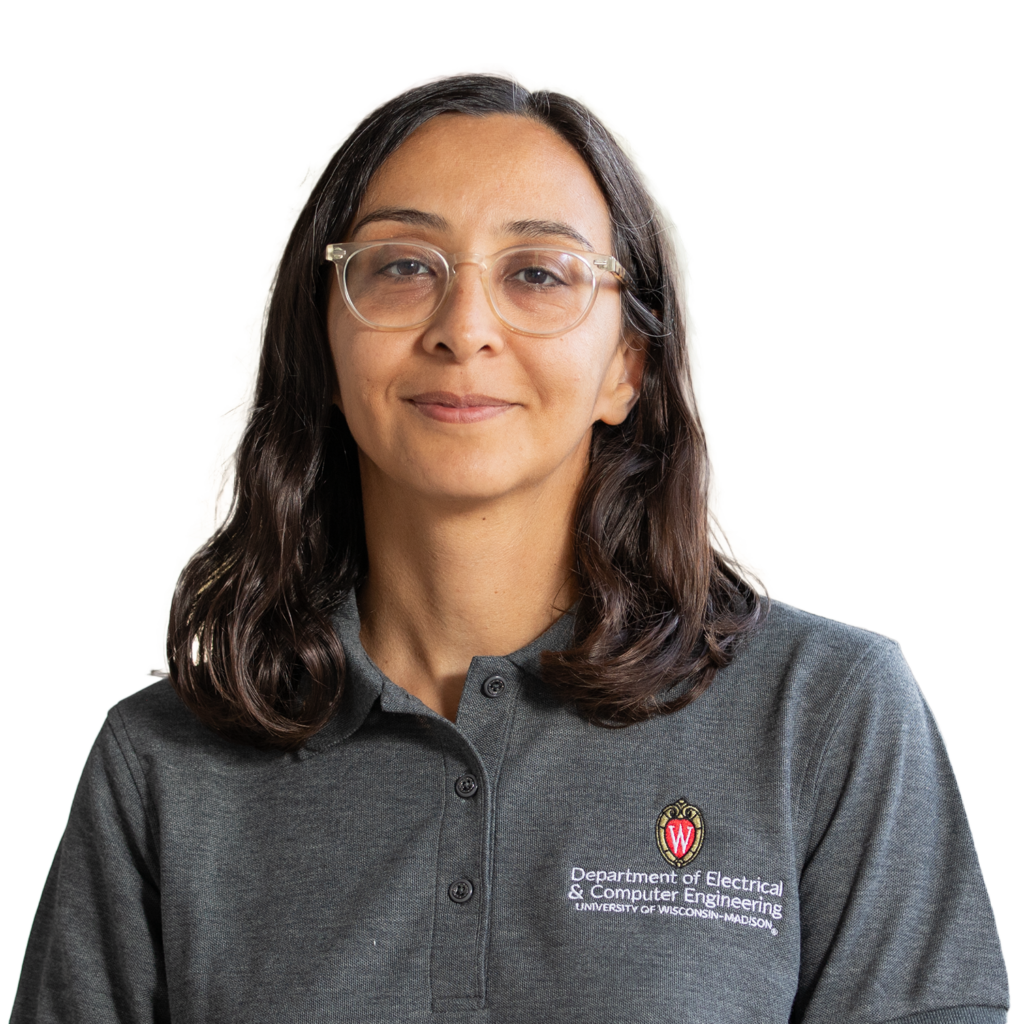
Azadeh Davoodi is a Vilas Distinguished Achievement Professor and Associate Chair of Undergraduate Studies in the Department of Electrical and Computer Engineering at the University of Wisconsin-Madison. Her research focuses on Electronic Design Automation (EDA), integrated circuit debug, and machine learning applications in VLSI design. She holds editorial roles in journals like IEEE TCAD and ACM TRETS, and has chaired major conferences such as ISPD 2015 and served on technical program committees for DAC, ICCAD, and others. Education: PhD in Electrical Engineering, University of Maryland-College Park (2006) Research Interests: Machine learning for VLSI chip design VLSI design automation for machine learning IC-CAD for emerging nanotechnologies Hardware security Recent Research Trends: Her work bridges machine learning and hardware design, with publications on neural network optimization, distributed inference, and explainable AI for circuit design. She emphasizes energy-efficient CNNs, latency reduction in edge computing, and security in split manufacturing. Awards: 2025 DATE Best Paper Candidate 2024 Vilas Distinguished Achievement Professor 2015 ACM Best Paper Award 2011 NSF CAREER Award Service and Grants: Leads NSF-funded projects on explainable ML for CAD and holds grants for distributed neural network synthesis. Her service includes roles as IEEE HKN member and editorial board positions. Labs/Teams: Engages in interdisciplinary research teams at UW-Madison, focusing on EDA innovation and hardware-software co-design.
Gerd Grau is an Associate Professor of Electrical Engineering at York University, affiliated with the Lassonde School of Engineering and the Department of Electrical Engineering & Computer Science. He holds a BA and MEng from the University of Cambridge and a PhD from UC Berkeley (2016). His research focuses on semiconductor devices, microfabrication, printed electronics, and additive manufacturing, funded by NSERC, CIHR, Mitacs, and industry partners. He leads the Electronics Additive Manufacturing (E-AM) Lab, which integrates 3D printing and printed electronics for applications in biomedical devices, aerospace, and smart materials. Education: BA and MEng (University of Cambridge), PhD (UC Berkeley, 2016). Research interests include printed transistor devices, carbon fiber composites with integrated sensors, and machine learning optimization for printing processes. His lab houses advanced equipment like 3D printers, micro-inkjet systems, and characterization tools. Grau supervises a dynamic group of graduate and undergraduate students, with former advisees now leading roles in industry and academia. Teaching includes courses on semiconductor physics, nanoelectronics, and printed electronics. The E-AM Lab collaborates with Prof. Garrett Melenka on carbon fiber structural health monitoring and explores novel applications of laser-induced graphene for energy storage and environmental sensors.
Bishnu Acharya serves as an Associate Professor and Saskatchewan Ministry of Agriculture Chair in Bioprocess Engineering within the Department of Chemical and Biological Engineering at the University of Saskatchewan. His research program focuses on sustainable conversion of agricultural biomass into high-value products through advanced bioprocessing techniques, addressing critical environmental and energy challenges. His primary research domains include: Cellulose-based biomaterials and nanocomposites for biomedical and packaging applications Thermochemical conversion (pyrolysis, gasification) and biochemical processing of agricultural residues Engineered biochar systems for wastewater remediation and soil enhancement Integration of remote sensing and machine learning for precision agriculture optimization Development of biodegradable materials from flax, wheat straw, and camelina meal Analysis of his 2024-2025 publications reveals a strong interdisciplinary trajectory bridging chemical engineering, environmental science, and agricultural technology. Key thematic clusters involve circular economy implementation in biomass valorization, nanocellulose-based advanced material development, and sustainable wastewater treatment solutions. His work consistently emphasizes practical applications for Canadian agricultural systems, particularly in Saskatchewan and Prince Edward Island contexts. Professional Recognition: Saskatchewan Ministry of Agriculture Chair in Bioprocess Engineering While specific grant details are not publicly enumerated in available materials, Dr. Acharya's prolific output across high-impact journals indicates substantial research funding and active supervision of graduate students. His collaborations span environmental remediation, advanced materials development, and sustainable agricultural technologies, reflecting a systems-thinking approach to bioresource management. Laboratory infrastructure likely includes biomass processing units, nanomaterial characterization facilities, and bioreactor systems supporting his diverse research portfolio.