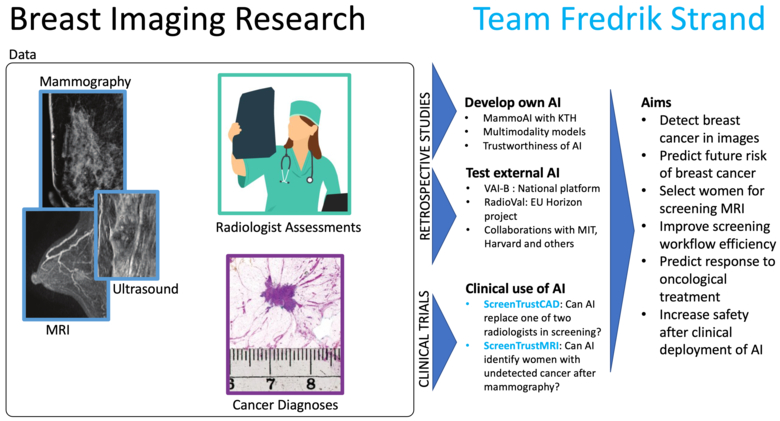
Fredrik Strand is a researcher at the Karolinska Institute , specifically within the Department of Oncology-Pathology under the Faculty of Medicine . He leads the Computational Breast Imaging Group , focusing on leveraging Artificial Intelligence (AI) for early breast cancer detection , precision diagnostics , and image-guided minimally invasive procedures . His work spans cross-disciplinary collaboration with institutions like the Royal Institute of Technology (KTH) and involves major clinical trials such as ScreenTrustCAD and ScreenTrustMRI . His research emphasizes AI in precision screening to address interval cancers and optimize radiologist workflows. Projects like VAI-B and RadioVal aim to validate AI algorithms and predict therapy response for neoadjuvant treatment . Recent publications highlight advancements in multi-modality imaging (mammography, MRI), GAN-based synthetic data generation , and trustworthy AI frameworks for clinical deployment. A consistent focus is on cost-effectiveness , equity in AI diagnostics , and human-AI interaction dynamics . Key trends in his work include deep learning for tumor detection , reinforcement learning for screening policies , and multi-institutional validation of AI tools. His research is funded by organizations such as Medtechlabs , Vinnova , EU Horizon Europe , and the Swedish Breast Cancer Association .
Daniel Lundqvist is Professor of Neuroimaging at Karolinska Institutet, appointed to this position effective November 1, 2024. He is affiliated with the Department of Clinical Neuroscience within the Faculty of Medicine and serves as Director of the Centre for Imaging Research (CIR) at BioClinicum. Additionally, he leads the Swedish node of the EU project "TEF-Health - Testing and Experimentation Facilities for Health AI and Robotics" and is the Scientific Director of NatMEG - the National Facility for Magnetoencephalography. His Multimodal Brain Imaging research group investigates how brain structure, function, and neurochemistry shape human consciousness, perception, decisions, and actions. Lundqvist earned his Doctor of Philosophy from Karolinska Institutet's Department of Clinical Neuroscience in 2003 and was awarded Docent (Associate Professor equivalent) status in 2016. His academic progression includes Senior Research Specialist (2021-2024) before his promotion to full Professor of Neuroimaging. Dr. Lundqvist's research centers on advancing magnetoencephalography (MEG) and on-scalp MEG technologies to elucidate neuronal brain activity. His work bridges cognitive, affective, and clinical neuroscience with a focus on both fundamental brain mechanisms and clinical applications. He combines two complementary approaches: one focused on his own research projects investigating the brain-mind relationship, and another aimed at promoting the imaging ecosystem across Karolinska Institutet, Karolinska University Hospital, and Europe. His research spans epilepsy, Parkinson's disease, emotion processing, social neuroscience, and the development of novel neuroimaging methodologies, with increasing integration of AI and computational approaches in recent years. His recent publications demonstrate a strong focus on advancing MEG technology for clinical applications, particularly on-scalp MEG. His work spans diverse neurological and psychiatric conditions while developing innovative imaging methodologies. A significant thread through his research is the application of advanced imaging techniques to understand both healthy brain function and neurological disorders, with particular emphasis on Parkinson's disease, epilepsy, and emotion processing. The cognitive neuropsychiatry of prediction systems in psychosis (Swedish Research Council, 2024-2026) CAPSI - Cancer related major depression treated with a single dose of psilocybin (Swedish Research Council, 2023-2026) TEF HEALTH (VINNOVA, 2022-2027) Finding a cognitive needle in a neural haystack (Swedish Research Council, 2022-2024) HD-MEG: High-definition neuroimaging for understanding the brain in health & disease (Swedish Research Council, 2022-2025) NatMEG: On-Scalp MEG Platform (Swedish Research Council, 2021-2025) Lundqvist has supervised doctoral and master students as part of his extensive teaching contributions across neuroscience education and brain imaging methods. His leadership extends to directing major research facilities and collaborative projects, including his role as National Node lead for TEF-HEALTH, which received over SEK 100 million in EU funding. His Multimodal Brain Imaging group forms part of the Brain & Mind academic environment that brings together cognitive neuroscience researchers using various brain imaging techniques to understand brain function in health and disease.
Volker Lauschke is an Associate Professor at the Department of Physiology and Pharmacology, Karolinska Institutet, where he leads the Personalized Medicine and Drug Development research group. His work integrates advanced 3D cell culture systems, microfluidics, and molecular profiling to develop novel therapeutic strategies. Department: Physiology and Pharmacology (FyFa) Research Focus: Inflammatory conditions (NASH), infectious diseases (COVID-19), metabolic diseases (type 2 diabetes) Funding: Swedish Research Council Consolidation Grant, KI Faculty Consolidator Grant His research spans pharmacogenomics , population-scale genetics , and machine learning to map ethnogeographic variability in drug response genes. The lab develops 3D primary human tissue models of liver, pancreas, adipose tissue, and skeletal muscle using patient-derived cells, with emphasis on cell-cell interactions and tissue-tissue crosstalk in microfluidic systems. They uniquely employ Nano Reaction Injection Molding (NanoRIM) for biomedical device fabrication and BRET-based biosensors for intracellular signaling monitoring. Analysis of recent publications reveals a strong focus on precision medicine applications through ethnogeographic pharmacogenomic atlases (e.g., PharmFreq), organ-on-chip systems for metabolic disease modeling, and viral pathogenesis mechanisms for hemorrhagic fevers. Key methodologies include chemogenomic screening in patient-derived models, population genomics, and advanced microphysiological systems. Swedish Research Council's Consolidation Grant for "Modulation of Tissue Communication to Combat Non-Alcoholic Fatty Liver" KI Faculty Consolidator Grant (1.2 million SEK/year for 5 years) Contributions to WHO-recommended baricitinib treatment for severe COVID-19 The lab actively collaborates on major initiatives including the Biofab core facility at Biomedicum. Their work on hepatic spheroids has opened new avenues for liver regeneration research, while pharmacogenomic studies directly inform clinical implementation of precision medicine. Current projects emphasize rare variant analysis in pharmacogenes and development of microfluidic multi-organ systems for glycemic control modeling.
Sándor Darányi is a Professor at the Swedish School of Library and Information Science, University of Borås (since 2011), with a career spanning over four decades in information science, digital libraries, and cultural heritage preservation. He also holds an Honorary Professorship at Szeged University, Hungary. His research focuses on advanced access to digital libraries, automatic indexing, information visualization, digital preservation, narrative genomics, and quantum interaction models for semantics. Education: Candidate of Science (CSc) in Ethnography, Hungarian Academy of Sciences (1994) PhD in Information Science, Eötvös Loránd University (1989) MA in Library and Information Science, Eötvös Loránd University (1985) MSc in Agricultural Sciences, University of Agriculture (1975) Research Interests: Darányi’s work bridges computational methods with cultural studies, including: - Formalization of folk narratives for big data analysis - Quantum-inspired models of semantic change - Haptic interfaces for accessibility in museums - Evolving semantics in digital ecosystems - Cultural heritage digitization projects Professional Activities: Editorial Board Member of Journal of Information Science Education Organized major conferences such as SEMANTiCS, IC-ININFO, and AMICUS workshops Supervised doctoral students in computer science and information studies Co-developed the PERICLES project on digital preservation Labs/Teams: His research groups have pioneered projects like the MuseIT inclusive museum initiative and the SHAMAN digital preservation framework, leveraging high-performance computing and cloud technologies.
Ran Friedman is a Professor of Chemistry at Linnaeus University, specializing in computational chemistry and biochemistry. He teaches medicinal and physical chemistry to students in nutritional sciences, pharmacy, and advanced programs. His research focuses on computational studies of biomolecules, particularly in cancer-related mechanisms, drug resistance, and protein-ion interactions. He leads the Computational Chemistry and Biochemistry Group and contributes to the Linnaeus University Centre for Biomaterials Chemistry. Research interests include using molecular dynamics simulations, quantum chemistry, and stochastic modeling to understand disease mechanisms, such as amyloid aggregation and cancer drug resistance. Current projects explore resistance mutations in leukemia and the development of inhibitors targeting kinases like FLT3 and Abl1. His work integrates computational methods with biological systems to address clinical challenges in oncology and drug design. Publications highlight advancements in kinase catalytic mechanisms, binding energy calculations, and drug resistance models. Collaborations span computational biology, materials science, and medicinal chemistry. His research emphasizes translating computational insights into therapeutic strategies for diseases like leukemia and chronic myeloid leukemia.
Eva L. Ragnemalm is an Associate Professor at the Department of Computer and Information Science, Linköping University, where she works in the Human-Centered Systems division. Her research focuses on human-computer interaction, usability engineering, and educational technology with an emphasis on making technology adapt to human needs. She has pioneered work in student modeling for adaptive learning systems and problem-based learning (PBL) methodologies. Her teaching includes courses in usability engineering and database systems for non-computer-science students. Notable projects include studies on empathy development in PBL environments, the role of e-portfolios in teacher professional development, and the efficacy of simulator technology in teacher training. Recent work challenges the necessity of advanced animation in classroom management simulations, advocating for simpler yet effective models. Ragnemalm has collaborated on research projects analyzing learning software through usability methods and exploring variation theory in teacher education. Her contributions span academic publications on adaptive systems, student modeling, and pedagogical innovation.
Johanna Björklund is an Associate Professor at the Department of Computing Science , Umeå University, specializing in Formal Language Theory , Machine Learning , and Semantic Parsing of Multimodal Data . Her research focuses on translating complex media (e.g., videos with audio/subtitles) into graph-based semantic representations for algorithmic processing. Current projects include WARA Media & Language (2024–2026) and AI-Driven Contextual Communication (2021–2023). Key research areas: tree automata , graph transduction , contextual advertising , and computational linguistics . Her recent publications highlight advances in tree-to-graph transduction , multimodal semantic analysis , and privacy-preserving advertising . She has secured significant grants, including SEK 12 million (2021) and 4 million SEK (2020), for AI and deep learning initiatives. Grants: SEK 12 million (2021) for AI projects. 4 million SEK (2020) for Deep Learning methods. Scientific Awards: Lead researcher in multiple EU-funded projects. Recognized for contributions to formal languages and machine learning . She collaborates with teams in semantic analysis , tree automata , and multimodal AI , emphasizing practical applications like visual analytics and advertising systems .
Joakim Lidstrom serves as a Lecturer at the Department of Informatics, Umeå University, with teaching experience since fall 2014 across bachelor's and master's programs including Digital Media Production, Systems Science, and Human-Computer Interaction and Social Media. His research focuses on digital cultural preservation, evidenced by the 2018-2020 project Digital access to the Sámi heritage archives , with broader interests spanning: Digital Media Production Web Development Interaction Design Human-Computer Interaction Digital Heritage 3D Graphics and Game Design He has taught comprehensive courses including Digital Media Production (180 credits), Web Development, Digital Audio/Video Editing, Post-production (visual effects/motion graphics), Design Theory, Non-linear Storytelling, Advanced Media Production, Programming Fundamentals, and Master's-level Prototyping Interaction, while supervising bachelor's theses and conducting specialized workshops. Lidstrom's work demonstrates applied research in cultural heritage digitization and educational technology development, with no scientific awards currently documented.
Bandaru Sunith is an Associate Professor at the University of Skövde's School of Engineering Science, with previous affiliation to The Virtual Systems Research Centre (closed May 2017). His research spans multi-objective optimization, digital twins, and knowledge-driven decision support systems for manufacturing applications. He actively leads the Virtual Factories with Knowledge-Driven Optimization (VF-KDO) research profile and contributes to the ADOPTIVE project focused on vehicle ergonomics optimization. Dr. Sunith's research interests include: Multi-objective optimization and evolutionary algorithms Digital twin frameworks for manufacturing systems Knowledge discovery and visualization for decision support Anomaly detection in industrial processes Factory layout optimization integrating human well-being metrics His recent publications (2023-2025) demonstrate a clear trend toward integrating advanced AI techniques with traditional optimization methods. The research increasingly focuses on practical industrial applications, particularly in automotive manufacturing, with strong emphasis on translating theoretical advances into usable tools. His work bridges the gap between computational optimization and real-world manufacturing challenges, often incorporating human factors considerations. Dr. Sunith has secured significant research funding from Swedish innovation agencies: Virtual Factories with Knowledge-Driven Optimization (VF-KDO) funded by Knowledge Foundation (Grant 2018-0011) Integrated Manufacturing Analytics Platform for Predictive Maintenance (IMAP) funded by Vinnova (Grant 2021-02537) LITMUS project on human-centric sustainable production funded by Knowledge Foundation He has supervised multiple researchers including Henrik Smedberg and Mahesh Kumbhar, resulting in collaborative publications and the development of practical tools like Mimer - a web-based platform for knowledge discovery in multi-criteria decision support. His research group maintains strong industry connections, particularly with automotive manufacturers in Sweden.
Magnus Hummelgård is an Associate Professor and Senior Lecturer at Mid Sweden University, affiliated with the Department of Engineering, Mathematics and Subject Didactics (IMD). He works at the MILAB - Materials and Innovation Laboratory within the FSCN Research Centre in Sundsvall. His research spans materials physics, nanotechnology, and energy applications, with a particular focus on developing advanced materials for next-generation energy storage and harvesting technologies. Hummelgård specializes in materials physics with expertise in electron microscopy techniques including TEM, SEM, and AFM. His research interests center around new nanomaterials development and instrument design, with significant contributions in battery technology and triboelectric nanogenerators. He has published extensively on silicon-based anodes for lithium-ion batteries, paper-based energy harvesting systems, and human-body energy conversion technologies. His work demonstrates strong interdisciplinary collaboration across physics, chemistry, and engineering disciplines. Analysis of his recent publications reveals a clear research trajectory focused on sustainable energy solutions. His work increasingly emphasizes green materials and waste-to-energy applications, particularly in triboelectric nanogenerator development. There's also a growing focus on human-body interactions with energy harvesting systems and the development of biocompatible energy solutions. His research shows consistent evolution from fundamental materials characterization to practical applications in energy storage and harvesting. Hummelgård leads the IMPHET research project focused on advanced Materials and Processes with Sustainable Energy Applications, building on previous work with the DRIVE project on silicon-graphene composite electrodes for lithium-ion batteries. His teaching portfolio includes fundamental physics courses covering mechanics, thermodynamics, and electromagnetism, as well as advanced topics in solid-state physics, electromagnetic field theory, and electron microscopy.
Daniel Gnad is an Assistant Professor at Linköping University's Department of Computer Science (IDA), working within the Artificial Intelligence and Integrated Computing Systems (AIICS) division. He specializes in "Planning and model checking" within artificial intelligence, focusing on theoretical foundations and algorithmic approaches to complex planning problems. Dr. Gnad completed his Computer Science studies at Saarland University, earning his MSc before continuing as a PhD student under Prof. Jörg Hoffmann. In 2022, he joined the RLPLab at Linköping University as a postdoctoral researcher, becoming an assistant professor in 2023. His research primarily centers on AI planning, model checking, and decoupled state-space search methodologies. His recent publications demonstrate significant advancements in planning algorithms, pattern databases, and numeric planning techniques. Gnad's work bridges theoretical computer science with practical applications in artificial intelligence, particularly in developing more efficient search algorithms for complex planning problems. His research often involves transforming planning problems into more tractable forms through abstraction techniques and novel search topologies. Dr. Gnad has received numerous prestigious awards recognizing his contributions to the field: ICAPS 2022 Best Dissertation Award for "Star-Topology Decoupled State-Space Search in AI Planning and Model Checking" SoCS 2022 Best Paper Award for "Additive Pattern Databases for Decoupled Search" SPIN 2018 Best Paper Award for "Star-Topology Decoupling in SPIN" Dr.-Eduard-Martin-Preis for the best dissertation of the Faculty for Mathematics and Computer Science in 2021 Multiple recognitions at the International Planning Competition (IPC) 2018 for the "Saarplan" planning system As a researcher at AIICS, Dr. Gnad contributes to Linköping University's strong position in artificial intelligence research. His work is part of the broader research activities within the Wallenberg Autonomous Systems Program (WASP), one of Sweden's largest research initiatives. While specific details about his advisees aren't provided in the available information, his research group likely contributes to the department's doctoral programs in computer science. Dr. Gnad's laboratory work focuses on developing and analyzing planning algorithms, with applications ranging from theoretical computer science to practical AI systems. His recent integration of techniques like pattern databases with numeric planning represents an important direction in making planning algorithms more versatile for real-world applications.
Johan Stymne is a Lecturer at the Department of Computer and Systems Sciences, Stockholm University, and a member of the ReVisE Research Group. His work focuses on Interaction Design for Technology Enhanced Learning, particularly Mobile Learning and Computer-Supported Collaborative Learning, with theoretical interests in Socio-Cultural Perspectives on Learning and Evaluation of Technology Support for Group Work. His research explores how mobile technologies and emergent tools like AR and GPS enable outdoor educational experiences. Key themes include balancing technology use to avoid student distraction, designing for physical environment orientation, and creating frameworks for mobile learning tools (e.g., design guidelines, models, and concepts). His publications highlight practical applications in primary education, especially in biology, and methodological advancements in data collection through photos and notes. The ReVisE group at Stockholm University investigates how IoT, AI, VR, and MR can innovate educational practices through visualizations and real-world collaborations with schools and industry partners across Sweden.
Fernando Jaramillo serves as an Associate Professor in the Department of Physical Geography at Stockholm University, where he conducts cutting-edge research at the intersection of hydrology, climate science, and remote sensing technologies. His work focuses on understanding water systems dynamics under changing environmental conditions, with particular emphasis on wetlands, lakes, and groundwater resources. Dr. Jaramillo is affiliated with the Baltic Sea Fellows research initiative and leads the Hydrogeodesy Lab, which specializes in developing innovative methods for hydrological monitoring using geodetic techniques. His research interests span multiple critical areas of contemporary hydrology including hydrogeodesy, wetland hydrology, groundwater systems, and the water-energy-food nexus. Dr. Jaramillo investigates how climate variability and human activities impact water resources across different spatial and temporal scales, with research sites spanning from Swedish lakes to tropical river basins in Colombia and wetlands across the globe. His methodological expertise includes advanced remote sensing techniques, particularly Interferometric Synthetic Aperture Radar (InSAR), which enables centimeter-scale water level monitoring in previously ungauged systems. Analysis of his recent publications reveals a strong interdisciplinary approach that integrates hydrological science with earth system thinking. His work demonstrates growing emphasis on planetary boundaries for freshwater systems, hydroclimatic vulnerability of ecosystems, and the application of machine learning to hydrological problems. The research shows particular strength in combining field measurements with satellite observations to address complex water resource challenges in both temperate and tropical regions. Dr. Jaramillo leads several significant research projects including DeepWetlands (quantifying wetland water extent changes using deep learning), DOWES (disclosing overlooked wetland ecosystem services), and initiatives focused on hydrogeodetic assessment of river-coastal system connections. His work has substantial policy relevance, particularly for water resource management in the context of climate change adaptation and sustainable development goals.
Omkar Salunkhe is a Postdoc researcher at Chalmers University of Technology, working within the Department of Industrial and Materials Science, specifically in the Production Systems division. His research focuses on advanced manufacturing systems, human-robot collaboration, and Industry 4.0 technologies, with particular emphasis on practical applications in wire harness assembly and final assembly processes. Salunkhe's research interests span multiple areas of modern manufacturing and automation. He specializes in collaborative robotics applications, particularly in wire harness assembly processes. His work explores task allocation between humans and robots, cost-benefit analysis of collaborative workstations, and the integration of computer vision systems in manufacturing environments. He also investigates operational flexibility in final assembly using Industry 4.0 enabling technologies, with applications in automotive and other manufacturing sectors. His research bridges theoretical concepts with practical industrial implementation, focusing on human-centered approaches to automation that maintain economic viability. Analysis of Salunkhe's publication record reveals a strong trajectory from foundational work on operational flexibility (2018-2020) to increasingly specialized research on collaborative robotics in wire harness assembly (2022-2024). His work demonstrates a clear evolution from general Industry 4.0 applications to targeted solutions for specific manufacturing challenges, with a consistent focus on the human element in automated systems. The 2025 MAXLabs project represents a significant expansion of his research into integrated cyber-physical testbeds for broader manufacturing research. Salunkhe has been actively involved in multiple research projects funded by VINNOVA, the European Commission, and other organizations. These include MAXLabs, EWASS (Empowering Human Workers for Assembly of Wire Harnesses), PLENUM, and Digital work Instructions for cognitive work. His collaborative network includes prominent researchers such as Johan Stahre, Anna Syberfeldt, and David Romero, reflecting strong interdisciplinary and industry-connected research activities.
Pierre Arne Ingvar Wijkman is a Senior Lecturer at the Department of Computer and Systems Sciences (DSV), Stockholm University. His research group focuses on Distributed Immersive Participation , exploring how technological advances enable humans and devices to connect and share information in real and virtual communities. Research applications span culture, transport, intelligent vehicles, and e-health Contact: pierre@dsv.su.se