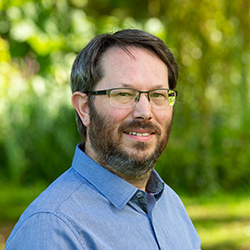
Erik Van Vleck is a Professor of Mathematics at the University of Kansas, affiliated with the College of Liberal Arts & Sciences. His research focuses on applied mathematics, numerical analysis, and numerical methods for partial differential equations (PDEs), with particular emphasis on data assimilation and reaction-diffusion systems. His work bridges theoretical advancements and practical applications in computational dynamics, environmental modeling, and ecological systems. Van Vleck’s research interests include multi-scale data assimilation techniques, adaptive mesh methods, and the numerical analysis of traveling wave solutions in discrete and continuous systems. He has contributed to understanding pattern formation in ecological models, particularly in savanna ecosystems and fire-driven dynamics. His methodological innovations span numerical methods for PDEs, reduced-order modeling, and stochastic filtering approaches for complex systems. His recent work highlights trends in developing robust adaptive frameworks for data assimilation, integrating advanced numerical techniques with real-world applications in geophysics and environmental science. This includes projects on metric tensor-based mesh adaptation and projected data assimilation using sliding window methods. His contributions to theoretical foundations include spectral stability analyses for discrete dynamical systems and bifurcation studies in reaction-diffusion equations. Van Vleck has collaborated extensively across disciplines, applying mathematical tools to ecological, climatological, and biomedical systems. His research often addresses computational challenges in high-dimensional spaces, emphasizing efficiency and accuracy in modeling complex phenomena. Despite the breadth of his contributions, no specific grants or advising roles are detailed in the provided materials.