
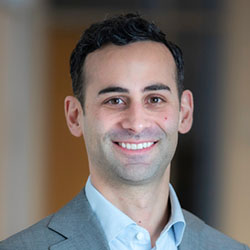
James Rondinelli serves as the Walter Dill Scott Professor of Materials Science and Engineering and Associate Chair of the Department of Materials Science and Engineering at Northwestern University. His research group pioneers structure-driven property design to overcome materials limitations in electronic, magnetic, and optical systems for next-generation technologies. Education: Ph.D. in Materials Science and Engineering, University of California, Santa Barbara B.S. in Materials Science and Engineering, Northwestern University Research Focus: Rondinelli develops computational frameworks for electronic structure theory and design of functional transition metal compounds. His work harmonizes contraindicated properties (electron/spin/inversion symmetry), controls complex correlations, designs matter for energy-efficient technologies, intersects ultrafast light sciences with materials, interfaces data science for accelerated discovery, models aqueous corrosion electrochemistry, and realizes advanced optical sources. His group maintains strong experimental collaborations for validation. Publication Trends: Recent work (2024-2025) reveals intense focus on multiferroics in halide perovskites, polar metals, heteroanionic stabilization, and computational design for quantum technologies. Emerging themes include AI-accelerated discovery, corrosion modeling for superconducting qubits, and negative thermal expansion materials, demonstrating convergence of theory, computation, and experimental validation. Awards: Outstanding Young Investigator Award (2017) NSF CAREER Award (2015) American Ceramic Society Ross Coffin Purdy Award (2014) DARPA Young Faculty Award (2012-2013) Army Research Office YIP Award (2012-2014) Joseph Katz Postdoctoral Fellowship, Argonne National Laboratory (2010-2011) Mentorship and Funding: Rondinelli leads a 22-member research group (14 PhD students, 1 MS student, postdocs, and researchers) supported by major grants from NSF (including CAREER), DARPA, Army Research Office, and Department of Energy. His funding portfolio emphasizes high-risk/high-reward projects in predictive materials design and quantum materials. Research Infrastructure: The Materials Theory and Design Group employs advanced computational methods for predictive materials discovery, focusing on picoscale structure-property relationships. The group maintains close ties with experimental facilities at Argonne National Laboratory and collaborates extensively on synthesizing and characterizing novel transition metal compounds.


