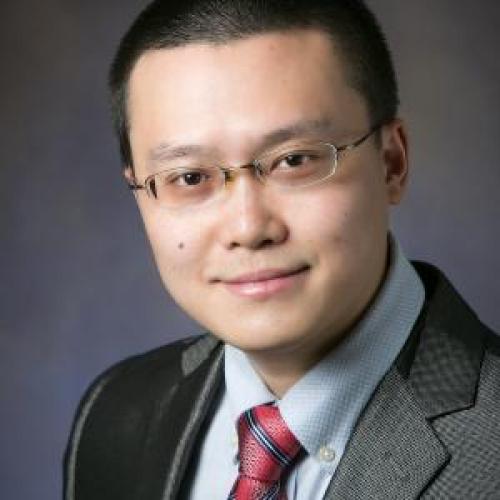
Zhen Peng
دانشیار · Computational Electromagnetics
University of Illinois Urbana-Champaignمعرفی
Zhen Peng is an Associate Professor in the Department of Electrical and Computer Engineering (ECE) at the University of Illinois at Urbana-Champaign (UIUC), part of the College of Engineering. He holds a B.S. from the University of Science and Technology of China and a Ph.D. from the Chinese Academy of Sciences. Prior to UIUC, he was an Assistant Professor at the University of New Mexico (2013–2019) and a Postdoctoral Fellow at The Ohio State University (2008–2013).
Research Interests: Prof. Peng’s work focuses on theoretical and computational electromagnetics, including scalable algorithms, statistical wave physics, quantum electromagnetics, and chaotic reverberation chambers. His research integrates machine learning, quantum computing, and domain decomposition methods to address challenges in wireless communication, metamaterials, and electromagnetic compatibility.
Recent Achievements: His group has developed groundbreaking frameworks like Photon Splatting for real-time channel modeling and quantum annealing-based optimization for reconfigurable surfaces. Key contributions include the efficient simulation of large metasurfaces and stochastic Green’s function methods for wave-chaotic environments. His work has been recognized through awards such as the NSF CAREER Award (2018), IEEE Antennas and Propagation Society Distinguished Lecturer (2024), and multiple best paper awards.
Grants & Collaborations: Supported by NSF, ONR, and DARPA, his research spans academia and industry, including collaborations with Nokia and GreenerWave. He is a leader in advancing smart radio environments and computational electromagnetics education.
Labs & Teams: The Advanced and Applied Computational Electromagnetics (ACEM) Group, led by Peng, drives innovation in electromagnetic modeling, quantum-assisted optimization, and statistical wave analysis. Recent highlights include developing hybrid classical-quantum computing frameworks and scalable algorithms for extreme-scale problems.