معرفی
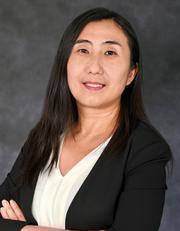
Yayue Pan is a Professor at the Department of Mechanical and Industrial Engineering, University of Illinois Chicago (UIC), and serves as the Director of NASA MIRO Center for In-Space Manufacturing: Recycling and Regolith Processing (CISM-R2). Her research focuses on advancing Additive Manufacturing (AM) technologies for applications in biomedical engineering, energy storage, and smart structures.
- Ph.D., Industrial and Systems Engineering, University of Southern California (2014)
- M.S., Mechanical Manufacturing and Automation, Zhejiang University, China (2010)
- B.S., Industrial Engineering, Zhejiang University of Technology, China (2007)
Her work addresses technical challenges in AM such as multi-material printing, multi-scale fabrication, and field-assisted processes. Notable projects include:
- Development of electrostatically-assisted direct ink writing (eDIW) for high-speed, high-resolution printing
- Continuous projection stereolithography for rapid solid object manufacturing
- Acoustic field-assisted particle patterning for smart composites
- Light-curable hydrogels for corneal repair applications
Her 15 most recent publications (2022–2025) span topics in:
- Multi-material AM (conductive polymers, hierarchical composites)
- Biomedical applications (soft robotics, corneal repair)
- Energy components (battery electrolytes, supercapacitors)
- Field-assisted processes (acoustic, electrostatic, magnetic)
Scientific Awards:
- 2024 ASME Chao and Trigger Young Manufacturing Engineer Award
- 2022 UIC Researcher of the Year Rising Star Award
- 2020 ASME CIE TC Leadership Award
- 2019 UIC Outstanding Teaching Award
- 2017 SME Outstanding Young Manufacturing Engineer Award
- NSF REU Supplements (2023–2024)
Advising: Mentored 24+ graduate/undergraduate researchers, including 17 NASA/GPIP interns. Former advisees hold academic positions at University at Buffalo and University of North Carolina at Charlotte, and industry roles at Apple, GE Healthcare, and ANSYS.
Grants: Recipient of a $4.65M NASA grant and multiple NSF awards. Collaborations include Northwestern University, University of Michigan, and NASA centers.