معرفی
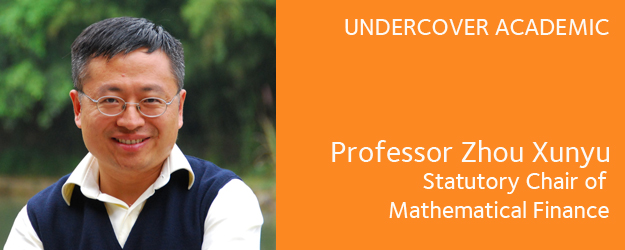
Xunyu Zhou is the Liu Family Professor of Financial Engineering at Columbia University's School of Engineering and Applied Science. He directs the FDT Center for Intelligent Asset Management, funded by a FinTech company. His research focuses on integrating behavioral finance models with human psychology into financial decision-making, and applying optimal control and machine learning to wealth management. Zhou holds a Ph.D. in Operations Research and Control Theory from Fudan University (1989) and previously served as the Nomura Professor of Mathematical Finance at the University of Oxford (2007–2016).
Key research areas include stochastic control, dynamic portfolio optimization, and behavioral asset pricing under frameworks like cumulative prospect theory. He has pioneered indefinite stochastic LQ control theory and developed methods for time-inconsistent problems in finance. Zhou is an IEEE and SIAM Fellow, recipient of the Wolfson Research Award, SIAM Outstanding Paper Prize, and Humboldt Research Fellowship.
- Education:
- Ph.D. in Operations Research and Control Theory, Fudan University (1989)
- Affiliations:
- Center Affiliation: Financial and Business Analytics
- Director: FDT Center for Intelligent Asset Management
His work bridges theoretical advancements with practical applications, including reinforcement learning for portfolio optimization, optimal stopping strategies under probability distortions, and risk-sensitive decision-making models. Recent research emphasizes sublinear regret bounds in continuous-time systems and algorithmic frameworks for financial applications.
- Awards:
- Wolfson Research Award (2020)
- SIAM Outstanding Paper Prize (2015)
- Humboldt Distinguished Lecturer (2012)
- Alexander von Humboldt Research Fellowship (2008)
Zhou’s contributions extend to editorial roles in journals like Mathematical Finance and keynote addresses, including a 2010 invited lecture at the International Congress of Mathematicians. His FDT Center advances AI-driven solutions for asset management, reflecting his vision of computational finance as a transformative field.