معرفی
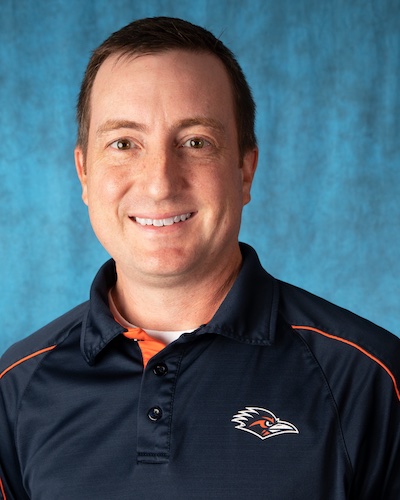
William Land, Ph.D., serves as an Associate Professor in the Department of Kinesiology within the College for Health, Community and Policy (HCAP) at the University of Texas at San Antonio (UTSA), where he conducts research at the intersection of Sport Psychology, Cognitive Psychology, and Kinesiology.
Education:
- Ph.D. in Sport Psychology, Florida State University (2010)
- M.S. in Sport Psychology, Florida State University (2007)
- B.S. in Psychology, University of Tennessee at Chattanooga (2003)
Research Focus: Dr. Land's program investigates attentional focus mechanisms in motor performance, with emphasis on how external versus internal focus instructions affect biomechanics, injury risk, and skill execution across sports contexts. His work spans volleyball landing mechanics, gymnastics form skills, and police tactical performance, while also examining psychological determinants of physical activity engagement across diverse populations including athletes, college students, and law enforcement personnel. Methodologically, he integrates motion capture, biomechanical analysis, MRI assessment, and advanced statistical modeling.
Publication Trends: Recent work (2023-2024) demonstrates consistent focus on attentional focus effects in motor tasks, with biomechanical analyses of landing mechanics and sport-specific skills dominating his output. Parallel research examines social physique anxiety through MIMIC modeling and explores motivational frameworks in physical activity contexts, reflecting his dual expertise in performance psychology and behavioral determinants of movement.
Research Support:
- Secured $29,732 in competitive funding for the Psychological Skills Inventory for Law Enforcement project (2018-2019)
- Presented 10 conference papers at major venues including FEPSAC Congress (2024) and NASPSPA Annual Conference (2023)
Research Environment: Dr. Land operates within UTSA's biomechanics and motor control research infrastructure, collaborating with interdisciplinary teams across sport psychology, orthopedics, and law enforcement to address performance optimization and injury prevention through attentional focus manipulation.