معرفی
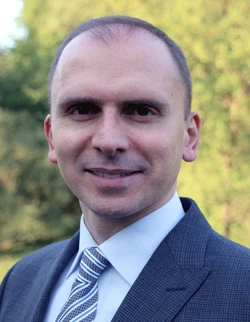
Professor Vladimir Stankovic is a leading academic in the Department of Electronic and Electrical Engineering within the Faculty of Engineering at the University of Strathclyde, UK. His research focuses on signal and information processing to tackle global sustainability challenges such as energy efficiency, net-zero transition, electrification of transport, and landslide monitoring. He is actively involved in multiple high-impact research initiatives and holds leadership roles in major AI and engineering conferences.
- PhD (Dr-Ing), University of Leipzig, Germany, 2003
- MEng (Dipl-Ing), Electrical Engineering, University of Belgrade, 2000
His research interests center on applying signal processing and AI to smart homes, micro-seismic analysis, health monitoring, remote sensing, and computer vision. He has developed innovative methods in energy disaggregation, graph signal processing, and interpretable machine learning. His work bridges engineering with sustainability, contributing to UN Sustainable Development Goals. He teaches core courses including image/video processing, communication systems, signals and systems, and information theory.
The recent publications highlight a strong trend in applying AI and machine learning to energy analytics in buildings and agriculture (e.g., dairy farms), landslide monitoring using seismic data, and equitable EV charging planning. These works leverage advanced techniques such as graph neural networks, transformers, and human-in-the-loop deep learning, demonstrating a consistent focus on real-world impact, interpretability, and sustainability.
He has received notable scientific awards:
- Finalist of the World first 10K Best paper Award (Top 3%)
- IEEE Multimedia Signal Processing Workshop (MMSP) top 10% best paper award 2010
Professor Stankovic has been a Principal or Co-Investigator on numerous research and knowledge exchange projects, including JED-AIs (Justice, Energy, Demand flexibility and AI for Sustainability), REMINDA, and multiple Digital Dairy Chain Innovation Vouchers. These projects are funded by EPSRC and other UKRI councils, focusing on AI-driven energy analytics, community energy sharing, and sustainable farming. He serves in key editorial roles, including Area Editor for IEEE Transactions on Communications and Associate Editor for Nature Scientific Data, and has organized major conferences such as IEEE MMSP 2017 and IJCNN 2025.
He is actively involved in research teams and collaborative networks focused on AI for sustainability, energy systems, and environmental monitoring. His lab works on datasets such as the Plegma Dataset and REFIT, supporting open science in energy and seismic analytics.
حوزههای پژوهشی