معرفی
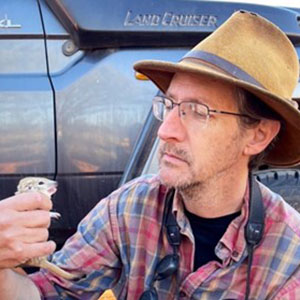
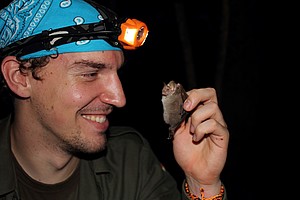
Thomas Hiller is a postdoctoral researcher at the University of Hohenheim, Germany, within the Hans-Ruthenberg-Institute for Tropical Agricultural Sciences of the Faculty of Agricultural Sciences. His work focuses on tropical ecology, biodiversity, species interactions, and land-use change, using bats and birds as model organisms to understand ecosystem functions across agricultural landscapes in Germany, Indonesia, and South Africa.
Education: He earned his PhD from the University of Ulm in collaboration with the Smithsonian Tropical Research Institute (STRI) in Panama, where he investigated biodiversity responses to anthropogenic land-use change and host-parasite networks involving bats and their ectoparasitic flies.
Research Interests: His current projects employ automatic acoustic recorders to monitor bat and bird communities, examining how landscape composition and fragmentation affect species distributions and ecosystem services such as seed dispersal, pollination, and pest control. A particular fascination lies in the evolutionary ecology of bat flies (Streblidae, Nycteribiidae) and their hyperparasitic fungi (Laboulbeniales), exploring coevolutionary dynamics and morphological adaptations in these specialized host-parasite systems.
Publications & Trends: Since 2017, he has authored or co-authored over 25 peer-reviewed articles spanning landscape ecology, conservation biology, parasitology, and mycology. Recent studies emphasize the impacts of rainforest fragmentation on plant-frugivore networks, the role of crop diversity in sustaining bat populations, and global syntheses of acoustic monitoring data.
Collaborations & Outreach: He collaborates extensively with international teams, including citizen-science initiatives to track invasive species and emerging pathogens. His multidisciplinary approach bridges field ecology, phylogenetics, and applied conservation to inform sustainable land-use practices.