معرفی
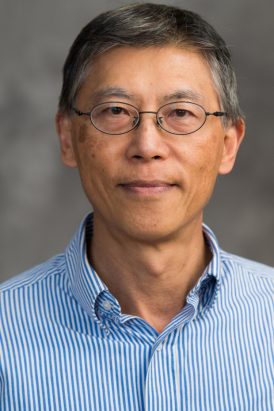
Tailen Hsing is the Michael B. Woodroofe Collegiate Professor of Statistics at the University of Michigan's Department of Statistics, part of the College of Literature, Science, and the Arts (LSA). His research focuses on functional data analysis, spatial statistics, and extreme value theory. He has held academic leadership roles, including serving as Chair of the Department of Statistics from 2010 to 2015.
Education: Tailen Hsing earned his Ph.D. in Statistics from the University of North Carolina in 1984, following an M.S. in Statistics from the same institution in 1983, and a B.S. in Mathematics from National Taiwan University in 1978. His academic career includes prior appointments at Ohio State University, the National University of Singapore, and Texas A&M University.
Research Interests: Hsing’s work centers on extreme value problems, functional data analysis, long-range dependence, and space-time models. He has made significant contributions to theoretical foundations of functional data, including a notable book published in 2015. His current research explores high-dimensional parameters in functional data and inference for locally stationary spatial processes.
Publications: His recent work includes advancements in spectral density estimation for spatial processes, functional data segmentation, and multivariate spatial models. These contributions highlight his expertise in bridging theoretical and applied statistical methods.
Editorial Roles: He serves as an Associate Editor of Statistical Science and the Editorial Board of SpringerBriefs in Probability and Mathematical Statistics, among other editorial positions. Previously, he co-edited the Annals of Statistics and contributed to editorial roles for leading journals like Bernoulli and Statistica Sinica.
Advising and Grants: While specific grants and student advisees are not detailed here, his extensive publication record reflects collaborative work with students and colleagues. His research has been supported through various academic collaborations and institutional resources.
Labs and Teams: Though no specific labs are mentioned, his collaborations with researchers such as Stoev and Yarger indicate active participation in interdisciplinary teams focused on spatial and functional data analysis.