معرفی
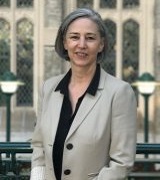
Sarah Easterby-Smith is a Senior Lecturer in the School of History at the University of St Andrews, where she is also affiliated with the St Andrews Institute for Transnational & Spatial History. She joined St Andrews as a lecturer in 2012 and was promoted to senior lecturer in 2018.
Her educational background includes a PhD in History from the University of Warwick (2010), followed by prestigious fellowships including an Early Career Fellowship at the Institute of Advanced Study, University of Warwick, a Max Weber Fellowship at the European University Institute, and a Dibner Fellowship in the History of Science at the Huntington Library, California.
As a social and cultural historian of science, Dr. Easterby-Smith's work focuses on French, British and global histories in the eighteenth and early nineteenth centuries. Her research explores how access to knowledge was permitted and constrained, especially with regard to gender and social status. Her first monograph, Cultivating Commerce: Cultures of Botany in Britain and France, was published by Cambridge University Press in 2018.
Her current research portfolio demonstrates a consistent focus on colonial knowledge systems, with particular attention to botanical networks and the role of families in colonial science. Her publications reveal an interdisciplinary approach that bridges history of science, cultural history, and global history methodologies, with increasing attention to indigenous knowledge systems in recent work.
Dr. Easterby-Smith has received numerous awards and recognitions, including:
- Dibner Fellowship in the History of Science and Technology (2011)
- Early Career Fellowship at the Institute of Advanced Study, University of Warwick (2010)
- Max Weber Fellowship at the European University Institute (2010)
- Fellow of the Royal Historical Society (2018)
- Huntington Library Conference funding (2014)
She has supervised 10 PhD students to completion on diverse topics ranging from early modern numeracy to the nineteenth-century whaling industry. Her teaching focuses on eighteenth-century politics, science, society and culture, with special emphasis on visual and material sources. She actively collaborates with external organizations, including historical consultancy for the Royal Horticultural Society and current work with UNESCO on botany and world heritage sites.