معرفی
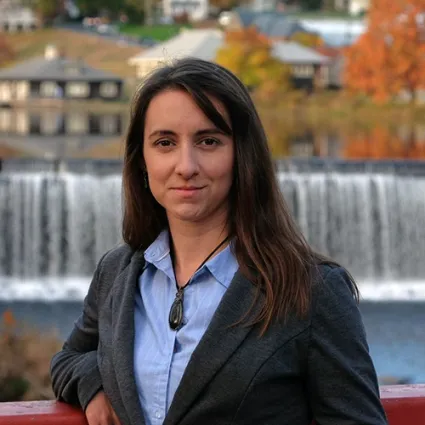
Sarah Mazza is an Assistant Professor of Geosciences at Smith College, specializing in hard-rock geology and geochemistry. Her research focuses on understanding Earth's evolution through volcanic studies and isotopic analysis, with teaching responsibilities including Introduction to Earth Processes and History, Mineralogy, and Petrology.
Her educational background includes:
- B.S. from the University of North Carolina
- M.S. and Ph.D. from Virginia Polytechnic Institute and State University (Virginia Tech)
Dr. Mazza's research spans geochemistry, volcanology, and structural geology, investigating planetary formation processes through intraplate volcanism, stable isotope fractionation, and subduction zone dynamics. Fieldwork locations include Bermuda, Virginia, West Virginia, Scotland, and Nepal, combined with advanced laboratory techniques for tungsten and zinc isotopic analysis.
Her publication trends reveal a dominant focus on isotope geochemistry to decode Earth's history, particularly tungsten isotopes as tracers for slab dehydration in subduction zones, mechanisms of intraplate volcanism in Bermuda and eastern North America, and tectonic evolution of ancient orogens like the Caledonides. This work bridges field observations with geochemical modeling to address fundamental questions in Earth sciences.
No specific scientific awards were documented in the provided materials.
Dr. Mazza actively mentors undergraduate researchers through diverse projects including mafic sediment analysis from Bermuda, petrographic surveys of Bermuda and New Hampshire samples, and whole-rock analysis of Lassen National Park basalts. She secured a 2023 visiting scientist position at Lawrence Livermore National Laboratory (LLNL) for zinc and tungsten isotopic data collection, demonstrating successful grant acquisition for cutting-edge instrumentation access.
Her laboratory at Smith College maintains active geochemical and petrological research programs, with collaborations spanning international institutions including the University of Münster (Germany), Cornell University, and LLNL, focusing on volcanic rock analysis and stable isotope applications.