معرفی
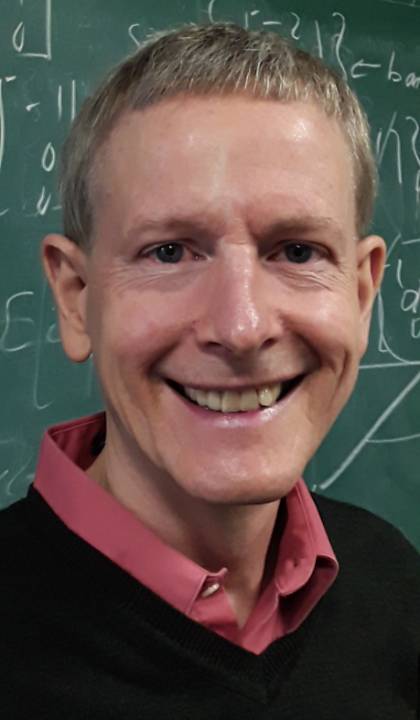
Russell D. Blyth is a Professor in the Department of Mathematics and Statistics within the College of Arts and Sciences at Saint Louis University. He holds a Ph.D. from the University of Illinois and a Bachelor's degree from Massey University in New Zealand. Currently teaching Spring 2025 courses including Calculus II (Math 1520) and Introduction to Linear Algebra (Math 3120), he has maintained an active academic career spanning several decades.
Dr. Blyth completed his Ph.D. under Derek J.S. Robinson at the University of Illinois. His research focuses on group theory with specific interests in rewritability, non-abelian tensor products, integrals of groups (when a group is a derived subgroup), and applications of the classification theorem of finite simple groups. He has also developed significant expertise in mathematics education, particularly in active learning methods and technology-enhanced instruction.
His scholarly output demonstrates a consistent research trajectory in group theory from the 1980s through the present, with recent publications continuing to explore advanced topics in non-abelian tensor products and group structures. In addition to pure mathematics research, he has contributed to mathematics education with publications on inquiry-based learning approaches and faculty development workshops. His work spans both theoretical group theory and practical applications in mathematics education.
Dr. Blyth has developed educational resources including mathmistakes.info, which explains common student errors in mathematics courses from algebra through multivariable calculus. He has also given presentations on GeoGebra at professional conferences and co-ran online workshops for mathematics faculty development focused on web-enhanced instruction.
His teaching philosophy emphasizes active learning methods and effective use of technology. He has taught across the mathematics curriculum including calculus sequence courses, linear algebra, abstract algebra, and the core-level course Math in the Real World. He maintains a strong connection with his students, requiring reflective writing assignments about their mathematical backgrounds and learning approaches.