Oliver Rheinbach
استاد · High-Performance Computing
Bergakademie Freiberg University of Technologyمعرفی
Oliver Rheinbach is a Professor of High-Performance Computing in Continuum Mechanics at the Institute of Numerical Mathematics and Optimization, Faculty of Mathematics and Computer Science, TU Bergakademie Freiberg. He also serves as the Pro-Dean of the faculty and the Scientific Director of the University Computing Center (URZ). His academic affiliations reflect a deep integration of computational mathematics and high-performance computing in engineering and biomedical applications.
Research Interests:
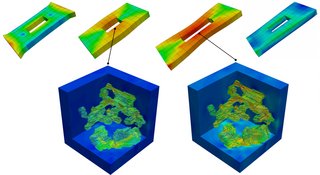
His primary fields include High-Performance Computing, Numerical Mathematics, Domain Decomposition Methods, Finite Element Methods, and Fluid-Structure Interaction. His work bridges theoretical numerical analysis with practical applications in biomechanics, materials science, and exascale computing. He actively explores the co-design of algorithms and solvers for next-generation supercomputers.
Research Trends from Publications:
The 15 most recent articles reveal a consistent focus on scalable domain decomposition methods (e.g., BDDC, FETI-DP), particularly for nonlinear and time-dependent problems in solid and fluid mechanics. There is a strong emphasis on parallel algorithms for exascale systems, with applications in hemodynamics, glacier modeling, and cardiac simulation. Recent work integrates machine learning into inverse problems, indicating a forward-looking research direction.
Scientific Awards and Recognition:
- h-index of 28 (Google Scholar), 16 (zbMATH)
- Active participation in DFG and BMBF-funded priority programs
- Leadership roles in major academic and computing infrastructures
Advising and Grants:
While no formal list of students is provided, his leadership in research projects such as SPP2311, SPP2256, and SCALEXA suggests extensive mentorship and collaboration. He has secured substantial grant funding from the DFG (e.g., EXASTEEL, Domain-Decomposition-Based FSI) and BMBF (SCALEXA, OERSax), reflecting national recognition of his research impact.
Labs and Teams:
As Scientific Director of the URZ, he leads the university's high-performance computing infrastructure. He is deeply involved in the Faculty’s Compute Cluster and collaborates with interdisciplinary teams in computational biomechanics and materials science. His work in the SPP2256 and SPP2311 consortia involves national and international research networks focused on variational modeling and cardiovascular simulation.