معرفی
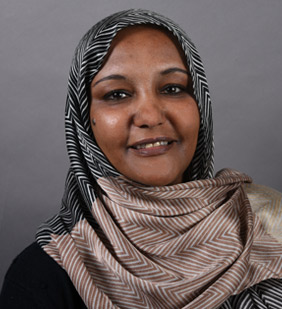
Nada Mustafa Ali serves as Senior Lecturer in the Women's, Gender, and Sexuality Studies Department within the College of Liberal Arts at the University of Massachusetts Boston, where she also directs the Human Rights Minor program. Her interdisciplinary work bridges comparative politics, feminist studies, development studies, and African/Middle Eastern studies through both academic scholarship and practical human rights advocacy.
Her educational foundation includes:
- PhD in Government (Development Studies Stream) from the University of Manchester, UK
- MA in Political Science from the American University in Cairo, Egypt
- BA (Honors) in Political Science from the University of Khartoum, Sudan
Dr. Ali's research centers on gender dynamics in post-conflict settings, with special focus on Sudan and South Sudan. She examines how militarization affects women's rights, analyzes HIV/AIDS through gendered lenses, and explores feminist methodologies across the Middle East and Africa. Her current projects investigate gendered peacebuilding processes, social media's role in feminist movements, and intersectional human rights frameworks.
Her recent publications reveal consistent engagement with African feminist thought, digital activism, and exile politics. Key themes include women's mobilization through platforms like Facebook during Sudan's civil disobedience movements, theoretical intersections of gender and human rights, and critical analyses of national belonging in diaspora communities.
Her scholarly recognition includes:
- Fellow of the Rift Valley Institute
Dr. Ali maintains dual academic-practitioner roles through extensive teaching across UMass Boston's departments and her advisory position with the African Feminist Initiative. Her professional trajectory demonstrates significant grant-funded work through UN agency consultancies (UN Women, UNDP, UNFPA) and policy engagement with organizations like Human Rights Watch and the US Institute of Peace. She has developed curricula spanning human rights education to gender in global health contexts.
Her institutional involvement extends to research networks including the Five College Women's Studies Research Center and the International Centre for Research on Women, while her fieldwork connects with grassroots organizations like the South Sudan Women's Empowerment Network.