معرفی
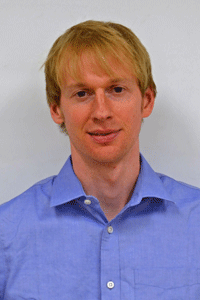
Michael Kelly is an Assistant Professor of Mathematics at Transylvania University, specializing in mathematical biology and interdisciplinary applications. His work bridges mathematics with ecology, epidemiology, and economics. He actively engages undergraduates in research projects, such as modeling media spread for advertisers and optimal control strategies for invasive species. Kelly holds a B.A. in Mathematics from Franklin and Marshall College (2008) and a Ph.D. in Mathematical Ecology from the University of Tennessee, Knoxville (2014). His teaching includes courses like Mathematical Modeling, Differential Equations, and Applied Statistics. His research focuses on applying mathematical models to real-world challenges in infectious disease prevention, invasive species eradication, and sustainable resource management.
Education
- B.A. Mathematics, Franklin and Marshall College, 2008
- Ph.D. Mathematics with concentration in Mathematical Ecology, University of Tennessee, Knoxville, 2014
Research Interests
Kelly's work emphasizes the practical application of mathematics to ecological and public health challenges. He develops models to address issues such as optimal fish harvesting strategies, cholera transmission dynamics, and habitat conservation. His research often involves collaboration across disciplines, leveraging tools like optimal control theory and partial differential equations to propose actionable solutions.
Publication Trends
His publications span topics in mathematical ecology, epidemiology, and resource management. Recent works focus on spatial dynamics of diseases, invasive species control via genetic strategies (e.g., Trojan Y Chromosome), and sustainable harvesting practices. These studies highlight his commitment to translating mathematical insights into real-world policy and management frameworks.
Grants & Advising
While specific funding details are not provided, Kelly mentors students on applied projects such as modeling media diffusion for advertisers. He emphasizes hands-on research opportunities for undergraduates, blending theoretical mathematics with tangible societal applications.