معرفی
Dr. Meagan Elinski serves as Assistant Professor of Chemistry at Hope College, where she joined the faculty in 2020. Her research program investigates chemical-mechanical mechanisms at sliding interfaces, bridging chemistry, materials science, and engineering to address challenges in energy conservation and biomedical applications.
Education:
- Postdoctoral Fellow, University of Pennsylvania (2018–2020)
- Ph.D. in Chemistry, Texas A&M University (2018)
- B.S. in Chemistry, Hope College (2013)
Her expertise centers on structure-function relationships at surfaces and interfaces, with specialization in tribology (friction, adhesion, lubrication, and wear), nanotribology, tribochemistry, and surface analysis techniques including AFM, ATR-FTIR, and SEM/EDS. Current research explores competing surface reactions, multifunctional tribofilms, and the impact of drug-delivery nanomaterials on joint sliding for cartilage repair applications. This interdisciplinary work spans biomaterials development and mechanochemical phenomena in biological systems.
Scientific Awards:
- Phi Beta Kappa (2013)
- Texas A&M U.S. Senator Phil Gramm Doctoral Fellowship (2017)
- Postdoctoral Academic Diversity Fellowship, University of Pennsylvania (2018)
- Hope College 10 Under 10 Award (2020)
- Towsley Research Scholars Program Finalist (2023)
- Cottrell Scholar Award, Research Corporation for Science Advancement (2024)
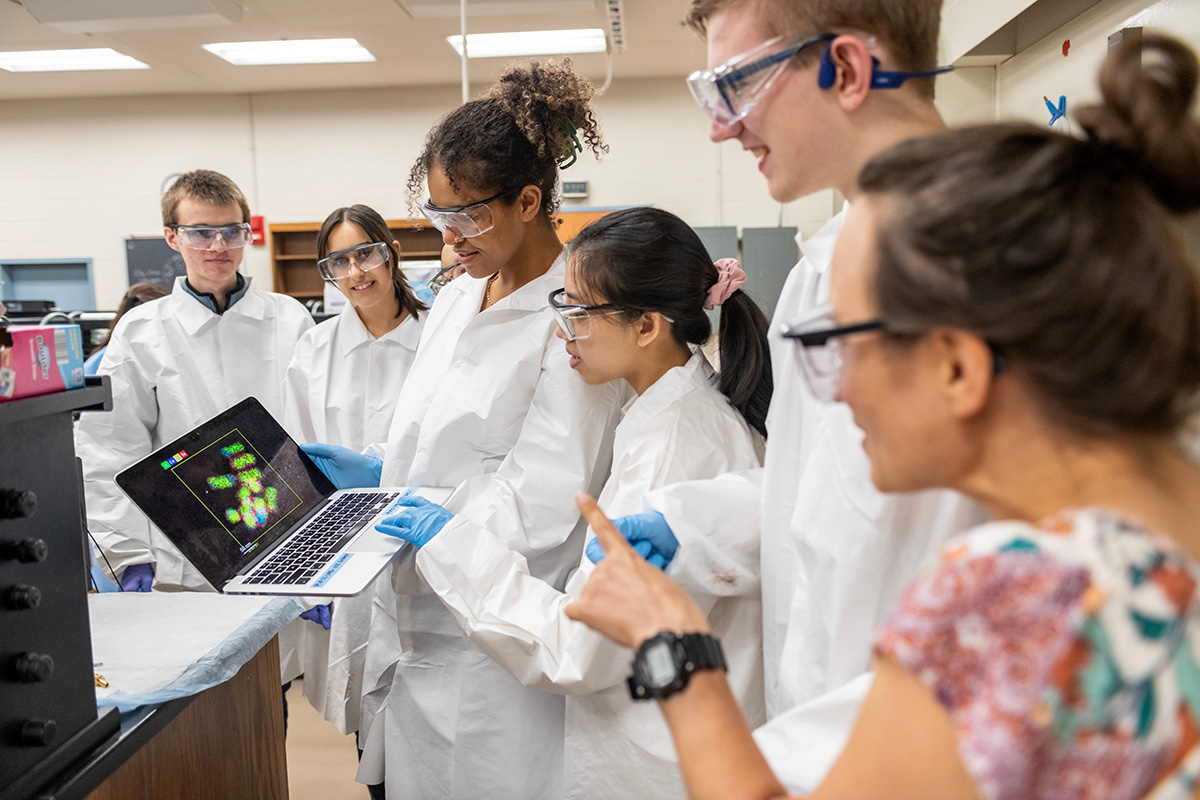
Dr. Elinski directs the Elinski Research Group, which operates advanced instrumentation including Bruker Dimension Icon AFM, HORIBA Xplora Plus confocal Raman microspectroscopy, TA Instruments DHR 20 tribo-rheometer, SEM, and FTIR systems. She secures competitive research funding through awards like the Cottrell Scholar grant and Towsley Research Scholars Program, focusing on nanomaterials for biomedical applications. Her lab actively mentors undergraduate researchers through the Primarily Undergraduate Nanomaterials Cooperative (PUNC) network.
The Elinski Lab (elinskilab.org) maintains strong industry and academic collaborations through PUNC, advancing surface science research with emphasis on translating fundamental discoveries into solutions for joint health and energy-efficient technologies.