معرفی
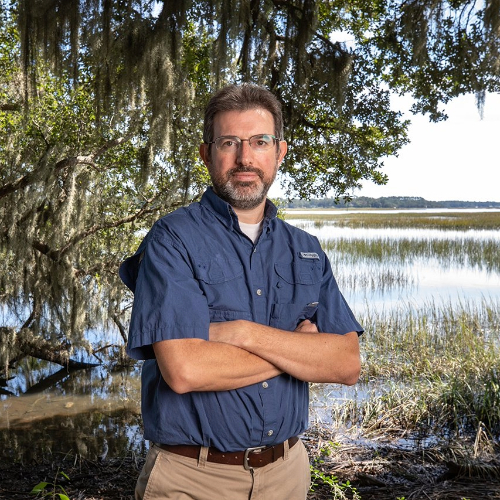
Matt Rutter is a Professor and Academic Director of Stono Preserve Education at the College of Charleston, specializing in evolutionary genomics and plant ecology using Arabidopsis thaliana as a primary model system. His work bridges theoretical evolutionary biology with empirical ecological studies.
Education:
- Ph.D. from Duke University
- A.B. from Harvard University
Rutter's research centers on mutation-driven evolutionary processes in ecological contexts, with emphasis on mutation bias, fitness effects, and genetic redundancy in plant systems. His unPAK project (undergraduates Phenotyping Arabidopsis knockouts) has pioneered large-scale phenotyping of single-gene mutants, revealing fundamental insights into how genetic variation manifests in natural environments. He actively investigates transposable elements, cadmium tolerance mechanisms, and genome evolution dynamics.
His publication record shows consistent focus on experimental evolution and plant genomics, with recent work demonstrating how mutation spectra interact with natural selection. Key trends include high-resolution analysis of spontaneous mutations, phenotypic consequences of gene knockouts, and ecological adaptations in metal-contaminated environments.
Scientific Awards:
- William V. Moore Distinguished Teacher-Scholar Award (2022)
- Gordon E. Jones Distinguished Achievement Award (2022)
- Michael J. Auerbach Award for Excellence in Student Research Mentorship (2020)
Rutter mentors undergraduate researchers through Stono Preserve Education and the unPAK project, developing innovative remote research experiences that earned him national recognition. His educational leadership extends to teaching core courses in biodiversity, genetics, evolution, and environmental biology, with emphasis on experiential learning.
As Academic Director of Stono Preserve Education, Rutter leads field-based environmental research initiatives. His laboratory in the Rita Hollings Science Center (Room 290) coordinates the distributed unPAK phenomics network, engaging multiple institutions in systematic mutant characterization while training next-generation plant scientists.