معرفی
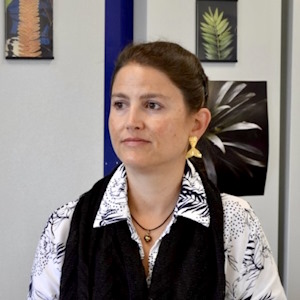
María Natalia Umaña is an Associate Professor in the Department of Ecology and Evolutionary Biology at the University of Michigan's College of Literature, Science, and the Arts. Her research focuses on understanding ecological mechanisms in species-rich forest ecosystems across the globe.
Education:
- Ph.D. in Biological Sciences from University of Maryland, College Park
- M.S. from Universidad de Los Andes, Colombia
- B.S. from Universidad de Los Andes, Colombia
Dr. Umaña's research addresses fundamental questions in ecology about how plant species coexist while utilizing limited common resources (light, water, and soil nutrients). Her work is particularly focused on the challenges of understanding species coexistence in tropical forests, which contain disproportionate numbers of species given their relatively narrow range of environmental conditions. The Umaña Lab integrates performance information (growth and survival) with species and individual-level trait data to understand organism-environment interactions. Her research spans tropical forests from Asia and the Americas as well as temperate forests from the USA.
Her recent publication in Ecology demonstrates how stage-specific leaf traits reflect different strategies over plant ontogeny and substantially improve predictability of survival models in tropical forests. This work shows that trait-survival relationships vary across life stages, with conservative traits leading to higher survival rates, and stage-specific traits being better predictors of corresponding stage-specific survival.
Advising and Research Team:
- Graduate Students: Sam Schaffer-Morrison (PhD), Tomas Fuentes-Rohwer, Minh Chau N. Ho (PhD, co-advisor)
- Postdoctoral Researchers: Tsun Fung Au (Tom), Andrés González-Melo, Peter Williams
The Umaña Lab maintains active research programs in both tropical and temperate forest ecosystems, with field sites across Asia, the Americas, and the United States.