معرفی
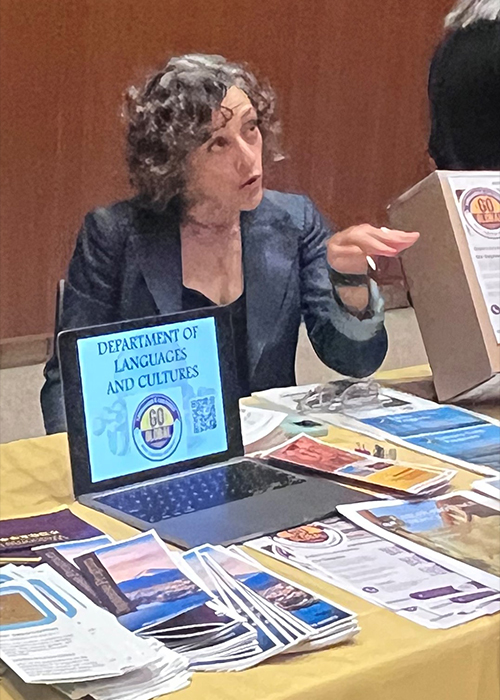
Maria Van Liew is a Professor of Spanish Cultural Studies, Film, and Literary Narrative at the Department of Languages and Cultures, West Chester University of Pennsylvania (WCU). She joined WCU in 1998, contributing to the department's evolution from its original 'Foreign Languages' focus to a broader emphasis on global cultural engagement. Her academic leadership includes co-editing books and special journal issues, such as the 2020 Moderna Språk special issue on transnational cultural difference and the 2012 Fotogramas para la multiculturalidad volume on immigration in Spanish cinema.
Van Liew holds a B.A. from Clark University and M.A./Ph.D. degrees from the University of California at San Diego. Her dissertation, Democratic Women: Gender, National Discourse and the Cinema of Post-Franco Spain, laid the foundation for her research on gender, migration, and national identity in Spanish cultural narratives. She regularly teaches courses in comparative cultural studies, Spanish literature, and film, emphasizing transnational and transcultural methodologies.
Her research interests center on Hispanic Cultural Studies, with particular attention to Spanish youth culture, Catalan rock music, and the intersection of horror cinema with ecological and political themes. She has explored the role of Catalan language in national identity through studies of bands like Els Pets and narratives of post-dictatorial Barcelona. Her work challenges traditional binaries in cultural representation, advocating for solidarity across borders through transnational perspectives.
Van Liew has created Study Abroad programs in Guadalajara, Mexico, and Barcelona, Spain, to foster student engagement with global cultures. Collaborative efforts include co-editing with Mónica Cantero-Espojo and mentoring graduate students in distance education studies. Her recent scholarship critiques the porosity of national boundaries in contemporary horror films and the pan-national influences of punk culture in literature and cinema.
In 2021, she transitioned to virtual teaching methods, reflecting her adaptability to evolving academic demands. Her contributions to cultural studies highlight the transformative potential of art and media in redefining national and transnational identities, particularly through marginalized voices and postcolonial frameworks.