معرفی
Lizabeth Romanski, Ph.D., is a Professor in the Department of Neuroscience, Biomedical Engineering, and the Center for Visual Science at the University of Rochester School of Medicine and Dentistry. Her research focuses on neural mechanisms underlying social communication, particularly how the primate prefrontal cortex integrates auditory and visual information (e.g., faces and vocalizations). She investigates multisensory processing, working memory, and the neural basis of communication deficits in autism spectrum disorders. Romanski leads the Romanski Lab, which uses neurophysiological and anatomical approaches in non-human primates to study these phenomena.
Education
- PhD, Neurobiology, Cornell University Medical College (1992)
- BA, Psychology, Rutgers State University (1984)
Research Interests
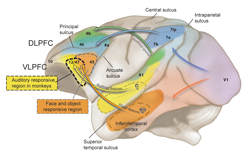
Romanski's work examines how the ventral prefrontal cortex encodes identity, emotional expression, and congruency in face-vocalization pairs. Her lab studies neuronal responses to mismatched stimuli and temporal offsets, as well as the role of prefrontal-auditory cortex connections in sensory integration. Collaborations with autism researchers explore deficits in audiovisual processing.
Recent Publications Trends
Her recent articles (2021–2024) emphasize neuronal population coding of identity, multisensory interactions in perception/memory, and novel imaging techniques like infrared neural stimulation. Key themes include primate prefrontal cortex function, audiovisual integration deficits, and evolutionary links to speech.
Awards
- Excellence in Medical Research Incentive Award (2006)
- Whitehall Foundation Research Award (2000)
- Cure Autism Now Young Investigator Award (1998–2000)
Advising & Grants
Romanski has mentored students like Bethany Plakke (Kansas State University), Keshov Sharma (MSTP at URMC), and Magdalena Diehl Faryna. Her lab receives funding for projects on audiovisual mnemonic processing, prefrontal connectivity, and autism-related sensory integration.
Labs/Teams
Her lab collaborates with URMC neuroscience groups and uses advanced techniques such as single-unit recordings and fMRI to map neural circuits. Ongoing projects include studying face-vocalization integration mechanisms and prefrontal-auditory pathway anatomy.