معرفی
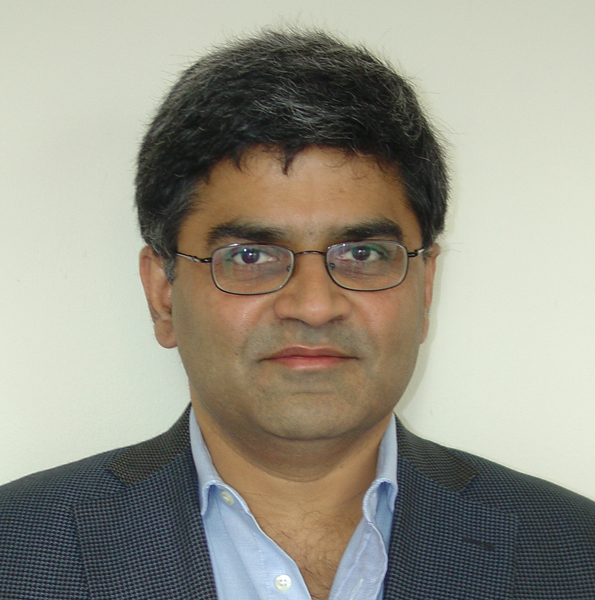
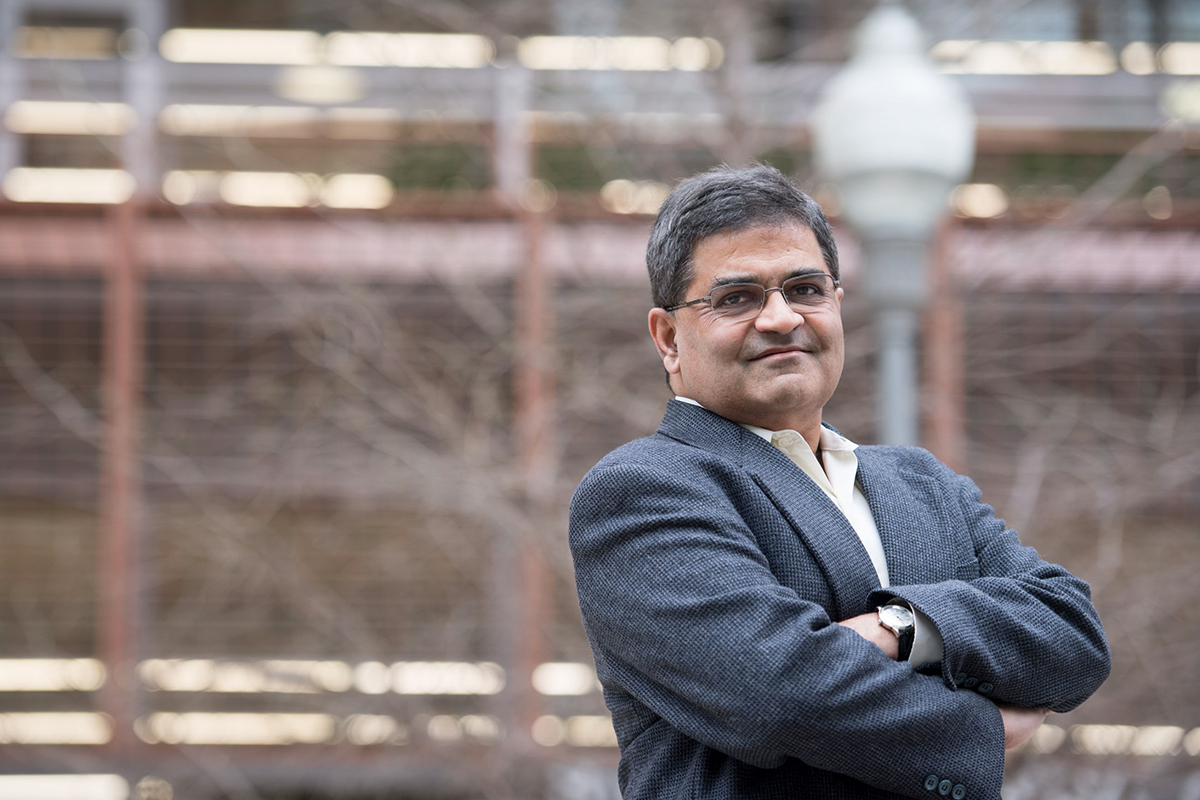
Keshav Pingali is a Professor and holds the W.A. 'Tex' Moncrief Chair of Grid and Distributed Computing in the Department of Computer Science at the University of Texas, Austin. He also holds a professorship at the Institute for Computational Engineering and Sciences at UT Austin.
His educational background includes:
- B.Tech. from Indian Institute of Technology, Kanpur, India
- S.M. in Electrical Engineering from Massachusetts Institute of Technology
- ScD from Massachusetts Institute of Technology
Dr. Pingali's research focuses on programming languages and compiler technology for program understanding, optimization, and parallelization. His current work centers on methodologies and tools for programming multicore processors, with particular emphasis on irregular applications from domains including graphics, social networks, and data mining. His research bridges the gap between theoretical computer science and practical high-performance computing systems, developing novel approaches to extract parallelism from complex applications.
His publication record shows a consistent focus on parallel computing challenges, particularly in handling irregular applications that don't fit traditional parallel programming models. His work has evolved from foundational theoretical approaches to practical systems like Elixir that synthesize parallel graph programs, addressing the growing importance of graph-based computation in modern applications.
His significant recognition includes:
- ACM SIGPLAN Programming Languages Achievement Award (2024)
- ACM/IEEE CS Ken Kennedy Award (2023)
- IEEE CS Charles Babbage Award (2023)
- Foreign Member of Academia Europaea (2020)
- Fellow of ACM, IEEE, and AAAS
Dr. Pingali has advised PhD students including Lain Mustafaoglu, with whom he co-authored research on evolutionary policy optimization. His service to the academic community includes chairing the PPoPP steering committee (2003-2013), serving as program chair for PLDI 2014, and editorial roles for prestigious journals including ACM TOPLAS. He has received multiple teaching awards throughout his career and continues to teach advanced courses including 'Foundations of Machine Learning for Systems Researchers' in Fall 2025.
His research group at the Institute for Computational Engineering and Sciences focuses on developing programming models and compiler technologies that enable efficient parallel execution of complex applications, particularly those with irregular structures that challenge conventional parallel programming approaches.