Jeremy Sanders
پژوهشگر · high-energy astrophysics
Max Planck Institute for Extraterrestrial Physicsمعرفی
Dr. Jeremy Sanders is a Researcher at the Max Planck Institute for Extraterrestrial Physics (MPE) in Garching, Germany, working within the High Energy Astrophysics Group. His research focuses on high-energy astrophysics, particularly the study of galaxy clusters and their X-ray emissions. Prior to his position at MPE, he was a postdoctoral researcher at the Institute of Astronomy, University of Cambridge.
Dr. Sanders' primary research interests include the dynamics of the intracluster medium (ICM), AGN feedback mechanisms, and the thermal properties of galaxy clusters. His work involves analyzing data from X-ray observatories such as Chandra and XMM-Newton to understand complex physical processes in galaxy clusters, with particular focus on how supermassive black holes interact with their surrounding environments in cluster cores. He has made significant contributions to our understanding of sound waves in galaxy clusters, the behavior of cool gas in cluster cores, and the role of AGN in regulating cluster evolution.
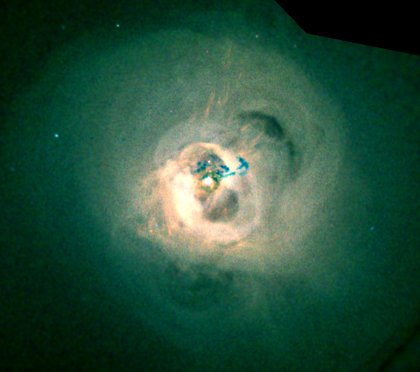
His publications demonstrate consistent expertise in high-energy astrophysics phenomena, with recent work examining turbulent energy propagation, cold fronts in the Perseus cluster, and molecular gas dynamics in cluster environments. Dr. Sanders has developed several software tools for X-ray data analysis, including Veusz (a scientific plotting package), contour binning algorithms, and adaptive binning algorithms, which have been widely adopted by the X-ray astronomy community.
His research on the Perseus cluster has revealed ripple-like structures corresponding to density variations in the hot gas, believed to be very low-frequency sound waves generated by the central black hole. He has also extensively studied radio bubbles emitted by black holes that create cavities in the X-ray emitting gas, providing crucial insights into the energy transfer mechanisms between AGN and the intracluster medium.