معرفی
Greg Asner is a Professor and Director of the Center for Global Discovery and Conservation Science at Arizona State University (ASU). He holds primary affiliation with the School of Ocean Futures and secondary affiliation with the School of Geographical Sciences and Urban Planning. Asner is a renowned ecologist specializing in large-scale ecosystem analysis using advanced remote sensing technologies. His work focuses on land and ocean conservation, climate science, and biodiversity preservation. He leads the Global Airborne Observatory (GAO), which employs cutting-edge airborne and satellite imaging to map forests, coral reefs, and carbon stocks globally.
Education: B.S. in Engineering (Radiative Physics), University of Colorado Boulder (1991); M.S. in Geography (1995); Ph.D. in Biology (1997). His career includes naval deep-sea diving, early work with The Nature Conservancy, and leadership at the Carnegie Institution for Science before joining ASU in 2019.
Research Interests: Remote sensing innovations, conservation policy, coral reef health, forest carbon dynamics, and climate change mitigation. He has pioneered technologies like CLAS/CLASlite for deforestation monitoring and AToMS for canopy species mapping. His efforts have influenced conservation policies in Peru, Panama, Colombia, and Hawaii, including guiding protected area design and carbon financing strategies.
Awards: Member of the U.S. National Academy of Sciences, 2017 Heinz Award for Sustainability, Presidential Early Career Award (2000), and multiple fellowships. He has published over 200 scientific articles and collaborates with governments, NGOs, and international bodies like NASA and the United Nations.
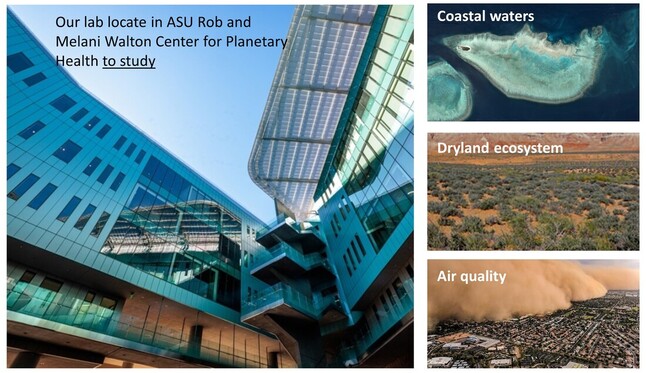
Current Projects: Allen Coral Atlas (global reef mapping), Carbon Mapper (methane and CO₂ tracking), and ridge-to-reef conservation in Hawaii. His lab employs advanced AI and spectral techniques to address biodiversity loss and climate challenges.