معرفی
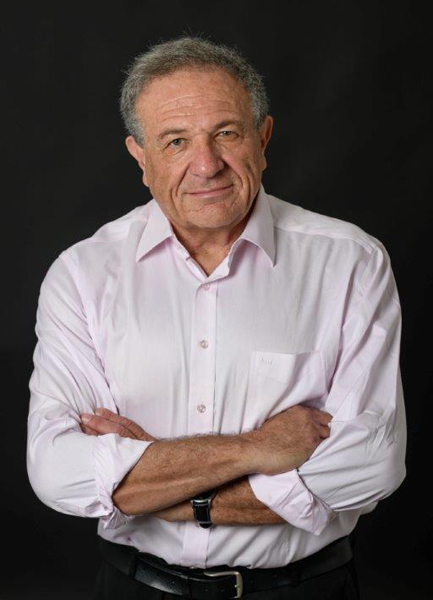
Prof. Gershon Kurizki is a Professor holding the Theoretical Quantum Optics Chair in the Chemical & Biological Physics Department at the Weizmann Institute of Science (WIS) in Israel since 1997. He also served as a Visiting Professor at Shanghai University's Center for Artificial Quantum Intelligence from 2017 to 2022.
Prof. Kurizki is one of the theoretical pioneers of quantum open-system control and thermodynamics. His research focuses on:
- Quantum optical solitons
- Coherent control in semiconductors
- Quantum measurements for state engineering
- Superluminal light propagation
- Control of quantum thermodynamics
- Control of open quantum systems and decoherence
- Engineering of quantum field-matter interactions and dispersion forces in confined media
Prof. Kurizki's work has led to significant breakthroughs including the discovery of the Anti-Zeno Effect, which represents relaxation and decoherence speedup by measurements or coherent operations. His research has revealed the impact of Zeno and anti-Zeno relaxation control on heating and cooling in quantum thermodynamics, challenged the unattainability of absolute zero in quantum systems, and demonstrated the possibility to engineer ultra-long-range quantum interactions.
His major publications include the authoritative book "Thermodynamics and Control of Open Quantum Systems" (Cambridge University Press, 2022) and the popular science book "The Quantum Matrix" (Oxford University Press, 2020).
Prof. Kurizki has received numerous prestigious awards for his work:
- 2009: The Humboldt-Meitner Award, Germany
- 2008: The Lamb Award in Laser Physics and Quantum Optics, USA
- 2004: Elected Fellow, British Institute of Physics
- 2002: Elected Fellow, American Physical Society
- 1999: Elected Fellow, Optical Society of America
Throughout his career, Prof. Kurizki has made seminal contributions to quantum optics and quantum information science. His work on the Anti-Zeno Effect has been particularly influential, opening new avenues for controlling quantum systems. He has also co-pioneered the concept of hybrid quantum systems, which has become key to quantum technological applications.