معرفی
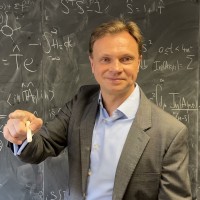
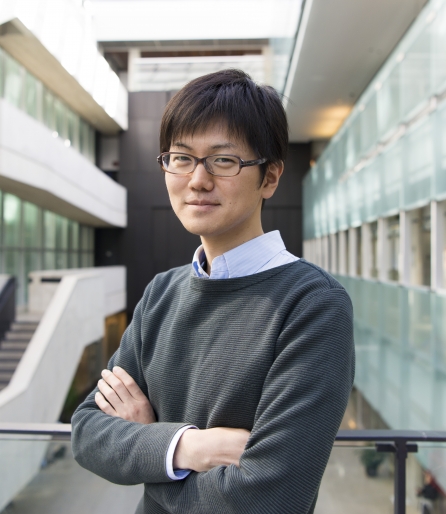
F.P. Schuller is a tenured Professor of Mathematics at the University of Twente, affiliated with the Faculty of Electrical Engineering, Mathematics and Computer Science (EEMCS), the Department of Applied Mathematics, and the Mathematical Systems Theory (EEMCS-AM-MAST) research group. He has held previous academic positions at the University of Erlangen, Max Planck Institute for Gravitational Physics, Nuclear Science Institute UNAM, and Perimeter Institute for Theoretical Physics.
- PhD in Applied Maths and Theoretical Physics, University of Cambridge (2000–2003)
- Master of Advanced Studies in Mathematics, University of Cambridge (1999–2000)
- BSc in Mathematics and Physics (double major), University of Kaiserslautern (1996–1999)
His research centers on mathematical physics, particularly the geometric and foundational aspects of gravity, general relativity, and theoretical physics. He is known for his contributions to the rigorous mathematical formulation of physical theories and has led educational initiatives such as the International Winter School on Gravity and Light. His work bridges deep theoretical inquiry with pedagogical innovation in advanced physics and mathematics.
While specific publications are not listed in the provided text, his academic trajectory and affiliations indicate sustained research in geometric methods, field theory, and mathematical structures in physics. His leadership in teaching and curriculum development is reflected in national and institutional teaching awards.
- National Teaching Prize (Ars Legendi) Germany – 2016
- University Teaching Prize, Friedrich Alexander University – 2016
- Departmental Teaching Prizes – 2013–2024
- Erice Original Work Award – 2003
- Smith-Knight and Rayleigh-Knight Prize, Cambridge – 2001
Schuller has advised students and contributed to academic training programs, particularly in mathematical physics and theoretical foundations. His involvement in the Applied Mathematics Talent Programme and media interviews reflect a commitment to education and public engagement. Though specific grants are not listed, his leadership roles and awards suggest sustained funding and institutional support for his teaching and research initiatives.
He is a key member of the Mathematical Systems Theory group at the University of Twente, contributing to research in mathematical modeling, geometric structures, and theoretical physics. His work is closely tied to interdisciplinary efforts within the Digital Society Institute, indicating engagement with broader scientific and societal applications of mathematical theory.