معرفی
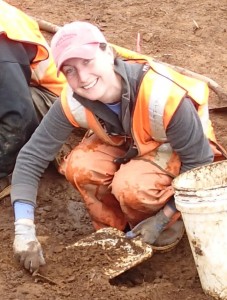
Emily Lena Jones is a Professor and UNM Regents' Lecturer in the Department of Anthropology at the University of New Mexico, where she has served since 2012. She directs the UNM Zooarchaeology Laboratory and coordinates the Master’s program in Public Archaeology. Her work bridges archaeological science and environmental studies through innovative zooarchaeological approaches.
Her educational background includes a BA from Vassar College (1996), MA (2001), and PhD (2004) from the University of Washington. Prior to UNM, she held faculty positions at Diné College and Utah State University following a postdoctoral fellowship at the University of Arizona.
Dr. Jones specializes in human-animal-environment interactions across temporal and geographic scales, with particular expertise in the Pleistocene-Holocene transition of Western Europe and post-Columbian Americas. Her research integrates traditional zooarchaeology with stable isotope analysis to examine domestication processes, colonization impacts, and long-term environmental change. Current projects investigate horse societies in the Americas, Columbian exchange effects in New Mexico, and refugia dynamics during Paleolithic transitions.
Her 15 most recent publications (2019-2022) reveal a consistent focus on zooarchaeological methodology and human-environment systems, with significant contributions to understanding animal domestication spectra, socio-ecological resilience, and cross-continental biogeographic shifts. Geographically, her work spans Southwestern US, Iberian Peninsula, and Southeast Asia, demonstrating exceptional interdisciplinary range.
- Weatherhead Resident Scholar (School for Advanced Research, 2024-2025)
Dr. Jones has mentored numerous doctoral students including William Taylor, Cyler Conrad, and Milena Carvalho, whose careers now span global institutions. Though currently unable to accept new graduate students, she maintains active research collaborations and has secured significant project funding for her investigations into historical biogeography and human adaptation. Her work frequently appears in high-impact journals like Antiquity and American Antiquity.
The UNM Zooarchaeology Laboratory under her direction houses comparative skeletal collections for Southwest US fauna, 3D scanners, and analytical equipment. Despite being closed for 2024-2025 academic year except by arrangement, it remains a vital resource for studying human-animal relationships through time.