
معرفی
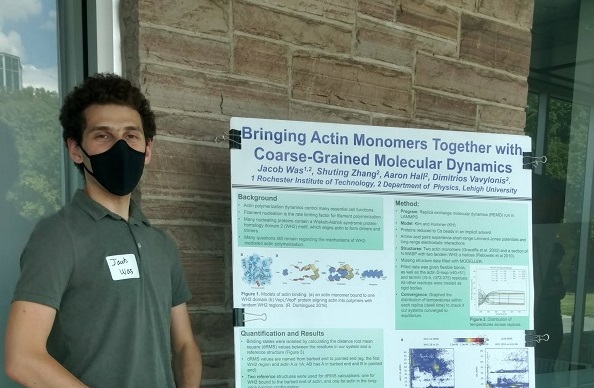
Dimitrios Vavylonis is a Professor of Physics at Lehigh University's College of Arts and Sciences, specializing in cellular biophysics. He is currently a Visiting Scholar at the Center for Computational Biology at the Flatiron Institute in New York, with previous visiting positions at the University of Lausanne, AMOLF (Amsterdam), and Kyoto University. His research is supported by NIH/NIGMS grants, and he serves on the editorial boards of Biophysical Journal, Cytoskeleton, and Scientific Reports.
- Bachelor's degree in Physics from the University of Athens
- Master's and Doctorate in Physics from Columbia University
- Postdoctoral work at Columbia's Department of Chemical Engineering and Yale's Department of Molecular, Cellular, and Developmental Biology
Vavylonis's research focuses on developing mathematical and computational models to understand the physical principles underlying cellular organization and function. His group investigates the actin cytoskeleton, cytokinesis (cell division), cell motion, cell polarization, and actin dynamics. They apply methods from statistical physics, soft matter physics, and nonlinear dynamics to biological processes such as the function of the actomyosin contractile ring during cytokinesis and cell polarization for motion, mating, and growth. Their work combines theoretical modeling with experimental collaborations to study how networks and bundles of actin filaments form subcellular structures with mechanical integrity that provide cells with shape, generate mechanical forces, and serve as tracks for motor proteins.
Analysis of Vavylonis's recent publications (2021-2024) reveals a continued focus on actin cytoskeleton dynamics, particularly in fission yeast models. His work explores contractile ring assembly during cytokinesis, cell polarization mechanisms, and the physical principles governing actin network organization. Key themes include the role of Cdc42 in cell polarity, force transmission through actin networks, molecular mechanisms of actin filament branching, and the interplay between membrane dynamics and cytoskeletal organization. His group increasingly employs advanced computational methods including coarse-grained molecular dynamics and discrete mechanical modeling to investigate these complex biological systems.
- Libsch Early Career Research Award
Vavylonis has mentored numerous PhD students, postdocs, and undergraduate researchers through programs like Research Experiences for Undergraduates (REU) and the Biosystems Dynamics Summer Institute (BDSI). His current research group includes Research Assistant Professor David Rutkowski and several PhD students. His lab has developed significant computational tools including SOAX, TSOAX, JFilament, Speckle TrackerJ, and LEAP for analyzing biopolymer networks and cellular dynamics. These software tools have become important resources for the cell biology community, enabling quantitative analysis of filamentous structures in biological images.
Vavylonis's laboratory operates as an interdisciplinary research team combining physics, biology, and computational science. The group develops mathematical models while collaborating closely with experimental biologists to test theoretical predictions. Their work spans from fundamental physical principles of cytoskeletal dynamics to specific biological processes in model organisms like fission yeast. The lab maintains strong international collaborations, particularly with groups in Switzerland, Japan, and the Netherlands, reflecting the global nature of modern biophysics research.
Dimitrios Vavylonis در جاهای دیگر
جستجوهای مرتبط
شاید اینها هم به کارتان بیاید
 Caroline LaplanteNorth Carolina State University · استادیار
- NNaomi CourtemancheUniversity of Minnesota Twin Cities · دانشیار
 William M BrieherUniversity of Illinois Urbana-Champaign · استاد
 Tatyana SvitkinaUniversity of Pennsylvania · استاد
 Maitreyi DasBoston College · دانشیار
- SSayed Iman MousaviYale University · پژوهشگر ارشد