معرفی
David Wallis is a researcher in the Department of Earth Sciences at the University of Cambridge, affiliated with the Cambridge NERC Doctoral Landscape Awards (C-CLEAR DTP) as a supervisor. His research focuses on high-temperature rock deformation across tectonic and human timescales, including post-seismic deformation and anthropogenic glacial isostatic adjustment. He utilizes laboratory experiments, fieldwork, microstructural analysis, and theoretical modeling to understand the rheological behavior of Earth materials.
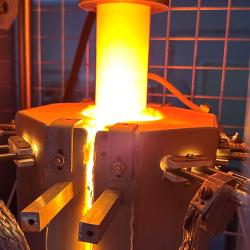
His research interests center on the microphysics of rock deformation, particularly transient creep in the lower crust and upper mantle. He investigates how stress changes from earthquakes or ice sheet melting affect viscosity evolution and microstructural development. His laboratory is equipped with a high-temperature creep apparatus (up to 1600°C) and an in-situ SEM deformation stage (up to 600°C), enabling direct observation of microstructural evolution during deformation. He specializes in high-angular resolution electron backscatter diffraction (HR-EBSD) to map residual stresses and geometrically necessary dislocations, linking experimental data with natural samples through fieldwork.
The recent publications reflect a strong focus on transient creep, dislocation dynamics in olivine, microstructural evolution in crustal rocks like marble and quartz, and the role of phase transformations and fluids in rock weakening. His work integrates experimental data with theoretical models to develop constitutive equations critical for simulating fault behavior and solid Earth-ice sheet interactions. He collaborates widely with leading rock deformation groups globally and encourages interdisciplinary project designs combining experiments, fieldwork, and modeling.
Scientific Awards:
Advising and Grants:
David Wallis is a supervisor within the C-CLEAR DTP, a NERC-funded doctoral training partnership, indicating active involvement in postgraduate research supervision and access to research funding. He supports projects across high-temperature rock deformation, promoting collaborative and multidisciplinary approaches. While specific grant details are not listed, his role in a major DTP confirms sustained research funding and mentoring responsibilities.
Labs and Teams:
He leads the Microgeodynamics Laboratory at Cambridge, equipped with advanced deformation apparatus and analytical tools. His research is conducted within the C-CLEAR DTP framework, involving collaboration with institutions such as the British Antarctic Survey and other departments within Cambridge, including Geography and Applied Mathematics. He is part of a global network of rock deformation researchers, fostering international scientific exchange.