معرفی
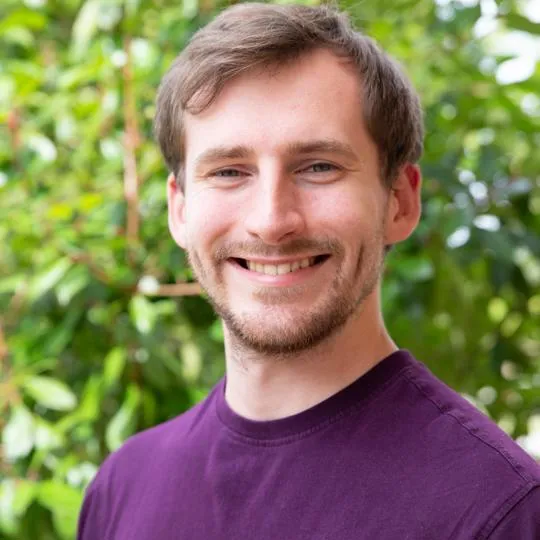
Daniel Platt is an Imperial College Research Fellow in Pure Mathematics at Imperial College London, based in the Huxley Building (room 608). His research bridges geometric analysis and machine learning, with affiliations to the geometry group and London Geometric Analysis Reading Seminar. He completed his PhD at Imperial under Jason Lotay (University of Oxford) and Sir Simon Donaldson, following prior postdoctoral work at King's College London under Richard Thomas and Toby Wiseman.
Platt's educational background includes:
- PhD in Mathematics from Imperial College London supervised by Jason Lotay and Sir Simon Donaldson
His research focuses on geometric structures in theoretical physics and machine learning. Key areas include G2/Spin(7) instantons, K3 surfaces, black hole uniqueness theorems, and group-invariant learning architectures. This interdisciplinary work combines differential geometry with computational methods to solve problems in mathematical physics and data science.
Platt's 13 publications (2020-2025) reveal a dual trajectory: geometric analysis dominates (8 papers on G2/Spin(7) geometry, K3 surfaces, and black holes), while machine learning contributions (3 papers) emphasize symmetry-preserving architectures. Collaborative work spans institutions including Oxford, King's College London, and international partners, with publications in Communications in Mathematical Physics and NeurIPS.
Scientific recognition:
- Imperial College Research Fellowship (prestigious competitive award)
Platt supervises undergraduate research projects (UROP) and master's theses (MSc, M2R, M3R, M4R), currently advising one MSc student for 2024-25. His research is fully funded by the Imperial College Research Fellowship, eliminating grant application requirements. Teaching includes the Complex Manifolds course with detailed online materials.
Platt actively participates in the geometry group at Imperial College London, collaborating with Richard Thomas, Toby Wiseman, and Anthea Monod. His research website hosts expository materials on differential geometry and machine learning for mathematicians, reflecting his commitment to interdisciplinary knowledge transfer.