معرفی
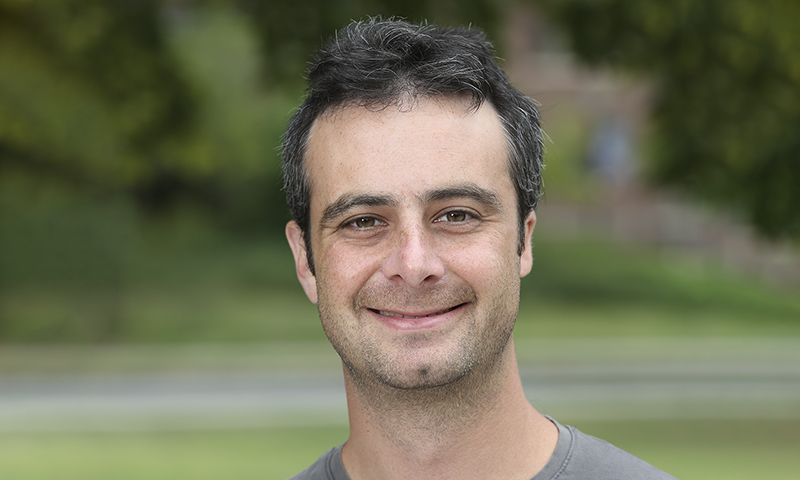
Daniel J. Graham is a Professor of Psychological Science at Hobart & William Smith Colleges, where he joined the faculty in 2012. His research bridges neuroscience, vision science, and aesthetics, with a particular focus on understanding brain function through computational approaches.
- Ph.D. in Psychology, Cornell University (2008)
- M.S. in Physics, Cornell University (2004)
- B.A. in Physics, Middlebury College (2001)
Graham's research centers on brain networks, vision, and neuroaesthetics. He investigates how neural systems process visual information efficiently, examining natural scenes, artistic representations, and aesthetic preferences. His work integrates computational modeling, behavioral experiments, and theoretical approaches to understand the principles of neural communication and visual processing. Graham argues that the brain operates similarly to internet networks, a theme he explores in his book An Internet in Your Head published by Columbia University Press (2021).
His publications from 2011-2025 reveal a consistent focus on network dynamics in the brain, efficient visual processing, and neuroaesthetics. Graham frequently collaborates with mathematicians like Yan Hao to model neural communication, while also exploring how statistical regularities in art relate to visual perception. His recent work examines affective responses to visual stimuli and develops AI-resistant problems for perception education.
- Outstanding Student Presentation Award (for student collaborators)
Graham actively mentors undergraduate students, with numerous publications featuring HWS student co-authors. His teaching portfolio includes Introduction to Psychology, Sensation and Perception, and advanced courses in visual perception. He collaborates extensively with colleagues across disciplines, particularly with mathematicians studying network communication in the brain. Graham maintains an active research program with continuous publications and conference presentations, including invited talks at major institutions like UC Berkeley.
His laboratory work focuses on computational modeling of brain networks and experimental studies of visual perception, with particular attention to how aesthetic preferences emerge from neural processing mechanisms.