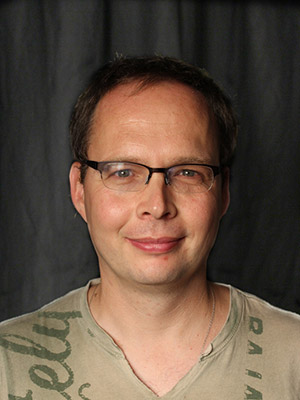
Colin Klaus
پژوهشگر ارشد · Parabolic partial differential equations
Ohio State Universityمعرفی
Colin Klaus is a Postdoctoral Research Fellow at The Mathematical Biosciences Institute (MBI) at The Ohio State University, where he applies advanced mathematical techniques to biological problems, particularly in protein dynamics and visual transduction.
He received his PhD in Mathematics from Vanderbilt University in 2017 under the supervision of Emmanuele DiBenedetto. His doctoral research focused on interior regularity of parabolic partial differential equations of p-Laplacian type and parabolic variational formulations of the total variation flow.
Klaus's research program bridges theoretical mathematics with practical biological applications. His primary interests include:
- Parabolic partial differential equations and their applications
- Multi-scale modeling techniques including homogenization and concentrated capacity
- Finite element methods for biological systems
- Protein diffusion modeling in cell membranes
- Visual and hearing transduction mechanisms
- Bayesian inference and Markov Chain Monte Carlo for uncertainty quantification
His recent publications demonstrate a strong interdisciplinary approach, combining rigorous mathematical theory with biological insight. Klaus has developed novel modeling frameworks that significantly reduce computational complexity while maintaining biological fidelity, such as his concentrated capacity model for protein-solvent interactions which transforms a 3D problem into an essentially 1D computational task.
His scientific contributions have been recognized with several awards:
- Invited Feature in SIAM DSWeb (2021)
- Bjarni Jonsson Prize for Excellence in Research (Vanderbilt Mathematics 2016-2017)
- BF Bryant Award for Excellence in Teaching (Vanderbilt Mathematics 2015-2016)
Klaus actively collaborates with experimental biologists across multiple institutions, including the Vanderbilt Pharmacology Department, Boston University School of Medicine, and the Sotomayor Research Lab at OSU. His work integrates mathematical theory with experimental data through statistical frameworks for global sensitivity analysis and parameter optimization.
He is a key contributor to the Sotomayor Research Lab's efforts in hearing transduction, where he develops innovative computational models that bridge molecular dynamics simulations with continuum approaches, enabling new insights into the biophysics of hearing.