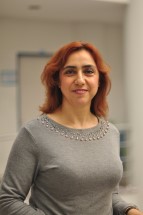
معرفی
Aysun Balkan serves as a Lecturer in the English Preparatory Division of Bogazici University's School of Foreign Languages, where she has been a faculty member since April 2011. She previously held administrative leadership positions including Assistant Director (2013-2014) and Director (2021-2022) of the School of Foreign Languages, demonstrating significant institutional commitment beyond classroom instruction.
Her academic credentials include:
- M.Sc. in Applied Linguistics from Georgetown University (2009)
- M.A. in Applied Linguistics/TESOL from Ohio University (2006)
- B.A. in Foreign Language Education from Bogazici University (2003)
Dr. Balkan's research centers on Second Language Acquisition with particular emphasis on crosslinguistic influence and language transfer phenomena between Turkish and English. Her cognitive semantics work investigates polysemy networks in spatial nouns, while her task-based language teaching research examines the differential impacts of explicit versus implicit corrective feedback on learner outcomes. This tripartite focus bridges theoretical linguistics with practical pedagogical applications.
Her publication history reveals dual engagement in scholarly research and professional service. The 2016 book chapter represents deep theoretical work on Turkish spatial semantics, while the 2009 newsletter articles document her organizational contributions to graduate student development within the applied linguistics community. Collectively, these works demonstrate consistent integration of cognitive linguistic theory with classroom practice.
No scientific awards or major research prizes were documented in the provided materials.
While the text confirms her leadership in conference organization (notably the 2009 AAAL Annual Conference) and administrative roles within the School of Foreign Languages, it contains no records of grant funding or formal student advisement. Her professional impact appears channeled through institutional service and curriculum development rather than traditional research mentoring.
Though no dedicated research laboratory is mentioned, her collaborative work with scholars like Elizabeth Kissling on conference programming and graduate student initiatives suggests participation in professional learning communities focused on applied linguistics education.