معرفی
Aurélie Calabrese is a Researcher and Co-Responsable of the Sens-Mouvement-Perception team at Université Côte d'Azur, affiliated with Inria Sophia Antipolis - Méditerranée. Her work bridges fundamental and applied research in visual neuroscience with strong clinical applications for visually impaired individuals.
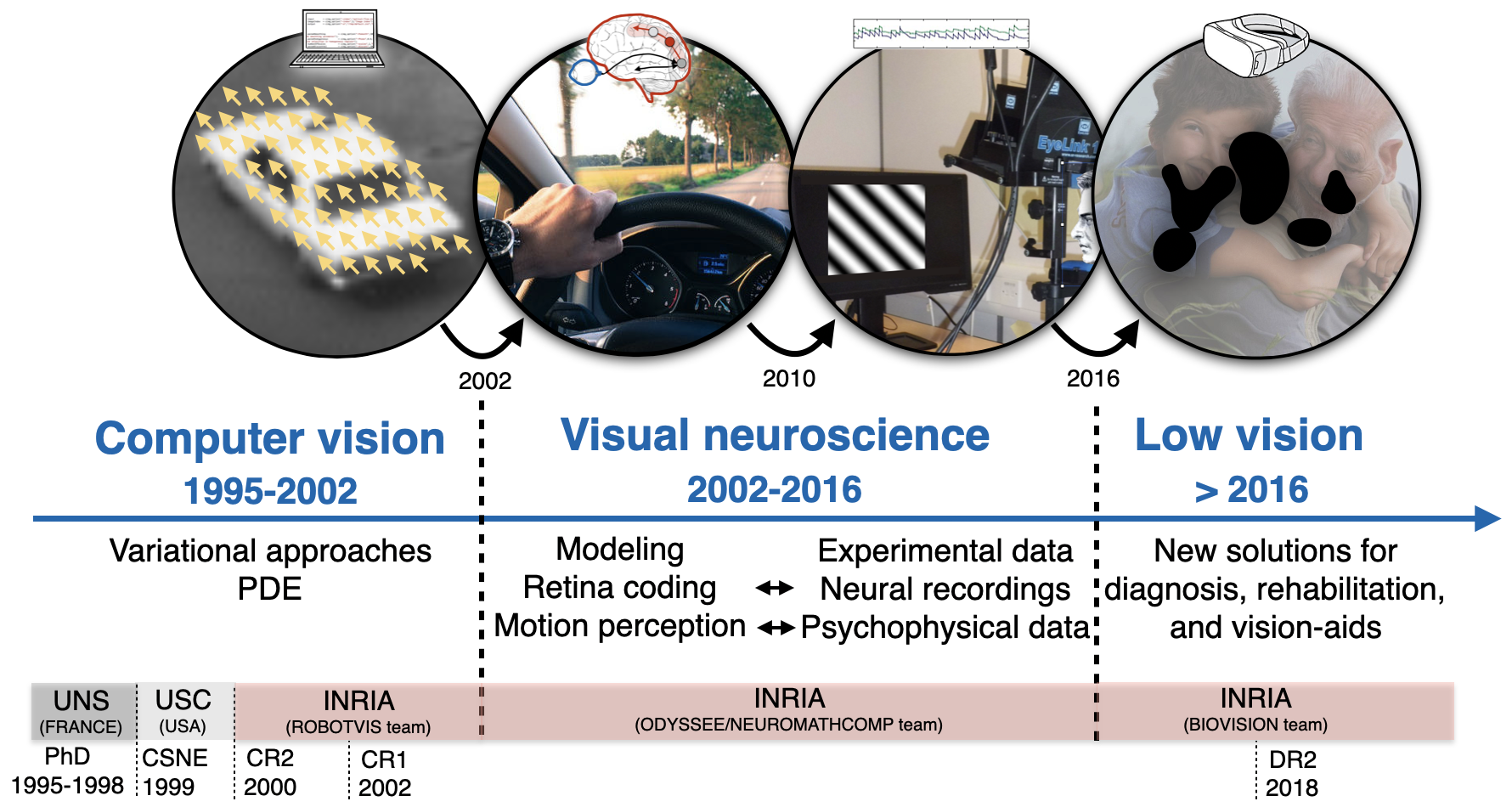
Her research interests focus on understanding how eye disorders affect visual information processing and brain plasticity across the lifespan. She investigates interactions between low-level visual impairments and higher-level perceptual functions using psychophysics, eye tracking, fMRI, computational linguistics, and modeling. Key areas include visual plasticity mechanisms, factors limiting visual performance in impaired vision, and developing rehabilitative methods to improve quality of life for visually impaired individuals, particularly regarding written communication.
Analysis of her recent publications reveals a strong interdisciplinary trajectory combining vision science with computational approaches. Her work increasingly integrates artificial intelligence and constrained text generation techniques to address reading challenges in low vision. The research shows progression from fundamental studies of eye movements in macular disease toward practical applications in virtual reality environments and adaptive reading technologies, with growing emphasis on accessibility solutions for real-world reading tasks.
As Co-Responsable of the Sens-Mouvement-Perception team, Calabrese leads collaborative research involving cognitive scientists, computer scientists, and clinicians. Her work receives support through institutional affiliations with Inria and Université Côte d'Azur, with publications spanning ophthalmology journals, vision science publications, and computer science conferences, demonstrating the translational nature of her research program.
Her laboratory work focuses on developing innovative methods for assessing and improving reading performance in visually impaired populations, particularly those with central field loss. Current projects include virtual reality toolboxes for accessible news reading, automated text simplification techniques, and novel approaches to estimate fovea position in maculopathies, all aimed at creating practical solutions for maintaining functional vision and literacy.