معرفی
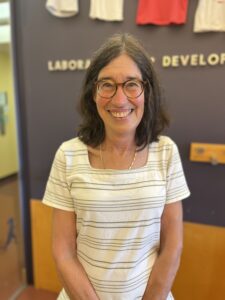
Anna Shusterman is a Professor in the Psychology Department at Wesleyan University, where she has taught and directed research in the Cognitive Development Laboratories since 2007. She co-founded and serves as co-chair of Wesleyan's College of Education Studies, established in 2020.
Her educational background includes:
- Bachelor's degree in Neuroscience from Brown University
- Graduate studies and post-doctoral fellowship at Harvard University's Laboratory for Developmental Studies under Elizabeth Spelke and Susan Carey
Dr. Shusterman's research centers on conceptual development in children, with a focus on the interplay between language and cognition in spatial and numerical domains. She investigates how language shapes children's understanding of numbers and space, and develops methodological approaches for translating developmental science into practical preschool classroom applications. Her work explores how young children perceive and learn about the world through simple, engaging games.
Analysis of her recent publications (2019-2025) reveals consistent emphasis on numerical cognition, language acquisition, and spatial reasoning. Key themes include language's role in math development, early numeracy in diverse populations (particularly deaf and hard of hearing children), and implementation of research-based math activities in preschool settings. Her work demonstrates how language exposure in any modality supports numerical concept development and how grammatical structures influence number word acquisition.
Dr. Shusterman has secured significant research funding including NSF CAREER grants and collaborative research awards. She mentors undergraduate researchers in her laboratory and actively bridges academic research with practical educational applications through her work with the College of Education Studies.
She directs the Blue Lab within Wesleyan's Cognitive Development Laboratories, located in Judd Hall. The NSF-funded lab conducts studies with children under 12 from central Connecticut preschools, schools, and daycare centers, using fun games to investigate how children think about numbers, space, language, and social concepts.