معرفی
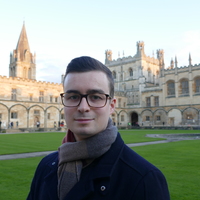
Andreas Schmid is a DPhil student in Medieval and Modern Languages at the University of Oxford and currently serves as a Research Associate at the Peter Szondi Institute for General and Comparative Literary Studies, Freie Universität Berlin. He holds a Master of Studies (MSt) in Modern Languages from Oxford and a BA in German Language and Literature, Political Science, and Philosophy from Universität Regensburg. His academic roles include Research Assistant positions at both the Peter Szondi Institute and Wadham College, Oxford, alongside prior teaching roles as a Non-Stipendiary Lecturer at Lincoln College & St. Hilda's College and a Graduate Tutor at Christ Church, Oxford.
His research focuses on the interplay between historical avant-garde movements and ethnological research, particularly examining photobooks and song anthologies as mediators of colonial-era 'world art' and 'world literature' concepts. He explores how media practices like formatting and scaling shaped cross-cultural encounters and redefined artistic boundaries. Central to his work is the critique of Eurocentric appropriation in literary modernism and the advocacy for provenance research to address colonial legacies in cultural materials.
Andreas has organized the exhibition “Literature as Colonial Loot? Provenance Histories 1910–2021” at the Freie Universität Berlin’s Philological Library, which interrogates the colonial origins of African oral literatures and their commodification in Western anthologies. His collaborative efforts include co-editing thematic foci on British German Studies during the World Wars and developing philological provenance methodologies with Irene Albers.
His publications span interdisciplinary topics such as the role of memoirs in Dada historiography, the intersection of avant-garde aesthetics and ethnological practices, and the analysis of colonial narratives in early 20th-century German literature. These works emphasize visual and textual media as sites of contested cultural exchange, challenging traditional boundaries between art, science, and colonialism.
In advising and teaching roles, he has contributed to academic essay writing instruction and supervision of graduate students, integrating his research expertise into pedagogical contexts. His work highlights the importance of rethinking modernist canons through postcolonial and decolonial frameworks, advocating for transparency in cultural heritage provenance.