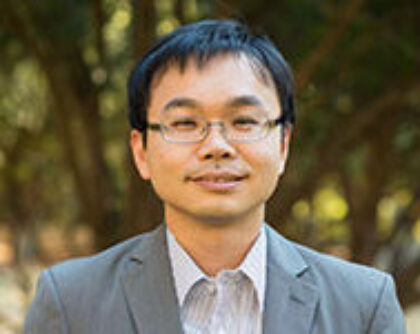
معرفی
Alfred H. Mueller is the Enrico Fermi Professor of Physics in the Department of Physics at Columbia University. He has established himself as a leading theoretical physicist specializing in high-energy nuclear and particle physics, particularly in Quantum Chromodynamics at high densities.
Dr. Mueller received his Ph.D. from MIT in 1965 and has maintained a distinguished career at Columbia University. His academic journey reflects deep commitment to advancing our understanding of fundamental particle interactions under extreme conditions.
Dr. Mueller's research focuses on the properties of QCD systems at very high density, which occur in high-energy heavy ion collisions and high-energy (small x) deep inelastic lepton-proton scattering. His specific interests include: the relationship between unitarity limits and parton density limits (saturation); maximal allowed occupation numbers for quarks and gluons in hadronic wavefunctions; first principles calculation of approach to equilibration using Boltzmann equations; the relationship between factorial divergence of the QCD perturbation series and high field strength configurations; and connections between saturation phenomena in QCD and reaction-diffusion processes in statistical physics.
Analysis of Dr. Mueller's publication record reveals a sustained focus on jet physics, diffractive processes, and saturation phenomena in QCD. His work bridges theoretical developments with experimental applications, particularly relevant for facilities like the Electron-Ion Collider. His research spans both perturbative and non-perturbative aspects of QCD, with significant contributions to understanding heavy ion collisions and deep inelastic scattering phenomena.
Dr. Mueller has established extensive collaborations with researchers worldwide, including Edmond Iancu, Dionysis N. Triantafyllopoulos, and Stéphane Munier. His work has been highly influential in shaping theoretical frameworks for high-density QCD systems.
While specific details about his mentoring activities are not explicitly documented in the available information, his extensive publication record spanning decades suggests active guidance of graduate students and postdoctoral researchers. His research program has likely been supported by major funding agencies in high-energy physics, contributing to Columbia University's strong presence in theoretical nuclear and particle physics.