معرفی
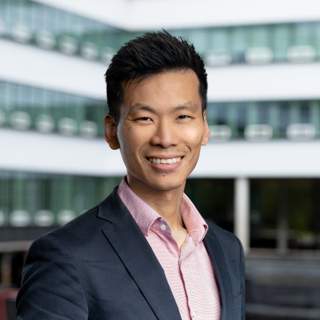
Albert Wong is an Associate Professor in Chemical Reaction Networks at the Department of Molecules and Materials, Faculty of Science and Technology, University of Twente, the Netherlands, where he leads research on out-of-equilibrium chemical systems and molecular intelligence. He progressed from Assistant Professor (2020–2024) to his current tenure-track position in 2024, building on postdoctoral work at Harvard University and a distinguished PhD at Radboud University.
Education
- PhD cum laude in Physical Organic Chemistry, Radboud University (2017), supervised by Prof. Wilhelm Huck
- MSc in Organic Chemistry, Radboud University (2013)
Research Focus: Dr. Wong investigates how chemical reaction networks (CRNs) govern living systems across scales, specializing in out-of-equilibrium dynamics, molecular self-organization, and origin of life chemistry. His CRN Lab bridges physical organic chemistry and nanofabrication to engineer programmable materials and chemical computing systems. Current work emphasizes sustainable applications through projects like RESPOND (smart coatings) and PRELIFE (interdisciplinary origin-of-life pathways).
Scientific Recognition
- Backer-KNCV Prize (2017) and IMM Best Thesis Award (2018) for groundbreaking PhD work
- NWO Rubicon (2018) enabling Harvard postdoc with Prof. Whitesides
- NWO Veni (2020) and Open Competition-M (2022) grants for CRN innovation
- Dutch Higher Education Award (2025) for educational leadership in CLEAR initiative
Research Leadership: As principal investigator, Dr. Wong secured €660k NWO Open Competition-M grant for higher-order CRN interactions and €178k TKI Green Chemistry grant for protein digestion modeling. He leads the €1.0M KIC RESPOND consortium (AkzoNobel, Wetsus, industry partners) and co-leads the €6.7M PRELIFE project. His Dutch Higher Education Award recognized team-based educational transformation in chemistry curricula.
Laboratory & Collaborations: The CRN Lab operates within Twente's Molecular Nanofabrication group, utilizing microfluidics and nanofabrication facilities. Dr. Wong maintains active collaborations with Harvard University (legacy from Rubicon grant), Radboud University (PRELIFE), University of Groningen (RESPOND), and industrial partners including AkzoNobel and n.able GmbH for sustainable chemistry applications.