معرفی
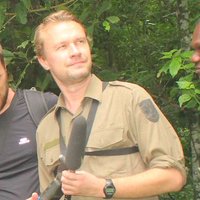
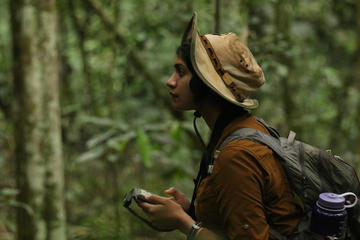
Adam Clark Arcadi is an Associate Professor in the Department of Anthropology at Cornell University's College of Arts and Sciences. His research centers on wild chimpanzee communication—both vocal (e.g., pant hoots) and percussive (e.g., buttress drumming)—and its implications for understanding social organization and language evolution. Fieldwork is primarily conducted in Kibale National Park, Uganda, with cross-site collaborations to study regional behavioral variations.
He earned his Ph.D. from the University of Michigan in 1991. His academic interests span
- Biological Anthropology
- Primate Behavioral Ecology and Conservation
- Human Evolution
- Chimpanzee Social Behavior
Arcadi's research integrates audiovisual analysis of chimpanzee communication to explore gait influences on drumming, lateralization in locomotion, nonlinear acoustics in vocalizations, and cultural transmission. His work bridges primatology with evolutionary linguistics, examining how gestural/vocal communication informs language origins. Key themes include individual distinctiveness, population-level variations, and socioecological drivers of behavior.
His publications trend shows sustained focus on chimpanzee communication mechanics (1993–2018), with increasing methodological sophistication in audiovisual analysis. Early work (1990s) established foundational patterns in pant hoots and drumming, while later studies (2000s–2010s) incorporated biomechanics, neuroethology, and cross-population comparisons. The 2018 book synthesizes decades of field research on chimpanzee social behavior.
As an educator, Arcadi teaches courses including Human Evolution: Genes, Behavior, and the Fossil Record (ANTHR 1300) and The Natural History of Chimpanzees and the Origins of Politics (ANTHR 2310) for Spring/Fall 2025. He supervises undergraduate/graduate independent studies (ANTHR 4910/7910) and honors theses (ANTHR 4983/4984), indicating active mentorship. Fieldwork in Uganda involves collaboration with international researchers, though specific grants are unmentioned.
His laboratory operations center on longitudinal field studies in Kibale National Park, with data collection spanning acoustic analysis, behavioral observation, and ecological monitoring. Current course schedules confirm ongoing academic engagement through 2025.