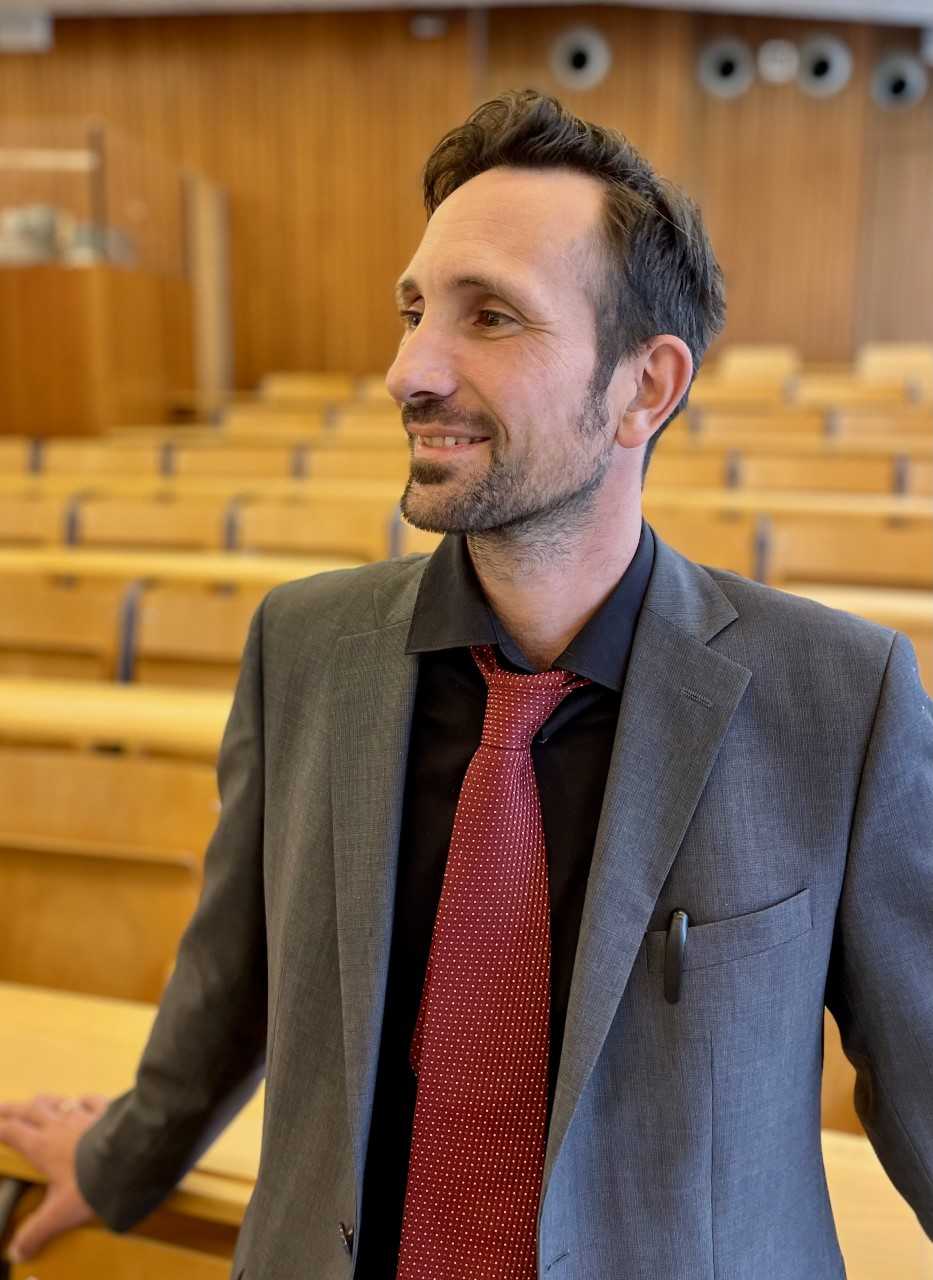
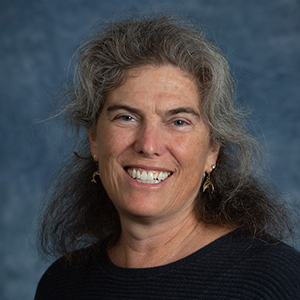
Lars Hanson is a Professor of Product Design Engineering at the University of Skövde's School of Engineering Science. His research focuses on ergonomics, digital human modeling, and optimizing manufacturing systems with a strong emphasis on human well-being and sustainable production. He leads projects like LITMUS (Industry 4.0 to 5.0 transition) and has contributed to developing tools such as IPS IMMA for ergonomic simulations. Active in virtual verification of human-robot collaboration and smart textile systems for workplace safety Published extensively in journals like International Journal of Human Factors Modelling and Simulation and IEEE Access Editor of conference proceedings and contributor to industry standards in automotive and healthcare sectors Research interests include multi-objective optimization of factory layouts, musculoskeletal risk assessment, and integrating ergonomic evaluations into product design processes. Current projects address Industry 5.0 sustainability challenges through digital twin technologies and smart manufacturing solutions.
Dr. Roy Lederman is an Assistant Professor at the Department of Statistics and Data Science , Yale University. He is affiliated with the Quantitative Biology Institute (QBio) , the Applied Math Program , the Institute for Foundations of Data Science (FDS) , and the Wu Tsai Institute (WTI) . He was awarded the Sloan Research Fellowship (2023) . He previously held a Gibbs Assistant Professorship at Yale (2014-2015) and a postdoc at Princeton University (2015-2018) . Education: PhD in Applied Mathematics, Yale University (2014); dual BSc in Physics and Electrical Engineering, Tel-Aviv University. Teaching: Courses include Computational Tools for Data Science, Signal Processing, and Mathematical Machine Learning. Research Areas: Dr. Lederman works at the intersection of computational biology , structural biology , Bayesian inference , numerical analysis , and machine learning . His recent work focuses on cryo-EM and hyper-molecules for studying molecular heterogeneity, alternating diffusion for common variable recovery, and Zernike polynomials for 3D imaging. He also develops Hamiltonian Monte Carlo methods and randomized DNA sequencing algorithms . Publications Trends: His publications (15 most recent) emphasize structural biology and cryo-EM applications, machine learning (Bayesian deep learning, diffusion maps), numerical analysis (Fourier/Laplace transforms), and computational biology (DNA sequencing algorithms). Key sub-fields include heterogeneity analysis , manifold learning , Hamiltonian Monte Carlo , and Zernike polynomials . Scientific Awards: Sloan Research Fellow (2023) Dr. Lederman actively mentors graduate students and postdocs at Yale, and co-organizes the One World Cryo-EM seminar series . His lab develops open-source software (e.g., prolate function implementation ) and explores theoretical bounds on transforms and common variable recovery in multi-sensor experiments.
Germain Gauthier is an Assistant Professor at the Department of Social and Political Sciences, Bocconi University. His work bridges economics and political science with a focus on political economy, public economics, and machine learning methods. He develops AI tools for social scientists, particularly for analyzing unstructured data like texts and images. Ph.D. in Economics, Ecole Polytechnique (2018–2023) Postdoctoral Researcher, ETH Zürich (2023) M.Sc. in Analysis and Policy in Economics, Paris School of Economics (2017–2018) M.Sc. in Quantitative Economics, HEC Paris (2013–2017) His research spans two main areas: applied studies on digital technologies' societal consequences (e.g., X's algorithms, #MeToo's impact) and methodological innovations in machine learning for social science data. Recent publications include work on protest dynamics, inequality, and narrative extraction from texts. Key trends in his publications include: Machine learning applications to political and economic analysis Text mining for social science narratives Empirical studies on protest movements and digital governance Algorithmic bias in labor markets Economic policy evaluation using big data He has received significant funding: Swiss National Sciences Foundation Grant (300K CHF, 2023–2026) Swiss National Sciences Foundation Grant (100K CHF, 2020) Laboratoire d’Excellence Ph.D. Grant (2018–2023) He teaches courses on Public Finance (Bocconi) and Text as Data for Social Sciences (LMU München), and has developed open-source software packages like relatio and DeepLatent for text analysis and latent variable modeling.
Istvan David is an Assistant Professor in the Department of Computing and Software at McMaster University , with research expertise spanning Digital Twins , Model-Driven Engineering , and Sustainability . His work bridges theoretical and applied domains, focusing on smart ecosystems , collaborative modeling , and AI-driven simulation . Key contributions include frameworks for digital twin evolution and interoperability in sustainable systems. Education : BSc, MSc, and PhD in Computer Engineering and Computer Science from Budapest University of Technology and Economics, and University of Antwerp. Research Areas : Digital Twins, Model-Driven Engineering, Reinforcement Learning, Smart Ecosystems, Sustainability, Collaborative Modeling, Cyber-Biophysical Systems, and Software Architecture. Recent Article Trends emphasize AI integration with digital twins, collaborative modeling in industrial contexts, and sustainable systems engineering . His work often combines machine learning with formal modeling to address challenges in technical sustainability and smart agriculture .
Konstantin Voigt, Professor of Musicology II , serves at the University of Würzburg within the Faculty of Philosophy and Institute of Music Research. His research spans medieval Latin song traditions, music theory, notation systems, and digital humanities applications. He also explores 20th-century composers like Arnold Schoenberg and the reception of medieval music in popular culture. Current: Chair of Musicology II, University of Würzburg (2024–) Previous: Tenure-track Professor, University of Freiburg (2020–2024) Education: PhD (Würzburg), MA (Erlangen-Nürnberg), Musicology & Art History Voigt's research bridges premodern music history with digital methodologies, focusing on: Medieval Latin song structures (9th–13th centuries) Development of musical notation and visualization Digital editions as tools for manuscript analysis Intermedial relationships in postmodern composition Stefan George’s poetry in Schoenberg’s works His recent publications analyze scribal practices in Paris 1139 manuscripts and digital approaches to monophonic music. He co-leads the Weave Lead project on French music reception in Central Europe before 1350 and contributes to the Corpus monodicum digital edition. Collaborations include PD Dr. Hana Vlhova-Wörner (Prague) and institutions like the Schola Cantorum Basiliensis.
Daniel Pettersson is a Professor at University of Gävle specializing in educational science with a particular focus on international knowledge measurements, comparative education, and curriculum studies. His work critically examines the hegemony of comparisons in education, particularly through large-scale assessments like PISA, and explores how these influence educational policy and practice. Professor Pettersson's research spans several interconnected domains within educational science. He investigates how international comparisons shape educational discourse and policy, examining the historical development of assessment practices and their impact on national education systems. His work frequently analyzes the production of educational knowledge through data visualization and quantification, revealing how numbers become authoritative in educational decision-making. A significant portion of his research focuses on Swedish education within international contexts, exploring how global educational trends are adopted, adapted, and contested in national settings. His extensive publication record reveals several key trends in his scholarly work. Over the past two decades, Pettersson has traced the evolution of international large-scale assessments from marginal research tools to central policy instruments. His recent work increasingly examines data visualization techniques in educational research and the historical construction of educational knowledge through quantification. He also explores the intersection of teacher education with international assessment frameworks, revealing tensions between global educational discourses and local teaching practices. Professor Pettersson has made significant contributions to understanding how educational policy is shaped by international comparisons. His research demonstrates how assessment data becomes transformed into policy narratives that influence educational reform. He has documented the historical trajectory of international assessment research, showing how it evolved from marginal academic interest to central policy instrument. His collaborative work with scholars like Sverker Lindblad, Thomas Popkewitz, and Tatiana Mikhaylova has been particularly influential in critically examining the political dimensions of educational measurement. His research activities include extensive work with international research teams, participation in major conferences including the Nordic Education Research Association (NERA) and the International Standing Conference for the History of Education (ISCHE), and contributions to systematic reviews of international comparative research. Professor Pettersson's work bridges historical analysis, policy studies, and critical examination of educational measurement practices, providing valuable insights into how global educational knowledge is produced and circulated.
Bryan Lilly is a Professor of Marketing at the University of Wisconsin Oshkosh , where he has been affiliated with the College of Business since 1991. His academic journey includes a Ph.D. from Indiana University (1997), an MBA from Northwestern University (1991), and a BS from The Ohio State University (1985). Education : Ph.D. (Indiana University, 1997), MBA (Northwestern University, 1991), BS (The Ohio State University, 1985) Dr. Lilly's research spans Marketing Education, Sales Pedagogy, Consumer Behavior, and Environmental Advertising . He has pioneered collaborative data collection models for regional workforce development and examined counterproductive work behaviors in sales. His 2024 article on student-teacher behavioral dynamics and 2023 work on patient satisfaction in healthcare marketing highlight his interdisciplinary focus. His recent publications (2016-2024) emphasize pedagogical innovation , sales ethics , and consumer psychology , with keywords spanning education, healthcare, and environmental marketing. Articles frequently address behavioral motivations, word-of-mouth dynamics, and experiential learning. Scientific Awards : College of Business Outstanding Faculty of the Year (2018) Dr. Lilly has served as a thesis advisor for UW Honors students, advised marketing clubs, and participated in university governance through committees like the COB Graduate Programs Committee and UWO Faculty Senate Budget Committee. He also contributes to community initiatives like the Neenah youth support group Brigade and Oshkosh Propel.
Dr. Joshua M. Pearce is a Professor at Western University, holding appointments in the Department of Electrical & Computer Engineering and the Ivey Business School. He is the John M. Thompson Chair in Information Technology and Innovation at the Thompson Centre for Engineering Leadership & Innovation and a Fellow of the Canadian Academy of Engineering. His research focuses on open-source appropriate technology for sustainability and poverty reduction, spanning solar photovoltaics, 3D printing, distributed recycling, and policy analysis. Ph.D. in Materials Engineering from Pennsylvania State University Former Richard Witte Professor at Michigan Tech Editor-in-Chief of HardwareX Author of multiple open-source sustainability books His work integrates engineering, economics, and policy to solve global sustainability challenges. Recent projects include agrivoltaic systems, open-source medical devices, and climate-resilient food production frameworks. He leads the Free Appropriate Sustainability Technology (FAST) research group, which has produced over 200 open-access publications cited in top-tier journals like Renewable and Sustainable Energy Reviews (IF=16.3) and HardwareX (IF=2). Dr. Pearce's scientific contributions include: Fulbright-Aalto University Distinguished Chair Top 0.06% most cited scientist (Elsevier metrics) Leading open-source hardware certification frameworks Developing low-cost scientific instruments His research team includes cross-disciplinary collaborators from Mechanical Engineering, Environmental Science, and Policy Studies. The FAST group emphasizes practical open-source solutions for energy, water, and food security in both developed and low-resource contexts.
Fabio Zanini is an Associate Professor at the University of New South Wales (UNSW) , leading a research group focused on computational biology , single-cell approaches , and transcriptomic analysis across diseases like severe dengue , neonatal lung disease , cancer , and marine biology . He previously conducted postdoctoral research at Stanford University (2016-2019) and earned a PhD in Bioinformatics from the Max Planck Institute for Developmental Biology and the University of Tuebingen (2015). Current Affiliation: Group leader, UNSW Previous Training: Postdoc (Stanford), PhD (Max Planck/University of Tuebingen) His research spans single-cell RNA sequencing , computational virology , developmental cell biology , and bioinformatics tool development , with recent work on: Severe dengue progression (viral-host interactions, immune signatures) Lung development (endothelial cell diversity, hyperoxia-induced injury) Cancer genomics (mutant HSC clones, AZA therapy response) Marine biology (plankton transcriptomics, evolutionary analysis) Bioinformatics (HTSeq 2.0, northstar algorithm) Recent scientific awards include grants from the Chan Zuckerberg Initiative ($270,000), NIH R01 (multiple), ARC Discovery Grant , and NHMRC Ideas Grant . Notable contributions include: Northstar - Cell classification algorithm SpectralSeq - Hyperspectral-transcriptomic integration Tabula Muris - Mouse aging atlas He has supervised research into hematopoietic stem cell regulation , lung vascular development , and autophagy in viral infections , with collaborations across Stanford , University of Sydney , and Harvard .
Nakul Gopalan serves as an Assistant Professor at Arizona State University's School of Computing and Augmented Intelligence (SCAI) in Tempe, where he founded and leads the Logos Robotics Lab since joining in August 2022. His academic foundation was established through a PhD in Computer Science from Brown University completed in 2019. Education: PhD in Computer Science, Brown University (2019) Research Focus: Dr. Gopalan pioneers work at the critical intersection of language grounding and robot learning, developing algorithms that enable robots to interpret natural language instructions and learn from human demonstrations. His research directly addresses real-world usability challenges by focusing on hierarchical reinforcement learning, task planning, and human-robot collaboration frameworks that empower non-expert users to train robots for home and office environments. Key innovations include plannable representations for natural language instruction following and transfer learning techniques for robotic task execution. Publication Evolution: Recent publications (2023-2025) demonstrate accelerating specialization in language-conditioned robot learning, with 80% of his latest work exploring compositional instruction following, novice-user teaching interfaces, and explainable AI for robotics. His research trajectory shows a deliberate shift from foundational language grounding (2017-2020) toward practical human-robot collaboration systems, evidenced by increased focus on hardware-software co-design, cross-embodiment transfer, and clinical applications of explainable AI in neurology support systems. Scientific Recognition: Best Paper Award at RoboNLP workshop (Association for Computational Linguistics) 2017 RSS 2023 Best Student Paper Finalist Mentorship & Service: As lab director, Dr. Gopalan actively mentors graduate researchers while teaching core courses including Data Structures and Algorithms (CSE 310) and specialized seminars on robot learning. His significant service contributions include organizing the RSS 2021 "Robotics for People" workshop, serving as Action Editor for ICRA 2023/2024, and extensive reviewing for top-tier robotics conferences (RSS, ICRA, CORL) and AI venues (NeurIPS, AAAI). Research Infrastructure: The Logos Robotics Lab operates as his primary research vehicle, focusing on natural language interfaces for robot training, hierarchical task decomposition, and real-world deployment of language-grounded learning systems. Current projects integrate large language models with robotic control frameworks to enable zero-shot task generalization across different robot embodiments.
Professor Leif Isaksen is a leading scholar in Digital Humanities and Ancient History at the University of Exeter, holding a chair in the Department of Classics, Ancient History, Religion and Theology. He also serves as Theme Lead for Humanities, Heritage and the Creative Industries at the Institute for Data Science and Artificial Intelligence (IDSAI). With a background in archaeology and a focus on Spatial-temporal representation in humanities Intelligent systems for historical data Digital skills development in arts and humanities , his work bridges classical scholarship and computational innovation. His research includes Pelagios Network projects like Recogito and Peripleo , which revolutionized semantic annotation and geospatial analysis of ancient texts. He directed the Cluny Hill Dig and co-founded initiatives like Hot Source! and DISKAH to democratize digital humanities skills. Key professional roles include: Executive Board Chair of ADHO (2019-2021) Co-Director of Web Science CDT at Southampton Active leadership in CAA, EADH, and ISHMap Scientific honors include fellowships at the Society of Antiquaries of Scotland and former affiliations with the Alan Turing Institute and Society of Antiquaries of London . His work aligns with UN Sustainable Development Goals 9: Industry, Innovation and Infrastructure and 4: Quality Education .
Fabienne Lind is a researcher at the Faculty of Social Sciences, Institute of Journalism and Communication Studies , focusing on communication studies, media framing, and political discourse. Her work spans migration, climate change, and social media analysis. Research interests include Comparative communication research Computational text analysis Media framing of climate justice and migration Digital political communication Multilingual text analysis Recent publications analyze social media dynamics , climate change coverage , and migration discourse across Brazil, India, and South Africa. Her 2025 work on longitudinal disparities in communication research highlights global trends. Scientific awards include PhD Award (2023) ICA Journalism Studies Division Top Student Paper Award (2019) Article of the Year by 'Communication Methods and Measures' (2018) She contributes to collaborative projects like CIDAPE (2024–2027) on climate, inequality, and democratic action, and engages in computational text analysis tools development for communication studies.
Lauri Väkevä is a Professor in the Department of Education at the University of Helsinki, specializing in educational sciences with a focus on performing arts, music education, and STEAM pedagogy. He actively supervises doctoral students in the Doctoral Programme in School, Education, Society, and Culture and leads the SKAPA project (2024–2026) on developing study paths in arts education. His research explores the intersection of artificial intelligence, creativity, and multimodal learning environments. Key Affiliations: Department of Education, Sibelius Academy collaboration, Gaudeamus publishing network Research Themes: AI in music education, safe spaces for artistic expression, responsible AI pedagogy, historical evolution of Finnish music institutions Recent Work Highlights : 2025: Generative AI as a Collaborator in Music Education (Action-Network Theory application) 2025: Voicing Responsible AI Pedagogy (Ethical frameworks for arts education) 2024: Changing Role of Sibelius Academy (Historical analysis of Finnish music education) Leadership & Engagement : Project Manager for SKAPA, organizing committee member for the 2024 Ainedidaktinen Symposium, and active participant in AI research events.
George Vosselman is a Full Professor at the University of Twente, Faculty of Geo-Information Science and Earth Observation (ITC), specializing in Geo-Information Extraction with Sensor Systems. Educated with honours at Delft University of Technology (1986) and PhD in Photogrammetry from Rheinische Friedrich Wilhelms University of Bonn (1991), he has held academic roles at the University of Stuttgart, University of Washington, and Delft University of Technology (1993–2004). Since 2004, he has been a key figure at ITC, serving as department head (2012–2018, 2023–). Education: Delft University of Technology (BSc with honours, 1986), Rheinische Friedrich Wilhelms University of Bonn (PhD with honours, 1991) His research focuses on leveraging sensor technology advancements for large-scale geo-information production. Key expertise includes quality analysis of laser altimetry data, point cloud segmentation/classification, 3D building/road modeling, and model-driven imagery analysis. He has published over 220 papers and co-edited the textbook Airborne and Terrestrial Laser Scanning (2010). Recent work integrates deep learning with geospatial data, addressing semantic segmentation, visual question answering, and drone-based mapping. Recent publications (2025–2023) highlight trends in deep learning for remote sensing , including multimodal question answering benchmarks (HRVQA), vectorized building extraction (RoIPoly), latent diffusion for road modeling (LDPoly), and drone obstacle avoidance systems. His work bridges photogrammetry , computer vision , and robotic mapping , with applications in urban planning, disaster management, and informal settlement monitoring. Scientific Awards : Hansa Luftbild (1993), ISPRS Otto von Gruber (2000), Schwidefsky Medal (2012), Karl Kraus Medal (2012), ASPRS Fairchild Award (2015), ISPRS Fellow (2020) As an educator, Vosselman has taught photogrammetry, remote sensing, and laser scanning at Delft University of Technology and globally. He chaired the ITC Examination Board (2015–2023) and modernized geo-information education in Asia/Africa. His software for point cloud processing is commercialized in Europe, and he currently leads ISPRS working groups on point cloud methodologies. Labs/teams include the Earth Observation Science Chair Group at ITC, collaborating on UAV-based datasets (UAVid, UAVPal) and indoor laser scanning systems. Recent activities (2025) involve invited talks on pulse matching limitations in laser scanning and deep learning for point cloud classification.
Professor Marie Roch is a distinguished faculty member in the Department of Computer Science at San Diego State University within the College of Sciences . Her groundbreaking research bridges Bioacoustics and Machine Learning , focusing on advanced algorithms for automated detection, classification, and analysis of marine mammal vocalizations using passive acoustic monitoring. Core research in marine bioacoustic signal processing and deep learning applications for echolocation click detection Published extensively in Journal of the Acoustical Society of America , Biological Reviews , and IEEE Transactions Developed deep learning frameworks for whale whistle extraction without human annotation Created open-source tools like Silbido Profundo for automated marine mammal call analysis Marie's work has been supported by over $3 million in grants from the DOD Office of Naval Research , Bureau of Ocean Energy Management , and Human Frontier Science Program . She actively mentors graduate students and serves on numerous thesis committees, with recent advisees working on deep learning for baleen whale calls and terrestrial animal recognition . Her Marine Acoustic Research Lab (MAR Lab) leads in developing the Tethys metadata workbench for ocean acoustic data management.