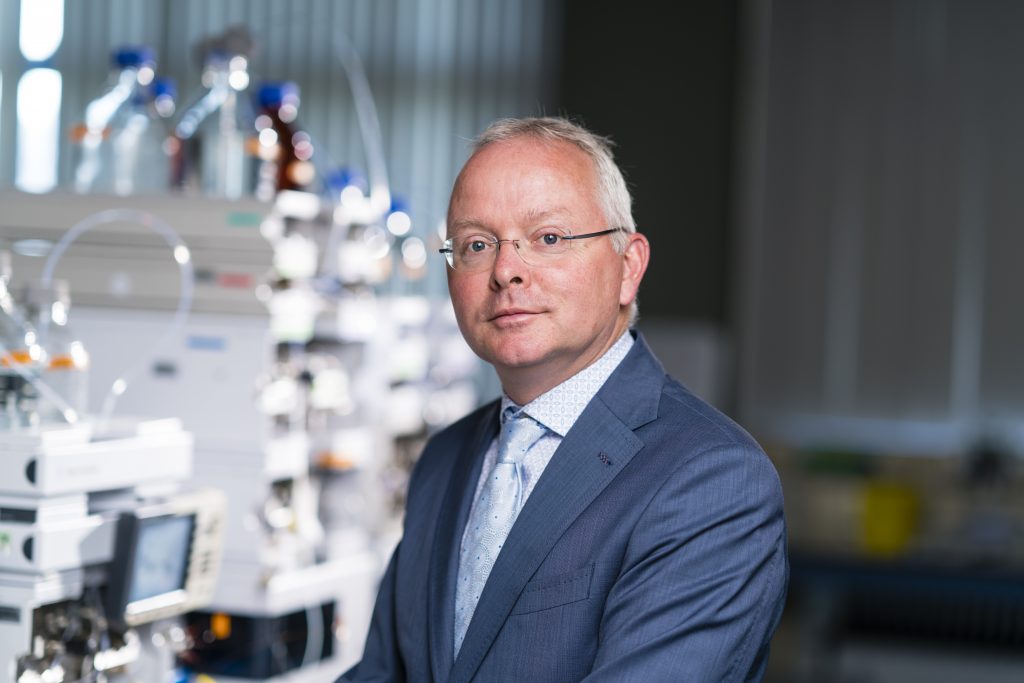
Albert Heck is Professor of Chemistry and Pharmaceutical Sciences at Utrecht University, leading the Biomolecular Mass Spectrometry and Proteomics group. He is scientific director of the Netherlands Proteomics Center and affiliated with Life Sciences Utrecht and the Utrecht Molecular Immunology Hub. His research focuses on advancing mass spectrometric technologies for proteomics, structural biology, and understanding protein networks in health and disease. Key innovations include TiO2-based phosphopeptide enrichment and LysN protease for de novo sequencing. 2015 JPR study revealed cross-talk between PI3K-mTOR and MAPK pathways 2017 Science paper on cyanobacterial clock proteins 2023 Power List recognition as top Connector in proteomics Major awards include the Spinoza Prize (2017), Sir Hans Krebs Medal (2018), and KNCV Golden Medal (2001). His lab develops cutting-edge instrumentation for native mass spectrometry and quantitative proteomics.
Eva Artinger is a Researcher at the Chair for Computer Aided Medical Procedures & Augmented Reality within the Faculty of Informatics at Technical University of Munich . Her work focuses on Human-Computer Interaction with specific emphasis on Multitouch and gestural User Interfaces , Information Visualization , and Tangible User Interfaces . Current position: Researcher at TUM Degree: Master of Science Her research particularly addresses the challenges of designing user interfaces for emergency response systems , including applications for Mass Casualty Incidents (MCIs) where she has developed innovative map interaction techniques and gesture-based text input systems like Gestyboard 2.0. Eva has contributed to multiple publications analyzing usability in high-stress environments and exploring interaction paradigms for augmented reality applications in medical and architectural contexts. Her recent work has focused on designing interfaces that maintain functionality while being operated in unstable conditions, with research trends showing increasing specialization in emergency response UI/UX , mobile device interaction , and real-time data visualization . Eva has also been actively involved in teaching activities at TUM, covering topics in Augmented Reality applications and Human-Computer Interaction for both desktop and mobile platforms.
Robert Nicholls is a Professor of Coastal Engineering at the University of Southampton , affiliated with the School of Engineering and the School of Ocean and Earth Sciences . He co-directs the MSc Engineering in the Coastal Environment and leads the Coastal Engineering and Management research group. Theme Champion, Society and Government at Southampton Marine and Maritime Institute Southampton Lead, Tyndall Centre for Climate Change Research Editorial Board, Anthropocene Coasts His research focuses on long-term coastal engineering and climate change adaptation , particularly sea-level rise and deltaic area vulnerability . Key projects include the Bangladesh Delta Plan 2100 and the development of the DIVA (Dynamic Interactive Vulnerability Assessment) model for global coastal risk analysis. Recent publications address compound flooding , coastal landfill risks , and adaptation frameworks for deltas . His work informs international policy through contributions to the IPCC , World Bank , and Asian Development Bank . Award Highlights: Roger Revelle Medal (2008) by UNESCO's Intergovernmental Oceanographic Commission Lloyd’s Science of Risk Prize (2012) for climate change research Robert leads major initiatives like the iCOASST Project and ESPA Delta Studies , while supervising PhD students in coastal resilience and flood management.
Anneli Kruve is a Professor at Stockholm University, affiliated with the Department of Chemistry since 2019. She focuses on mass spectrometry research, particularly non-targeted analysis and ion mobility separation for structural characterization. Her work bridges modeling, machine learning, and analytical chemistry to address environmental and metabolomics challenges. PhD, University of Tartu (2011) Postdoctoral Fellow, Technion, Israel Humboldt Fellow, Freie Universität Berlin (2017–2018) Supervised doctoral students at University of Tartu Research Interests: Her group develops semi-quantitative non-targeted analysis workflows using LC-MS and machine learning. Projects span environmental contaminant quantification, toxicity prediction in complex mixtures, sustainable pesticide detection, and AI-driven chemical screening. Awards: 2018 Top 40 under 40 Power List, Analytical Scientist Collaborations: Leads projects like MS2Tox (deep learning for endocrine disruptor prediction), RapMixTox (risk assessment), and self-learning AI for recycled materials toxicity screening. Maintains Kruve Lab, specializing in ESI understanding and data-driven analytical methods.
Dr. Sarah White is an Adjunct Senior Lecturer in the Discipline of General Practice within the Faculty of Medicine & Health at the University of New South Wales. With a Doctor of Philosophy from the University of Otago (2011) and a Bachelor of Arts (Hons) in Linguistics and Spanish and Latin American Studies from UNSW (2006), she brings a strong interdisciplinary background to her work in healthcare communication. As a conversation analyst, Dr. White specializes in researching real-world clinical interactions, with particular focus on surgeon-patient consultations, telehealth communication, and pain talk. Her work bridges linguistic theory and practical healthcare applications, developing data-driven training approaches to improve clinical communication. She has published extensively in healthcare communication journals and serves on the editorial boards of BJGP Open, Qualitative Health Communication, and Health Literacy and Communication Open. Dr. White's recent publications (2023-2025) reveal a consistent research trajectory examining communication dynamics across various healthcare contexts, with increasing attention to telehealth implementation challenges and opportunities. Her work employs rigorous conversation analysis methodology to extract practical insights for clinical practice, showing particular interest in how communication patterns affect patient outcomes and clinical decision-making. Her notable achievements include receiving the 2021 Australian Award for University Teaching Citation, being awarded Senior Fellow of Advance HE (SFHEA) in 2019, and securing significant research funding including a $95,000 Avant Foundation grant for telehealth research (2021-2023). She is also the founder and director of Bedside Manners Pty Ltd, providing healthcare communication training services. As an educator, Dr. White supervises research students including Avisak Bhattacharjee (University of Adelaide) and Kanesha Ward (Macquarie University), and has contributed to curriculum development in medical education. Her research has been supported by multiple grants from UNSW Health@Business Network, Avant Foundation, and Macquarie University, totaling over $140,000 in the past decade. Dr. White maintains active professional engagement through the International Society for Conversation Analysis (ISCA) and the International Association for Communication in Healthcare (EACH), contributing to the global advancement of healthcare communication research and practice.
Joyce Main is a Professor of Engineering Education at Purdue University and currently serves as the Interim Head of the School of Engineering Education . She is also the Co-Editor-in-Chief of the Journal of Engineering Education , a flagship journal in her field. Education : Ph.D. in Education (Cornell University), Ed.M. in Administration, Planning, and Social Policy (Harvard Graduate School of Education), B.A. in Integrative Biology (University of California, Berkeley) Research Focus : Academic and employment pathways of science and engineering students, including studies on veteran transitions, wage disparities, and mentoring dynamics. Her work employs both qualitative and quantitative methods, such as thematic analysis with AI tools and longitudinal tracking of career trajectories. Scientific Contributions include a National Science Foundation CAREER grant and a series of recent publications analyzing mentoring, workplace climate, and educational equity. Notably, her 2025 work explores military veteran pathways in engineering education, while 2024 studies address peer review processes and AI-driven qualitative methods. Awards : Purdue 2024 Excellence in Leadership Purdue 2023 Excellence in Mentoring Purdue 2022 Excellence in Graduate Teaching ASEE Fellow Lab and Research : Conducts research in WANG 3511 , focusing on intersectional analyses of STEM education and workforce dynamics.
Dimitrios Tsoumakos serves as an Associate Professor of Big Data Management Systems at the School of Electrical and Computer Engineering of the National Technical University of Athens (NTUA) where he also directs DBLab, the Knowledge and Database Systems Laboratory. His academic career spans over two decades with significant contributions to large-scale data management and distributed systems. Diploma in Electrical and Computer Engineering from NTUA (1999) M.Sc. in Computer Sciences from University of Maryland (2002) Ph.D. in Computer Sciences from University of Maryland (2006) Professor Tsoumakos' research focuses on the intersection of big data management, cloud computing, and distributed systems. His work addresses fundamental challenges in large-scale data processing, including wavelet synopses for data summarization, vector embedding frameworks for analytics operators, multi-engine analytics systems, and cloud application deployment with failure recovery mechanisms. His research consistently bridges theoretical algorithms with practical implementations for real-world data challenges. His publication record demonstrates consistent innovation from early work on P2P data management systems through to current research on vector embeddings and deep reinforcement learning for cloud autoscaling. Recent work shows a clear progression toward content-based analytics, multi-dataset integration, and intelligent resource management in heterogeneous environments. Best Paper Runner Up Award at SSDBM 2019 Best Paper Award at CCGrid 2013 Professor Tsoumakos has secured substantial research funding through multiple European projects including RELAX (2023-2027), HiDALGO2 (2023-2026), DAPHNE (2021-2024), and previous initiatives like HiDALGO, TraMOOC, ASAP, CELAR, ARCOMEM, and GREDIA. These projects reflect his leadership in big data analytics, cloud computing, and distributed systems research. As director of DBLab, Professor Tsoumakos oversees research on the Knowledge and Database Systems Laboratory, which has produced significant work on analytics operators, multi-engine resource scheduling (IReS platform), cloud elasticity (TIRAMOLA), and RDF data management (H2RDF+). The lab maintains strong industry connections and has developed multiple open-source tools for big data analytics.
Bradi Bartrug Granger is a Research Professor at Duke University School of Nursing, Director of the Duke Heart Center Nursing Research Program, and adjunct faculty at the University of Gothenburg. She holds core faculty status at the Duke-Margolis Center for Health Policy. With doctorate in nursing from the University of North Carolina at Chapel Hill, an MSN from Duke University, and a BSN from the University of Tennessee at Knoxville, her expertise spans implementation science, heart failure care, workforce stability, hypertension management, and health equity. 2004 - Ph.D., University of North Carolina at Chapel Hill 1991 - M.S.N., Duke University 1988 - B.S.N., University of Tennessee at Knoxville Her recent publications focus on nurse retention strategies, virtual reality rehabilitation for ICU patients, hypertension control in Black populations, and palliative care integration in heart failure management. Key grants include NIH/NINR-funded Nurse LEADS program (2024-2029), NSF research on XR rehabilitation games (2025-2027), and NHLBI-funded urine output tracking studies (2024-2026). She actively promotes evidence-based practice through clinical decision support tools and workforce analytics, maintaining affiliations with Duke's Science & Society initiative and Margolis Center for Health Policy.
Abhraneel Sarma is a PhD candidate in Computer Science at Northwestern University, advised by Professors Matthew Kay and Jessica Hullman. His research focuses on addressing uncertainty in data analysis through tools like multiverse (an R package for sensitivity analysis) and Milliways (a visualization system for multiverse analysis validation). Uncertainty visualization Multiverse analysis Bayesian inference Reproducibility in research His work combines empirical studies and system development to improve data-driven decision-making. Publications include best paper awards at CHI 2019 and honorable mentions at CHI 2024, CHI 2023, and VIS 2022. 2025 : CHI 2024 : CHI (Best Paper Honorable Mention) 2023 : CHI (Best Paper Honorable Mention) 2022 : VIS (Best Paper Honorable Mention) 2019 : CHI (Best Paper Award) Email: abhraneel@u.northwestern.edu
Thomas Day is a Clinical Research Fellow at King's College London's School of Biomedical Engineering & Imaging Sciences, Department of Cardiovascular Imaging. He works within the Intelligent Fetal Imaging and Diagnosis (iFIND) project and practices clinically at The Evelina London Children's Hospital, part of Guy's and St Thomas' NHS Foundation Trust. Education: MBChB in Medicine, University of Manchester (2002-2008) MRes (intercalated) in Medicine, University of Manchester (2006-2008) His research focuses on leveraging artificial intelligence to enhance congenital heart disease screening through fetal echocardiography and ultrasound imaging. Key contributions include developing AI-driven tools for fetal biometric estimation, lymphatic perfusion segmentation, echocardiogram synthesis, and outlier detection in medical imaging. Scientific Awards: KHP Clinical Research Excellence Fellow Research Projects: Randomised controlled trial of AI-assisted fetal ultrasound (NIHR, 2025-2027) AI in Sub-Saharan Africa echocardiography (NIH, 2023-2025) Antenatal congenital heart disease detection (NIHR, 2021-2024)
Dr. Yuzhu Li is a Professor at the Department of Decision & Information Sciences , Charlton College of Business , University of Massachusetts Dartmouth . Her expertise spans Digital Transformation , Blockchain , Information Systems Development , and Project Management . She teaches courses in Customer Analytics , Business Analytics , and Agile Development , emphasizing CRM strategies , Data Mining , and Information Visualization . PhD in Business Administration, University of Central Florida (2008) Master of Technology Management , Washington State University (2002) BA in Information Systems , Nankai University (1999) Her research focuses on Emerging Technologies like blockchain and AI, Behavioral Project Management , and E-commerce frameworks. Key themes include Team Resilience , Control Systems in Interorganizational Teams , and Digital System Security , with recent articles analyzing Bitcoin vulnerabilities and collaborative project governance. Dr. Li serves as Treasurer of the New England Association of Information Systems Chapter, an Editorial Review Board Member of the Project Management Journal, and Associate Editor of the Nankai Business Review International. She actively contributes to the academic community through roles in international conferences and editorial committees.
Mu-Han Lin, Ph.D., is a Professor in the Department of Radiation Oncology at UT Southwestern Medical Center, with leadership roles including Senior Director of Clinical Physics and lead physicist for head and neck radiation oncology. Her academic profile spans Medical Physics , Adaptive Radiation Therapy , and Artificial Intelligence (AI) in Radiotherapy . Education: Master’s and Ph.D. in Medical Physics from National Tsing Hua University, Taiwan Training: Medical Physics Residency at Fox Chase Cancer Center, Philadelphia Dr. Lin’s research focuses on online adaptive radiation therapy (oART) systems, particularly cone beam CT-guided workflows for gastric MALT lymphoma and head/neck cancers. She pioneered techniques for dose prediction , plan quality assurance , and deep learning integration to address anatomical variations during treatment. Her work demonstrates reduced PTV margins (0.5-0.7 cm) while maintaining target coverage and minimizing organ-at-risk (OAR) doses through auto-contouring and synthetic CT optimization . Recent publications highlight her leadership in adaptive treatment planning (15+ articles from 2024-2025) across journals like Medical Physics , Practical Radiation Oncology , and Radiotherapy and Oncology . Key contributions include: X-Ray Guided Ethos Platform workflows Plan Quality Review Checklists HyperSight CBCT for image quality enhancement Inter-patient adaptive strategies for spine SAbR AI-driven segmentation and dose adaptation She actively contributes to clinical education as an instructor in UT Southwestern’s Medical Physics Certificate Program and Biomedical Engineering Graduate Program , and chairs symposiums on X-ray Guided Adaptive RT . Dr. Lin serves on editorial boards for Therapeutic Radiation and Oncology and Medical Physics , and collaborates on grants with Varian Medical Systems and other industry partners.
Eric B Schneider is an Associate Professor of Surgery at Yale School of Medicine and holds a secondary appointment in the Department of Chronic Disease Epidemiology at Yale School of Public Health . His research spans health services, surgical outcomes, and data science , with a focus on bariatric surgery, trauma care, and health equity . PhD in Public Health from Johns Hopkins University (2009) BS in Biomedical Engineering from Johns Hopkins University (2003) Dr. Schneider's research integrates machine learning, clinical outcomes analysis, and global health initiatives . Recent publications highlight applications of AI in surgical decision-making , disparities in pediatric trauma fatalities , and metabolic surgery outcomes . His work addresses health equity in underserved populations and cost-effectiveness in surgical care. Key trends in his 2024–2025 articles include AI-driven clinical tools , health disparities in post-mastectomy reconstruction , and cost analysis in complex surgeries . Collaborative efforts involve institutions like Johns Hopkins , Karolinska Institutet , and Uniformed Services University . Dr. Schneider has mentored over 40 postdoctoral fellows and serves as Principal Investigator for Department of Defense-funded studies . He co-leads the Surgery Center for Health Services and Outcomes Research , which provides biostatistical support , database infrastructure , and machine learning expertise for surgical research.
Hyung Paek, MD, MSEE, is a Lecturer in Biostatistics and Clinical Informatician at the Yale School of Public Health. His work bridges Biomedical Informatics with Emergency Medicine , focusing on Clinical Decision Support Systems and Health Equity in electronic health record (EHR) applications. Dr. Paek holds board certifications in Clinical Informatics and Internal Medicine , and his research explores Machine Learning for healthcare workforce predictions, Telehealth Equity for HIV patients, and Opioid Use Disorder interventions in emergency settings. MD, St. Louis University (1996) MSEE, Politechnic University (1986) Board Certified: Clinical Informatics (ABPM, 2017), Internal Medicine (ABIM, 2000) Dr. Paek's recent publications analyze EHR-Driven Predictive Models , Gender Productivity Gaps , and Telehealth Implementation during the pandemic. He frequently collaborates with Yale colleagues including Dr. Edward Melnick , Dr. Gail D'Onofrio , and Dr. James Dziura . His 2023 work in JAMA Network Open highlights emergency department buprenorphine adoption, while 2025 studies examine adaptive decision support systems for addiction treatment.
Massimo Mecella serves as Full Professor at Sapienza University of Rome's Faculty of Information Engineering, Computer Science and Statistics, where he leads the Processes, Services and Software Management research group and participates in the CINI National Cyber Security Lab. His academic foundation stems from a PhD in Computer Engineering earned at Sapienza in 2002. His research expertise spans service-oriented computing, business process management, and cyber-physical systems with emphasis on service composition, process mining, and adaptive distributed architectures. Key technical domains include IoT integration, digital twin development, and security frameworks for complex software ecosystems. Recent publications (2024-2025) demonstrate a pronounced shift toward Large Language Model (LLM) integration in business processes and smart manufacturing. Dominant themes include LLM-driven process modeling, multimodal quality control systems, and digital twin implementations for energy management and production optimization. Methodological innovations focus on retrieval-augmented generation (RAG) for service discovery and fuzzy cognitive maturity assessments. His distinguished recognition includes: ICSOC 2013 Most Influential Paper Award (2003-2012 decade) 2017 Best Paper Award As research group leader, Mecella directs projects in smart manufacturing, process mining, and cyber-physical security, with funding typically sourced from EU initiatives and industry partnerships in aerospace, healthcare, and energy sectors. His team maintains active collaborations with aerospace manufacturers through the MICS SPOKE8 project and develops frameworks like SAMBA for human-in-the-loop manufacturing systems. The Processes, Services and Software Management group operates within Sapienza's engineering faculty infrastructure, utilizing specialized labs for CPS/IoT testing and digital twin simulation, with strong ties to the CINI Cyber Security Lab for security validation.




/prod01/production-cdn-pxl/media/umassdartmouth/profiles/charlton/Yuzhu-Li.jpg)