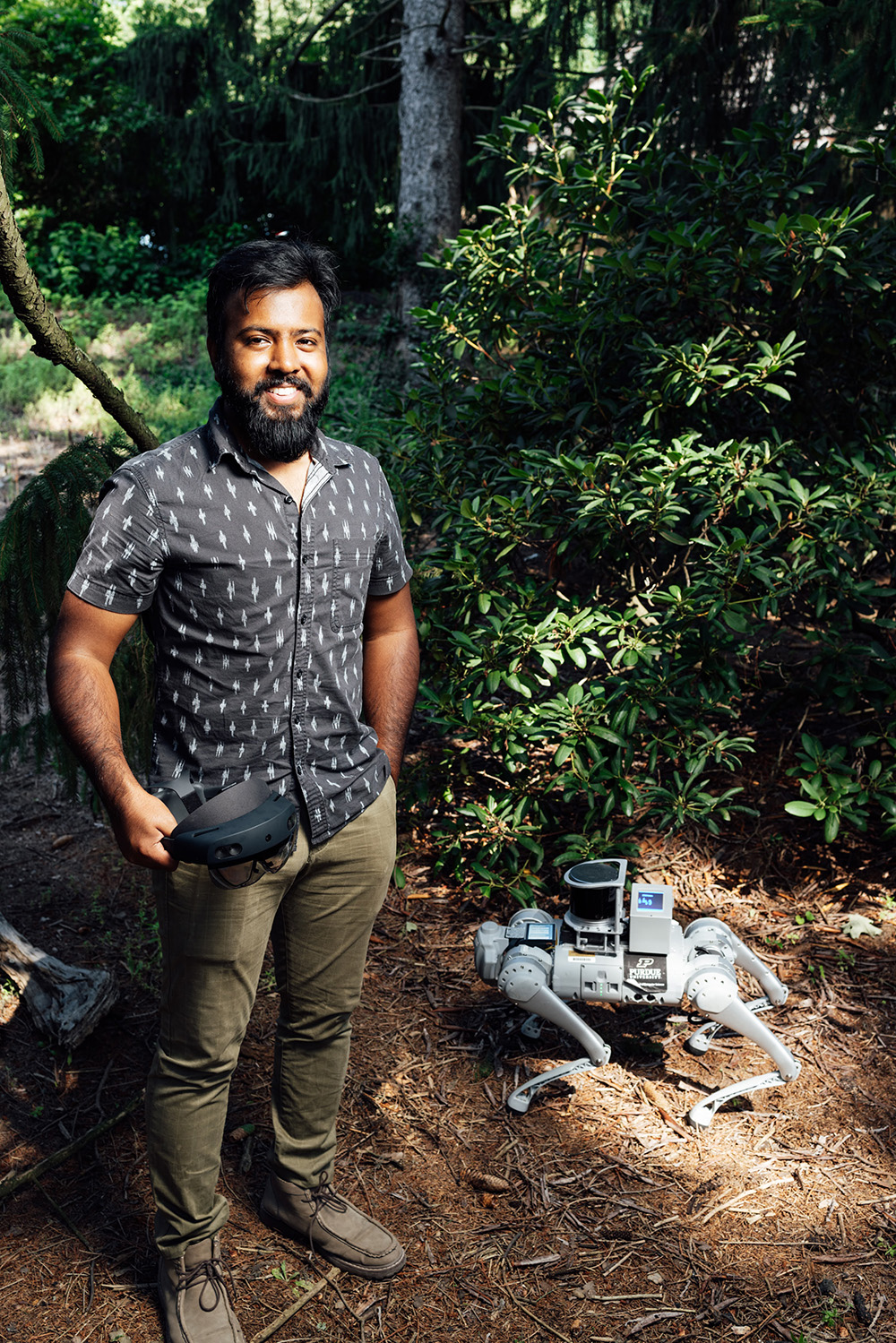
Dr. Aniket Bera is an Associate Professor in Computer Science at Purdue University and holds an Adjunct Associate Professor role at the University of Maryland at College Park (UMIACS). He directs the IDEAS Lab at Purdue and previously served as a Research Assistant Professor at UNC Chapel Hill. His research focuses on Affective Computing, Computer Graphics (AR/VR), AI & Robotics, Social Robotics, and medical AI applications for mental health diagnostics. Affiliations: Purdue University (Primary), University of Maryland (Adjunct), UMIACS Career: Joined Purdue in 2017, extensive industry collaborations with Disney Research, Intel, and C-DAC Research Interests: Affective Computing: Emotion perception via gait analysis, speech, and facial/body expressions AR/VR: Redirected walking, virtual environments, and human motion modeling Medical AI: AI-driven mental health detection systems (e.g., VidSole dataset) in collaboration with medical schools Key Contributions: Developed Project Dost (mental health initiative) Received 2020 Brain & Behavior Seed Grant ($X) for emotion-gait research Authored 65+ papers (1,800+ citations) with awards at IEEE VR 2021 Funding & Leadership: Serves as Senior Editor for IEEE RA-L (Planning/Simulation) Conference Chair for ACM SIGGRAPH MIG 2022 Labs/Teams: IDEAS Lab (Purdue), UMD GAMMA Group
Dr. Matthew Jones is a Senior Lecturer in Criminology at Swinburne University of Technology’s School of Social Sciences, Media, Film and Education. With a career spanning institutions in the UK and Australia, Matthew’s research bridges interdisciplinary domains including policing, sociology, law, and organizational studies. He is a Senior Fellow of the Higher Education Academy, emphasizing evidence-informed pedagogy and curriculum innovation. Affiliation: Swinburne University of Technology (2022–Present) Previous Roles: The Open University (2017–2022), Northumbria University (2014–2017), Cardiff Metropolitan University (2013–2014). Research Themes: Matthew’s work focuses on three core areas: Policing: Police visibility, digital strategies, occupational culture, diversity, and leadership. LGBTQI+ Criminology: Workplace discrimination, hate crimes, community-police relations, and victimology. Digital Criminology: Technology’s role in policing, crime prevention, and digital victim support systems. Publications: His 15 most recent articles highlight evolving trends in digital policing, police visibility, academic standards in policing education, and LGBTQI+ workplace experiences. These works span qualitative studies, policy analysis, and interdisciplinary collaborations, reflecting his commitment to visual criminology and semiotics. Scientific Awards: Senior Fellow of the Higher Education Academy (2022) Fellow of the Higher Education Academy (2013) Professional Activities: Matthew served as Chair (2019–2022) and Board Member (2013–2019) of the British Society of Criminology’s Policing Network. He led curriculum development for police apprenticeships (2017–2019) and contributed to the first UK Subject Benchmark Statement for Policing (2022). He supervises PhD students on topics like community policing, child maltreatment resilience, and crime drama narratives. Education: He holds an LLB in Law, an MSc in Social Science Research Methods, a PhD in Socio-Legal Studies, a PGCert in Higher Education pedagogy, and an MBA in Leadership Practice.
Kathleen M. Carley is a full professor at Carnegie Mellon University's School of Computer Science with courtesy appointments in Engineering and Public Policy, Heinz School, and Electrical and Computer Engineering. As director of the Center for Computational Analysis of Social and Organizational Systems (CASOS) and the Center for Informed Democracy and Social-Cybersecurity (IDeaS) , she leads interdisciplinary research at the intersection of network science, cognitive modeling, and cybersecurity. Ph.D. in Sociology from Harvard University SB degrees in Economics and Political Science from MIT Her research focuses on Dynamic Network Analysis (DNA) and Social-Cybersecurity (SC) , developing tools like ORA (network analysis), AutoMap (semantic mining), Construct (influence simulation), and BotHunter (bot detection). She has over 400 publications and 15+ active research projects addressing disinformation, cognitive security, and organizational resilience. Recent work examines LLM-powered bots , multi-platform misinformation dynamics , and public health analytics . As an IEEE Fellow, she contributes to standards in computational social science while teaching courses on network analysis and complex socio-technical systems.
Nicholas Ng-A-Fook is a Full Professor in the Faculty of Education at the University of Ottawa, where he has served as former Associate Dean of Graduate Studies and Director of Teacher Education and Indigenous Teacher Education Programs. His work is deeply engaged with the Truth and Reconciliation Commission's 94 Calls to Action, working in partnership with Indigenous communities and school boards to disrupt colonialism, systemic racisms, and inequalities in educational curricula. Dr. Ng-A-Fook's educational background includes a Ph.D. in Curriculum and Instruction from Louisiana State University (2006), an M.A. in Education (Multicultural Education) from York University (2001), a Graduate Diploma in Education (Secondary Science and History) from the University of Western Sydney (1998), and a B.A. in Classical Studies from the University of Ottawa (1996). His research interests span Curriculum Studies, History of Education (particularly oral history), Life-writing research (autobiography and narrative inquiry), Critical Youth Studies (focusing on first-generation immigrant and Indigenous youth), Community-based research, and Contemporary perspectives in philosophy, science and technology including AI, genomic education, and anti-racist science education. Dr. Ng-A-Fook approaches his work as a curriculum theorist who draws on life writing research methodologies to co-create culturally responsive, relevant, and relational curriculum with educators. Dr. Ng-A-Fook's publications reveal a strong focus on reconciliation education, decolonizing curriculum, and addressing systemic racism in educational contexts. His work increasingly engages with digital technologies and artificial intelligence from a critical, decolonial perspective, examining how these technologies intersect with historical and ongoing colonial structures. His research shows a clear evolution toward more interdisciplinary work connecting curriculum studies with Indigenous knowledge systems, technology studies, and social justice movements. Among his notable honors are the 2024 Coutts Prize, the Ted T. Aoki Distinguished Service Award (2018), and the R.W.B. Jackson Award for an outstanding article in the Canadian Journal of Education. He also serves as Director of the EdCan Network and was Past-President of the Canadian Society for the Study of Education. As a supervisor, Dr. Ng-A-Fook currently mentors several graduate students including Melissa Daoust, Lisa Ambaye, Bahareh Samsamiardekani, and Madelaine McCracken. He created the FooknConversation podcast to address educational challenges with colleagues, community activists, artists, education leaders, teachers, and politicians, and maintains the Canadian Curriculum Theory Project website as a resource for his research.
Luís Miguel Mendonça Rato is an Associate Professor at the Universidade de Évora and a Senior Researcher with a PhD at Centro ALGORITMI. He is affiliated with the CST R&D Group and VISTA Lab R&D Lab, focusing on interdisciplinary research at the intersection of Electrical Engineering, Computer Science, and Agricultural/Biomedical applications. Academic Degree: PhD Current Position: Associate Professor Labs: VISTA Lab Researcher IDs: ORCID 0000-0003-4492-7548, ResearcherID A-9152-2013, CiênciaID A914-6344-CD2D His research spans machine learning applications in Agricultural Engineering (Sentinel-2 satellite data for nutrient analysis), Biomedical Imaging (MRI-ADC texture analysis for tumor classification), and Control Systems (predictive control algorithms for water delivery canals and solar fields). With an h-index of 11 and 51 publications, his work emphasizes hybrid systems combining traditional engineering with computational innovation. Recent publications highlight trends in SLAM efficiency (2024), cloud service optimization (2022), and deep learning for medical imaging (2022-2023). He has contributed to Smart Cities initiatives through projects like M-Traffic (2006) and NanoSen-AQM (2020). As a senior researcher, he leads projects in the CST R&D Group and VISTA Lab , with notable work in the Universidade de Évora ecosystem.
Prof. Dr. Michael Amberg is a full-time Professor of Business Informatics, specializing in IT Management, at Friedrich-Alexander University Erlangen-Nuremberg (FAU) . He has held this chair since 2001 and serves as director of the Dr. Theo and Friedl Schöller Research Center for Business and Society since 2010. Formerly, he occupied a professorship at RWTH Aachen University (1999–2001) and served as Vice Dean and Dean of FAU's Faculty of Law and Economics (2007–2012). Education: Computer Science at RWTH Aachen and FAU Erlangen-Nuremberg (1989) Research Focus: Systems development, IT management, and digitalization trends including AI, Industry 4.0, and smart services Leadership Roles: Spokesperson for the Department of Business and Social Sciences, Dean of Faculty (2007–2012), Research Center Director (since 2010) Key Collaborations: Interdisciplinary work with FAU's digitalization and innovation research cluster His recent publications address Explainable AI (XAI) integration into software development (2023) and human-centric work design in SMEs during Industry 4.0 transformations (2018). Current research emphasizes empirical methodologies for IT governance in digital ecosystems.
Dr. Siwei Lyu is a SUNY Distinguished Professor and SUNY Empire Innovation Professor in the Department of Computer Science and Engineering at the University at Buffalo. He serves as Co-Director of the Center for Information Integrity (CII) and Director of the UB Media Forensic Lab (UB MDFL). His research focuses on digital media forensics, computer vision, and machine learning, with significant contributions to counter-deepfake technologies. Education includes a PhD in Computer Science from Dartmouth College (2005), MS from Peking University (2000), and BS in Information Science from Peking University (1997). He has held academic positions at the University at Albany and New York University. His work spans media forensics, adversarial machine learning, and AI security. Notable achievements include developing the Celeb-DF dataset, leading NSF-funded projects, and testifying before U.S. and NYS legislative bodies on disinformation threats. Over $11.3M in grants have supported his research on AI-generated media detection, including a $5M NSF Convergence Accelerator grant. Key awards include IEEE and IAPR Fellowships, Google Faculty Award, and SUNY Chancellor's Research Award. He has authored 230+ papers, 4 patents, and serves on editorial boards of top journals and conferences (e.g., CVPR, ICCV).
Lynn Wu is an Associate Professor at the Wharton School of the University of Pennsylvania, focusing on the intersection of artificial intelligence, analytics, and innovation. She teaches MBA, undergraduate, and doctoral courses on emerging technologies' transformative impact on business and society. Education: B.S. in Finance and Computer Science, MIT M.S. in Computer Science, MIT Ph.D. in Management Science, MIT Sloan Her research explores how AI and digital platforms reshape productivity, workforce dynamics, and innovation strategies, with applications in antitrust policy and startup ecosystems. Key trends in her publications include AI's role in post-IPO innovation, robotics' impact on managerial roles, and social media's ability to mitigate funding disparities. Scientific Awards: Kauffman Best Paper Award (2019) Sandy Slaughter Early Career Award (2019) AIS Early Career Award (2018) ISR Best Published Paper (2014) Best Paper Awards at ICIS (2009), HICSS (2013), etc. She has collaborated with IBM, Google, Meta, and advised the U.S. Department of Justice and World Bank, with her work cited by The New York Times , The Economist , and Harvard Business Review .
Barbara J. Grosz serves as Higgins Research Professor of Natural Sciences in Harvard University's School of Engineering and Applied Sciences, renowned for foundational contributions to Artificial Intelligence through pioneering work in dialogue processing and multi-agent collaboration theories applied to human-computer interaction, healthcare coordination, and science education. Her research spans Artificial Intelligence, Natural Language Processing, Multi-agent Systems, and Computational Ethics, with recent focus on improving computer system design for healthcare and education. She co-founded Harvard's Embedded Ethics program, which integrates ethical reasoning into core computer science curricula, reflecting her commitment to responsible AI development. Professor Grosz has earned exceptional recognition including: ACM/AAAI Allen Newell Award (2009) IJCAI Award for Research Excellence (2015) ACL Lifetime Achievement Award (2017) Election to the National Academy of Engineering Membership in the American Philosophical Society Her leadership extends to establishing interdisciplinary research institutions and advancing women in science, demonstrating sustained impact across academia and societal applications of AI.
Steff Lewis is a Professor of Medical Statistics at the University of Edinburgh , affiliated with the Usher Institute within the College of Medicine and Veterinary Medicine . She leads the statistics group at the Edinburgh Clinical Trials Unit and holds roles in the Deanery of Molecular, Genetic and Population Health Sciences . Her expertise spans meta-analysis, randomized trial design, and clinical trial governance, with involvement in Cochrane Collaboration and UK Clinical Research Collaboration initiatives. Education: MSc and PhD in Medical Statistics. Research Interests: Focuses on methodological advancements in clinical trial reporting (e.g., CONSORT and SPIRIT guidelines), cardiovascular outcomes (e.g., SCOT-HEART trial), stroke prevention (ASPIRING trial), and ethical data management. She actively contributes to international standards for trial protocols, anonymization practices, and statistical validation. Recent Contributions: Over 200 peer-reviewed articles and 37 ongoing projects, including leadership in trials assessing antiplatelet therapies, Paget’s disease interventions, and pediatric asthma treatments. Collaborates globally on guidelines for randomized trials and data-sharing protocols. Grants & Teams: Principal or co-investigator on projects funded by NIHR, BHF, and ESRC, including trials on iron therapy in critical care (INTACT-2) and cannabinoid treatments for endometriosis pain (ENDO-CAN). Leads multidisciplinary teams integrating statistical rigor with clinical innovation. Labs/Teams: Embedded within the Edinburgh Clinical Trials Unit and the Centre for Population Health Sciences , fostering collaborative research across molecular, genetic, and public health domains.
Tianxi Li is an Assistant Professor in the Department of Statistics at the University of Minnesota, Twin Cities, within the College of Science and Engineering. Their research integrates statistical methodology with applications in network science, data privacy, and biomedical data analysis. Their research interests lie at the intersection of statistics and network science, focusing on statistical modeling of complex networks , data privacy , network security , and biomedical applications such as neuroimaging and genomics. They develop adaptive and scalable methods for network estimation, community detection, and differential correlation analysis. The recent publications demonstrate a consistent focus on advancing statistical tools for network-structured data, with increasing applications in neuroscience and cancer genomics. The work spans theoretical development (e.g., network growth models) and practical applications (e.g., glioblastoma gene modules), reflecting a balance between methodology and real-world impact. Tianxi Li leads an active research program funded by the National Science Foundation, indicating recognition and support for their innovative work. Principal Investigator, Statistical tools for network security protection: from data privacy to threat detection , NSF (2024–2025) They advise graduate students in statistics and data science, though specific advisees are not listed. Their collaborative network includes researchers in biostatistics, computer science, and machine learning, as evidenced by co-authorships and interdisciplinary projects. Li's work contributes to the UN Sustainable Development Goals, particularly through advancements in data-driven solutions for secure and ethical data analysis.
Dr Jonathan Cook is a Research Fellow at Jesus College, University of Oxford, affiliated with the Medical Sciences division. He holds a primary medical qualification from Queen’s University (Canada, 2021) and a PhD investigating viral immune evasion mechanisms under Prof Jeffrey Lee. His work was supported by the Vanier Canada Graduate Scholarship and recognized with the Stuart Alan Hoffman Memorial Prize. As an incoming Banting Fellow at the Jenner Institute, he focuses on vaccine design for infectious diseases. His research interests include malaria eradication, emerging pathogens, and structure-based vaccine strategies. **Education**: - PhD (Investigation of viral entry glycoproteins), University of Toronto, supervised by Prof Jeffrey Lee - Primary Medical Qualification, Queen’s University, Canada **Research Interests**: - Malaria Eradication : Developing vaccines targeting Plasmodium species. - Emerging Infectious Diseases : Designing rapid-response strategies for pathogens like SARS-CoV-2. - Structure-Based Vaccine Design : Leveraging protein structural data to enhance immunogenicity. **Awards**: - Vanier Canada Graduate Scholarships Programme (2017–2020) - Stuart Alan Hoffman Memorial Prize (2021) - Banting Fellowship (incoming) **Grants/Advising**: Works on Jenner Institute-funded projects. No listed advisees yet. **Labs/Teams**: Collaborates with Prof Lee's lab at the Jenner Institute and the University of Toronto's Medical Microbiology program.
Maya Balakrishnan is an Assistant Professor of Operations Management at the Jindal School of Management (JSOM), University of Texas at Dallas. She holds a PhD in Business Administration from Harvard Business School (2024) and a BS in Computer Science from Stanford University (2016). Her primary research focuses on Human-AI collaboration, Corporate Social Responsibility, and Behavioral Operations Management. She teaches courses such as AI in Supply Chain Management (OPRE 4393) and Advanced AI in Supply Chain Management (OPRE 6383). Her research explores how humans interact with algorithms in operational contexts and the ethical implications of workforce diversity disclosures on consumer behavior. Recent work emphasizes trust-building through operational design and mitigating risks in human-AI systems. Her awards include multiple first-place recognitions in behavioral operations competitions and a best presentation award at the Advances in Decision Analysis Conference. Awards: 2024 Production and Operations Management Junior Scholar Paper Competition (1st Place) 2023 INFORMS Behavioral Operations Working Paper Competition (2nd Place) 2022 Best PhD Blitz Presentation (Advances in Decision Analysis) Dr. Balakrishnan is actively involved in professional organizations such as INFORMS and the Manufacturing and Service Operations Management Society (MSOM). Her work bridges behavioral insights with operational systems, addressing real-world challenges in AI ethics and supply chain innovation.
Prof. Dr. Martin Johns serves as Chair of Application Security at the Institute for Application Security within the Carl Friedrich Gauss Faculty at Technical University Braunschweig. He joined TU Braunschweig after working as Research Expert at SAP Security Research, where he shaped security strategy and led software security teams. Prior to SAP, he worked as software engineer in Germany at companies like TC Trustcenter and Infoseek Germany. Academic qualifications include a PhD in Computer Science (University of Passau, 2009) and a Diploma in Computer Science (University of Hamburg, 2003). His research focuses on web security and software security , particularly secure programming , vulnerability detection , and attack mitigation strategies. Recent publications cover topics like GDPR compliance frameworks , WebAssembly security , federated learning privacy , and server-side request forgery (SSRF) defenses. His work appears in top conferences including IEEE S&P, CCS, WWW, and ACM CODASPY.
Professor George Buchanan is a leading researcher in human-computer interaction and digital libraries at RMIT University . His work bridges information science, digital humanities, and health informatics, focusing on usability in sensitive contexts like healthcare and misinformation. Deputy Dean, Research at RMIT University Former Director, University of Melbourne iSchool Research Interests: Digital information interaction Health and aging informatics Disinformation analysis Mobile interface design Digital library systems Key Contributions: Developed mobile web usability benchmarks, spatial hypertext tools, and thermal feedback interfaces. Currently seeking PhD students for 2025 projects on digital browsing and view change dynamics. Awards: Over twenty best paper awards and Honorary Life Fellow of the Royal Society of Arts. Advising: Accepting Masters/PhD supervision in information interaction and digital health domains.