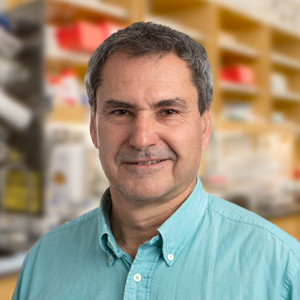
Simone Paolo Ponzetto is an Assistant Professor (Juniorprofessor) at the University of Mannheim since 2013, affiliated with the Research Group Data and Web Science. His research focuses on Semantic Web technologies, Natural Language Processing (NLP), and knowledge acquisition, particularly leveraging collaboratively built resources like Wikipedia. Prior to Mannheim, he held postdoctoral roles at Sapienza University of Rome and research positions at the University of Heidelberg and Stuttgart. His work includes pioneering projects like BabelNet, a multilingual semantic network. Ponzetto earned his PhD in Computational Linguistics from the University of Stuttgart, with interdisciplinary contributions to coreference resolution, semantic relatedness, and ontology learning. Research Interests: Unsupervised/weakly-supervised knowledge extraction Multilingual ontology learning and semantic networks Lexical semantics (word sense disambiguation, semantic similarity) Discourse semantics (coreference resolution, coherence modeling) Professional Contributions: Guest editor for a Artificial Intelligence Journal special issue on AI and Wikipedia Area chair for EMNLP-CoNLL 2012 and EACL 2014 Program committee member for ACL, AAAI, and other top conferences Lab/Team: Active in the Research Group Data and Web Science at Mannheim, advancing AI and NLP applications in collaborative knowledge systems.
Dr. Stuart Marshall serves as Associate Dean of Academic Development in the Faculty of Science and Engineering at Victoria University of Wellington - Te Herenga Waka, where he also holds the academic rank of Senior Lecturer. Previously, he served as Head of School for the School of Engineering and Computer Science from 2015-2021 after joining the institution as a Lecturer in 2003. His academic journey includes completing his BSc, MSc, and PhD in Computer Science at Victoria University of Wellington, with his doctoral research focusing on software reuse. Marshall's research interests center on information and data visualization, particularly exploring how visualization can function as collaborative tools in team environments rather than single-user applications. He also investigates explainable AI and mobile user interface design with emphasis on promoting healthy device usage patterns. His work bridges theoretical computer science with practical applications in education and environmental analysis. Analysis of his publication record reveals a consistent focus on visualization techniques, with recent work shifting toward immersive analytics and virtual reality applications for complex data analysis, particularly in ecosystem services. Earlier publications concentrated on mobile learning applications grounded in transactional distance theory, software visualization for large codebases, and graph layout algorithms. Marshall has supervised six PhD students and eight Masters students to completion, with current doctoral supervision spanning immersive environments for reading assistance, medical diagnosis interfaces, and cardiac procedure simulation. His grant portfolio includes multiple ACM ISS 2022 projects with industry partners including Sensor Holdings Limited, Niantic, Autodesk, and Northeastern University, along with an Australian Research Council grant for digital games preservation. Teaching responsibilities encompass foundational programming, safety-critical systems, human-computer interaction, and data visualization across undergraduate and graduate courses. He teaches subjects including SWEN326 (Safety-Critical Systems), CGRA151 (Introduction to Computer Graphics and Games), and DATA301 (Data Science in Practice), with teaching assignments scheduled through 2026.
Andries "Andy" van Dam is a distinguished Dutch-American professor of computer science at Brown University, where he also served as vice-president for research. Born in Groningen, the Netherlands on December 8, 1938, van Dam has been instrumental in shaping computer science education and research for over five decades. He helped establish Brown's computer science program, serving as its first department chair from 1979 to 1985, and was appointed Thomas J. Watson, Jr. University Professor of Technology and Education in 1995. His educational background includes a B.S. with Honors in Engineering Sciences from Swarthmore College (1960) and M.S. and Ph.D. degrees from the University of Pennsylvania (1963, 1966), where he was the second person to receive a PhD in Computer Science. Van Dam's research interests span computer graphics, hypertext systems, virtual reality, and educational technology. He is particularly known for his pioneering work in hypertext systems, having co-developed the first hypertext system with Ted Nelson in the late 1960s. His influential textbook "Computer Graphics: Principles and Practice" is often referred to as the "Bible" of computer graphics. His work has consistently focused on making complex computing concepts accessible through innovative interfaces and educational approaches. His research publications demonstrate a consistent trajectory from foundational work in computer graphics and hypertext to more recent explorations in immersive virtual reality, digital visual literacy, and next-generation educational software. His work bridges theoretical computer science with practical applications in education, medicine, and scientific visualization. Among his notable honors are: IEEE Centennial Medal (1984) Fellow of the Association for Computing Machinery (1994) ACM SIGGRAPH Distinguished Educator Award (2019) Van Dam has mentored numerous students who have gone on to make significant contributions in computer science, including Randy Pausch, Danah boyd, Scott Draves, and Steven K. Feiner. His teaching extends beyond traditional academic settings, as evidenced by his influence on the character of Andy in the film Toy Story, which pays tribute to his pioneering work in computer graphics. He continues to serve on the technical board of Microsoft Research and as chairman of the Rhode Island Governor's Science and Technology Advisory Council. His research lab has been instrumental in developing innovative approaches to human-computer interaction, with particular focus on post-WIMP (Windows, Icons, Menus, Pointer) interfaces, immersive environments, and educational technologies that transform how we learn and interact with digital information.
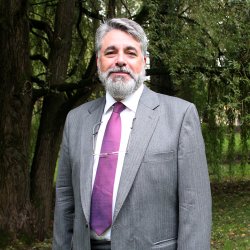
Assoc. Prof. Boyan Zhekov, PhD is an active faculty member at the University of Library Studies and Information Technologies (UNIBIT) in Sofia, Bulgaria, where he serves in the Department of Computer Science under the Faculty of Information Sciences. He teaches courses including Case Studies in Digital Transformation (SHEB609) and holds academic appointments at Sofia University "St. Kliment Ohridski" and New Bulgarian University as a visiting lecturer. MSc in Information Technologies from Technical University - Sofia Specialized in IT and Economics across UK, France, Netherlands, South Korea, Japan, and Taiwan His research focuses on the intersection of digital governance and emerging technologies, with significant contributions to Internet of Things applications in public administration, smart city ecosystems, and open data frameworks. His work demonstrates a consistent emphasis on practical implementations of ICT solutions for governmental modernization, particularly through EU-funded projects and national initiatives. Current projects examine IoT business models and startup ecosystems within smart city contexts. Prof. Zhekov actively contributes to European research policy as a Horizon 2020 National Contact Point for Future and Emerging Technologies, ICT, and Secure Societies, while serving on the Programme Committee for ICT. His professional engagement extends to leadership roles in Japanese-Bulgarian academic networks including JICA Alumni Bulgaria and Nihon Tomono Kai. Member of Horizon 2020 National Contact Network Board member of Union of Electronics, Electrical Engineering and Communications (SEES) President of JICA Alumni Bulgaria Vice President of JSPS Alumni Bulgaria His advisory work includes technical ICT audits for EU-funded projects under Operational Program RCBIS (2007-2013) and development of sectoral information strategies for regional governance (2014-2020). Recent projects for the Ministry of Education analyze national research infrastructure roadmaps and map Bulgaria's scientific infrastructure landscape.
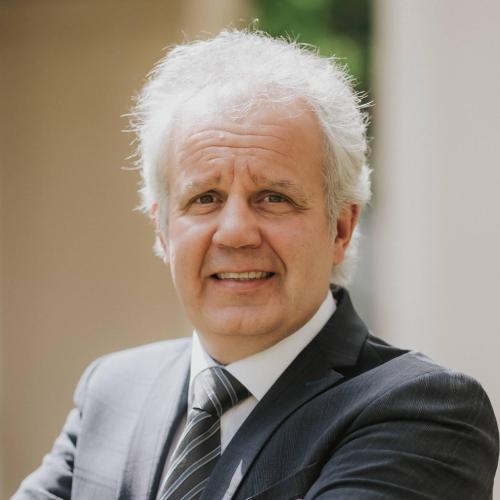
Markus Bick is a Full Professor and Chair of Business Information Systems at ESCP Business School, where he also serves as the Director of Studies for the MBA in International Management. His academic career spans multiple leadership roles within the institution, including various local academic director positions for bachelor's and master's programs. Professor Bick earned his PhD in Business Information Systems from the University of Duisburg-Essen (Germany) and holds a Diploma (MSc equivalent) in Business Information Systems from the University of Essen (Germany). His research focuses on cutting-edge digital transformation topics including digital competencies, digital maturity models, eXplainable AI, trust in large language models (LLMs), gamification, knowledge management, and Web 3.0 technologies. His scholarly work has led to customized education programs for major corporations including telecommunications companies and international buying groups, as well as application-oriented research and consultancy projects in the media industry. Professor Bick maintains an active publication record in prestigious international journals such as Information & Management, Decision Support Systems, Electronic Markets, Business Information Systems Engineering, and Information Systems Frontiers. He also serves as a senior editor for two renowned peer-reviewed journals: Electronic Markets and Information Systems Management. PhD in Business Information Systems, University of Duisburg-Essen (Germany) Diploma (MSc equivalent) in Business Information Systems, University of Essen (Germany) As Director of Studies for the MBA in International Management, Professor Bick oversees one of ESCP's flagship programs that enables students to study across two of the school's six international campuses. His leadership extends to developing educational content that integrates emerging technologies with business management principles, reflecting ESCP's position as the world's first business school established in 1819.
Dr. Faisal Mohd-Yasin is a Senior Lecturer in the School of Engineering and Built Environment at Griffith University, specializing in Electrical and Electronic Engineering. He has been with Griffith University since 2010, initially as a Lecturer (2010-2016) and promoted to Senior Lecturer in 2017. He is also a member of the Queensland Quantum and Advanced Technologies Research Institute (QUATRI) since 2025. His research spans microelectronics, MEMS technology, compound semiconductors, and electronic sensors/instrumentation, with particular expertise in silicon carbide-based devices for harsh environments. Dr. Mohd-Yasin holds dual PhD qualifications: a Doctor of Philosophy (Engineering) from Multimedia University, Cyberjaya, Malaysia (2014) and a PhD in Engineering from Ibaraki University, Hitachi, Japan (2009). His educational background provides a strong foundation for his interdisciplinary research that bridges semiconductor physics, sensor technology, and electronic circuit design. His research interests focus on Microelectromechanical systems (MEMS), compound semiconductors (particularly $$ ext{SiC}$$), electronic sensors, and electronic instrumentation. He has made significant contributions to the development of silicon carbide MEMS devices for harsh environments, piezoelectric energy harvesters, and noise analysis in microelectronic systems. His work has important applications in sustainable cities (SDG 11), health and well-being (SDG 3), and clean energy (SDG 7). Analysis of his recent publications reveals a strong trend toward MEMS sensor technology, particularly silicon carbide-based devices for harsh environments, and noise analysis in piezoelectric sensors. His research also demonstrates a growing interest in engineering education, with several publications on practical electronics teaching methods. The publications span electrical engineering, sensor technology, energy harvesting, and engineering education, reflecting his interdisciplinary approach to research and teaching. Dr. Mohd-Yasin has successfully supervised multiple doctoral and masters students through completion, including Utkarsh Jadli (PhD on Parasitic Capacitances of Power Transistors), Siti Aisyah Zawawi (PhD on MEMS capacitive microphone), Mei Kum Khaw (PhD on magnetically actuated droplets), Abid Iqbal (PhD on AlN thin films), Noraini Marsi (PhD on MEMS pressure sensors), and Kai Meng Mui (Masters on Power management IC). He has also secured numerous research grants totaling over $1.5 million from various sources including Griffith University, Innovative Manufacturing CRC, IRU, and Malaysian research councils. He is actively involved in professional service as a peer reviewer for the IEEE Sensors Conference series (2015-2025), Micro and Nano Engineering Conference series (2009-2018), and the International Conference on Solid-State Sensors, Actuators and Microsystems (2018-2019). He is also a member of IEEE (Institute of Electrical and Electronics Engineers) since 1997. Dr. Mohd-Yasin's research is primarily conducted through the Queensland Quantum and Advanced Technologies Research Institute (QUATRI), where he collaborates with researchers working on advanced semiconductor technologies and quantum applications. His laboratory work focuses on MEMS fabrication, sensor characterization, and circuit design for harsh environment applications.
Dr. Rosa Krajmalnik-Brown is a Professor and Director of the Biodesign Center for Health Through Microbiomes at Arizona State University's School of Sustainable Engineering and the Built Environment. She holds affiliations with the School of Life Sciences, College of Health Solutions, and serves as a Senior Global Futures Scientist. Her research integrates molecular microbial ecology to address bioremediation, bioenergy production, and the gut microbiome's role in obesity, metabolism, and autism. She earned a Ph.D. in Environmental Engineering from Georgia Tech (2005), an M.S. in Environmental Engineering from Georgia Tech (2000), and a B.S. in Industrial Biochemical Engineering from UAM-I Mexico City (1996). Her research focuses on microbe-environment interactions in three key areas: optimizing bioremediation systems for contaminants like chlorinated solvents; developing microbial bioenergy platforms; and investigating links between gut microbiota and human health conditions such as autism, obesity, and metabolic disorders. She pioneered gut microbiome research in autism spectrum disorders. Her recent publications emphasize interdisciplinary approaches, including clinical trials on diet-microbiome interactions, multi-omic analyses of microbial communities, and innovative environmental remediation strategies. Research frequently incorporates metagenomics, metabolomics, and biofilm reactor technologies. Scientific Awards: Fulbright Scholarship NSF CAREER Award Fulton Engineering Exemplar Faculty Arizona Researcher of the Year (AZBio, 2020) Highly Cited Researcher (Web of Science, 2020 and 2021) She has secured extensive funding from NIH, DoE, DoD, and NSF for projects spanning microbial ecology, bioenergy, and medical applications. As director of the Biodesign Center, she oversees interdisciplinary teams developing microbiome-based therapies and environmental solutions. Current work explores microbial contributions to energy balance and precision synbiotics for neurodevelopmental disorders.
Professor Alan Woodward is a renowned computer security expert at the University of Surrey, affiliated with the Surrey Centre for Cyber Security and Computer Science Research Centre. His career spans academia, government service, and private sector leadership, including pivotal roles in IT businesses like Charteris plc. He holds fellowships and chartered status across multiple prestigious institutions and actively advises governmental bodies such as Europol. Education: Undergraduate studies in Physics & Astronomy Postgraduate research in adaptive filtering and signal recovery at the University of Southampton's Institute of Sound and Vibration Research Research Focus: Woodward's interdisciplinary work bridges cybersecurity, digital forensics, and signal processing. His expertise includes cryptographic methods, steganography for covert communications, digital watermarking for data protection, and novel approaches to forensic computing. Current projects explore quantum computing threats and real-world cybercrime mitigation. Publication Trends: His recent articles demonstrate a strong focus on emerging cyber threats across societal and technical domains. Key themes include quantum cryptography vulnerabilities, organized cybercrime patterns, critical infrastructure risks, mobile/cloud security challenges, and public cybersecurity education with practical guidance for digital safety. Honors & Credentials: Fellow: Institute of Physics, British Computer Society, Royal Statistical Society Chartered Status: Engineer (CEng), IT Practitioner (CITP), Physicist (CPhys) Eur Ing (European Engineer) Leadership & Outreach: Beyond academic research, Woodward directs technology enterprises and leads public STEM engagement. He frequently contributes to international media (BBC, The Times, The Telegraph) as a cybersecurity commentator. His Surrey research teams collaborate with law enforcement and industry partners on threat intelligence initiatives.
Michael Donald Bailey is a Professor and former Chair of the School of Cybersecurity and Privacy (SCP) at Georgia Institute of Technology, part of the College of Computing. Previously, he served as a Professor at the University of Illinois at Urbana-Champaign (UIUC) and as a Research Associate Professor at the University of Michigan. His research focuses on the security, performance, and availability of distributed systems, with over 90 scholarly publications. He has led initiatives to expand cybersecurity education, including new undergraduate threads and professional master’s programs at Georgia Tech. Bailey’s industry experience includes roles at Arbor Networks, where he managed teams protecting internet traffic from DDoS attacks, and three startups. He is a Senior Member of IEEE and ACM. Roles: Professor, Chair (until 2025), Researcher Affiliations: Georgia Tech (SCP, College of Computing), UIUC (Security and Privacy Research Group) His research interests span network security, distributed systems, and privacy engineering. Notable contributions include work on TLS certificate management, IoT security, and phishing defense mechanisms. Bailey advises students at both UIUC and Michigan, fostering next-generation cybersecurity experts.
Tej Chajed is an Assistant Professor in the Department of Computer Sciences at the University of Wisconsin-Madison, focusing on formal verification of systems software. His research bridges theoretical foundations and practical implementations to ensure software correctness in concurrent and crash-safe systems. Research interests include formal verification, concurrency, crash safety, and programming languages, particularly using Coq, Perennial, and Goose frameworks. He has contributed to systems like DaisyNFS, a verified file system with sequential reasoning, and Verus, a foundation for systems verification. His work appears in top venues like SOSP, OSDI, and PLDI. 2025: Dafny PC Member 2024: PLDI Committee Member, CoqPL Co-chair 2023: CoqPL Co-chair, POPL Program Committee He actively mentors students and develops tools for systems verification education, including extensive Coq-based course materials.
Shari Trewin is a prominent researcher in accessibility and human-computer interaction at IBM Research with over 25 years of scholarly contributions. Her work focuses on making digital technologies accessible to people with disabilities, particularly in web and mobile contexts. She has published extensively in top-tier venues including ACM SIGACCESS conferences (ASSETS, W4A) and journals, CHI, and other leading HCI publications. Dr. Trewin's research interests span web accessibility, mobile accessibility for users with physical and cognitive disabilities, inclusive design methodologies, and the application of artificial intelligence to improve accessibility. Her work addresses both theoretical foundations and practical implementations of accessible technologies, with particular emphasis on user-centered design approaches and evaluation methodologies. She has made significant contributions to understanding how people with disabilities interact with digital interfaces and how to design systems that accommodate diverse user needs. Her publication record shows a clear progression from foundational work on input devices and keyboard accessibility in the 1990s to contemporary research on AI fairness for people with disabilities. Recent publications demonstrate her leadership in addressing emerging challenges at the intersection of AI and accessibility, particularly around algorithmic fairness and inclusive design practices for AI systems. Among her notable contributions are editorial work for ACM Transactions on Accessible Computing and co-editing conference proceedings for the ASSETS conference. She has collaborated extensively with leading researchers in the field including Vicki L. Hanson, Gregg Vanderheiden, and Calvin Swart. Dr. Trewin has advised junior researchers including Jessica J. Tran, and her work has influenced both academic research and industry practices in accessibility. Her research has practical implications for web developers, designers, and policy makers working to create more inclusive digital experiences.
Robert Berry is a Senior Lecturer at the Faculty of Computing, Engineering and Science at the University of South Wales. He holds a PhD in Geographical Information Systems, an MSc in GIS, and a BSc in Geography. His research focuses on geocomputation, integrating AI, NLP, and GIS to address geospatial challenges, with recent work in accessibility modeling and 3D landscape visualization. He is affiliated with the GIS Research Centre and WISERD, an interdisciplinary social science institute. Dr. Berry teaches modules in computing and information systems, including big data analytics, GIS, and project management. He has supervised numerous MSc and PhD students and contributed to over 50 research outputs, including peer-reviewed articles, conference papers, and technical reports. His expertise spans FOSS tools, programming (R, Python), and cloud computing for geospatial applications. Key projects include the 'People, Places and the Public Sphere' initiative (2024–2027) and evaluations of agricultural risk management policies. He has collaborated with UK government agencies, local authorities, and third-sector organizations on projects involving environmental planning, flood management, and cultural heritage preservation. Dr. Berry is a Fellow of the Royal Geographical Society and actively engages in advancing participatory technologies for environmental decision-making. His work emphasizes enhancing public participation through digital tools and addressing socio-economic challenges via geospatial analysis.
Matthew Leybourne is an Associate Professor in the Department of Geological Science and Geological Engineering at Queen's University, affiliated with the Faculty of Arts and Science. He holds a cross-appointment at the Arthur B. McDonald Canadian Astroparticle Physics Institute. His research focuses on geochemical and isotopic investigations of ancient and modern rocks, particularly developing analytical methods for ultra-low trace element concentrations. He leads projects at the Queen’s Facility for Isotope Research, including low-level trace material determinations for astroparticle physics applications. Education: PhD (1998) in Earth Sciences from the University of Ottawa; M.Sc. (1988) in Geology from Acadia University; B.Sc. (1985) in Geology from the University of Waikato. Research interests include ore deposit geochemistry, environmental geochemistry, and quality assurance in analytical methods. Key projects involve fluid geochemistry of ore deposits, marine hydrothermal systems, and isotopic tracers for astrophysics. His work bridges geology and physics, addressing questions about Earth’s early evolution and宇宙起源. Advising includes postdoctoral fellows focused on geochemical analysis and mineral exploration. He collaborates with the McDonald Institute on interdisciplinary projects combining geology with astroparticle detection. Affiliations include the Journal of Tethys, Canadian Geosciences Education Network, and the Society of Economic Geologists.
Aleksandar Jevremović is a Full Professor at the Faculty of Informatics and Computing, Singidunum University (Belgrade, Serbia), and holds multiple academic and professional roles. He is the Serbian representative at the UNESCO IFIP Technical Committee on Human-Computer Interaction since 2018. He has served as Vice-Dean of his faculty (2015–2018) and held visiting professorships at institutions like Ss. Cyril and Methodius University (North Macedonia) and Tallinn University (Estonia). His research focuses on cybersecurity, IoT, AI, and e-learning innovation. Education and Affiliations: External Researcher at the Mathematical Institute of the Serbian Academy of Sciences and Arts Visiting Scholar at Cyprus Interaction Lab (Cyprus University of Technology) Alumni/Postdoc Researcher at Tallinn University's HCI Group Member of IEEE and the Informatics Association of Serbia Research Interests: Jevremović’s work spans cybersecurity (e.g., intrusion detection, secure IoT protocols), human-computer interaction (HCI), AI-driven education tools, and neurotechnological applications like EEG-based assessment systems. He emphasizes practical solutions for digital safety, such as children’s online protection and cryptographic key generation from biometric data. Grants and Projects: Member of the External Advisory Committee for the EU-funded ONTOCHAIN project (2022–2023) Mentor for training schools like AAPELE Training School and NET4Age-Friendly initiatives Trainer in IoT, cybersecurity, and health promotion programs across Europe Labs and Teams: He collaborates with interdisciplinary teams on projects like CASPER (Children Agents for Secure and Privacy Enhanced Reaction) and led the development of WIDE, a collaborative web development education platform.
MICHEL SANNER is a Professor of Molecular Biology at the Department of Integrative Structural and Computational Biology at Scripps Research. He holds a PhD in Computer Science from the University of Haute Alsace, France (1992). His research focuses on computational methods for molecular interactions, molecular graphics, and component-based software development. Notable contributions include the AutoDock suite (for molecular docking), PMV (a molecular visualization environment), and Vision (a visual programming tool). His research group develops tools like AutoDock CrankPep for peptide docking and F2Dock for protein-protein interactions. These tools are widely used in drug discovery and structural biology. His work emphasizes software engineering principles to create adaptable computational pipelines for analyzing macromolecular structures and simulating interactions. Publications span topics like peptide-docking methodologies, ligand-binding site prediction, and GPU-accelerated docking algorithms. His articles highlight advancements in computational methods for understanding protein-ligand interactions, with applications in anticoagulant research and HIV/FIV protease inhibition. Collaborations include work with Arthur J. Olson and David S. Goodsell on docking methodologies.