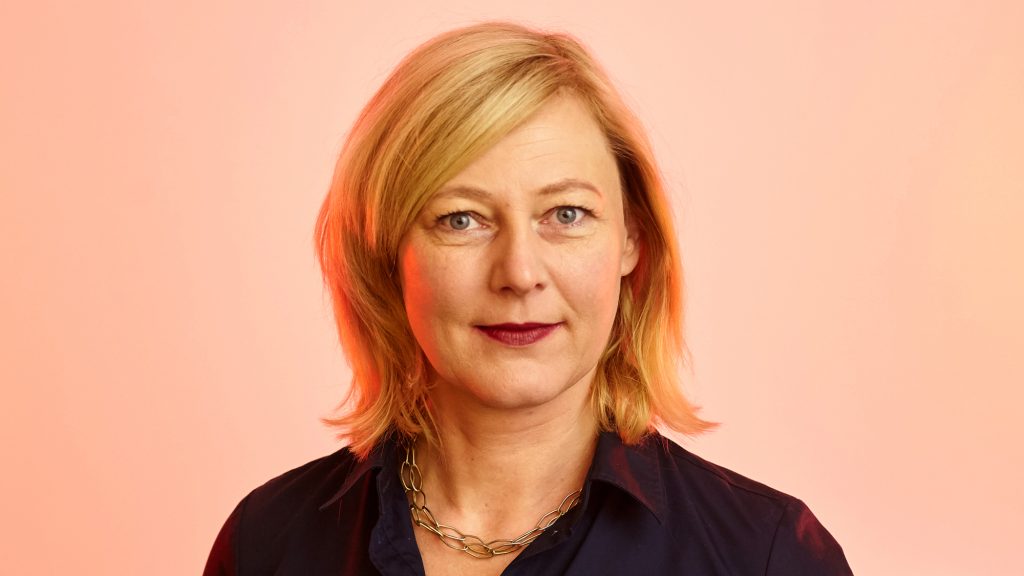
Prof. Dr. Nina Gerlach is the Rector of the Academy of Fine Arts Münster and has held the professorship in Aesthetics and Art History since 2015. She is a leading scholar in contemporary art theory, digital media studies, and film aesthetics. Her research explores intersections between technology, ethics, and visual culture, with a focus on post-digital art, garden symbolism in cinema, and artificial intelligence. Gerlach studied European Art History, Ancient History, and Media Studies at Heidelberg and Mannheim, earning her MA in 2005. Her 2010 doctoral dissertation, later published as Gartenkunst im Spielfilm , received the August-Grisebach Prize. She has held visiting professorships across institutions including Harvard University (Dumbarton Oaks Fellowship, 2008-09) and served as Prorector at the Academy of Fine Arts Münster (2018-2021). Her current research projects include Zwischen Pixel und Pigment (2025), co-edited with Simon Vagts, examining post-digital painting practices. She advises doctoral candidates like Malte Frey and Tonio Nitsche, and leads interdisciplinary initiatives linking art with human rights and democracy. Gerlach also chairs the Art Law Clinic advisory board and serves on the Landesrektorenkonferenz NRW.
Overview Gualtiero Volpe is a Professor affiliated with the Department of Informatics at the University of Genoa, Italy. His research focuses on Human-Computer Interaction (HCI), Affective Computing, and Multimodal Interaction, with particular emphasis on analyzing social interactions, embodied cognition, and expressive movement qualities in contexts such as music performance and education. He has collaborated extensively with researchers like Antonio Camurri, contributing to interdisciplinary projects that bridge computer science, cognitive science, and the arts. Research Interests Analysis of human movement and affect through computational methods Design of multimodal interactive systems for education and healthcare Investigation of laughter and social dynamics in human interactions Development of technologies for music performance and collaborative creativity Key Contributions Volpe's work spans over 140 publications in top-tier venues such as IEEE Transactions on Affective Computing, ACM Conference on Human Factors in Computing Systems (CHI), and International Conference on Multimodal Interaction (ICMI). His research has led to innovations in: Automated analysis of movement qualities using machine learning Sonification platforms for exergames and rehabilitation Embodied interaction frameworks for children's education Computational models of group cohesion and synchronization Recent Trends in Publications Recent studies emphasize the integration of cognitive science principles into movement analysis and the application of multimodal systems to address challenges in post-pandemic social interaction (e.g., digital commensality). His work on 'Embodied Multisensory Training' and 'Hybrid Co-Working in Industry 5.0' highlights a growing focus on real-world applications of HCI research. Awards & Grants No specific awards or grants are explicitly mentioned in the provided data, though his prolific publication record and leadership in collaborative projects suggest sustained academic recognition and funding support. Labs & Teams Volpe is part of the EyesWeb XMI research group at the University of Genoa, developing open-source platforms for real-time multimodal interaction analysis. He collaborates with institutions like the University of Trento and Goldsmiths, University of London on projects related to music technology and social robotics.
Prof. Dr. Heike Trautmann is a leading researcher in statistics and optimization at the University of Twente (2021-2026) and former Professor at WWU Münster (2013-2016). Her work bridges computational statistics, evolutionary optimization, and social media analytics. She has held visiting positions at TU Dortmund, Leiden University, and RWTH Aachen. Current affiliation: University of Twente (Data Science: Statistics and Optimization) Previous roles: WWU Münster (Professor for Information Systems and Statistics), TU Dortmund (Postdoctoral researcher) Research Focus: Multi-criteria optimization, automated algorithm selection, data stream mining, and disinformation detection in social media. Her methodological innovations in exploratory landscape analysis and evolutionary computation have transformed algorithm configuration practices. Developed COSEAL consortium for algorithm selection Co-founder of Benchmarking Network (2019) Principal investigator in projects like PropStop and MODERAT! Academic Contributions: Over 150 publications in top venues like GECCO, PPSN, and Evolutionary Computation journal. Pioneered feature-based landscape analysis tools (flacco, pflacco) and stream clustering frameworks.
Dr. Tim Gerrits is a researcher at the Institute for Visualization (VIS) at RWTH Aachen University, where he leads the Visualization Team. His work bridges scientific visualization, high-performance computing, and immersive technologies, with a strong focus on in-situ and in-transit analysis for large-scale simulations. University: RWTH Aachen University Institute: Institute for Visualization (VIS) Role: Lead of the Visualization Team Tim Gerrits' research centers on developing tools and frameworks for efficient and interactive visualization of complex scientific data. His interests include ensemble data analysis, uncertainty visualization, virtual reality interaction techniques, and leveraging game engines like Unreal Engine for scientific applications. He is particularly active in the domain of neuronal network simulations and oceanographic modeling. His recent publications highlight a strong trend toward accessible, real-time, and hybrid visualization workflows. He has contributed to the development of DaVE, a curated database of visualization examples to support HPC users, and Insite, a lightweight pipeline for in-transit processing in neuroscience simulations. His work emphasizes usability, performance, and integration with existing scientific workflows. Scientific Awards: Best Paper Award at IEEE Uncertainty Visualization Workshop, 2024 Honorable Mention Award at Eurographics Workshop on Visual Computing for Biology and Medicine (VCBM), 2022 Dr. Gerrits actively mentors and collaborates on interdisciplinary projects involving computational neuroscience and climate modeling. He has led the curation of datasets for the IEEE SciVis Contest and promotes open science through Zenodo-hosted resources. His lab focuses on building scalable, user-centered visualization systems that empower domain scientists to gain early insights from massive simulations.
Berenike Herrmann is a Professor in the Faculty of Linguistics and Literary Studies at the University of Bielefeld, Germany. She is affiliated with the Department of German Studies and the Department of Literary Studies, and actively contributes to interdisciplinary research through centers such as the Bielefeld Center for Data Science (BiCDaS) and the Center for Uncertainty Studies (CeUS). She leads major research projects within Collaborative Research Centers SFB 1288 and SFB 1646, focusing on comparative literature and linguistic creativity. Faculty of Linguistics and Literary Studies Department of German Studies Department of Literary Studies Collaborative Research Center 1288 – Subproject E06 SFB 1646 – Project A05 Bielefeld Center for Data Science (BiCDaS) Center for Uncertainty Studies (CeUS) Her research spans computational stylistics, data humanities, German-Swiss literature, affect and emotion, metaphors, and social reading practices. She employs digital methods to analyze literary texts and reader responses, bridging traditional literary scholarship with computational approaches. Her work emphasizes comparative frameworks, national literature formation, and the impact of digitality on contemporary literary culture. The 15 most recent articles reflect a strong interdisciplinary trend, combining literary theory with data science, cognitive linguistics, and affect studies. Key themes include computational analysis of style and creativity , emotional dynamics in literature , metaphorical structures , and digital reading practices . The research is characterized by methodological innovation, using metrics and models to study linguistic and literary phenomena in both historical and contemporary contexts. Deputy Chairwoman, Board of Literary Studies Deputy Chair, Library Commission Member, IKM Officers (with Prof. Dr. Maximilian Benz) Voting Member, Linguistics Department Member, BiSEd (Faculty of Linguistics and Literature) She is involved in academic governance and digital infrastructure, advising on library policy, research data services, and curriculum development. She is the module responsible for 'Literature in the present: Culture, media, digitality' (23-GER-PLit2_a), indicating active teaching and program leadership. Her projects are supported by third-party funding, particularly through the German Research Foundation (DFG), and she collaborates across disciplines, especially at the intersection of humanities and data science. Berenike Herrmann is embedded in several interdisciplinary research environments, including the Collaborative Research Centers 1288 and 1646, the Bielefeld Center for Data Science (BiCDaS), and the Center for Uncertainty Studies (CeUS). These labs and teams foster innovative, cross-disciplinary approaches to literary and linguistic research, combining traditional hermeneutics with computational modeling and data-driven analysis.
apl. Prof. Dr.-Ing. Claus Brenner is an Adjunct Professor at the Institute of Cartography and Geoinformatics within the Faculty of Civil Engineering and Geodetic Science at Leibniz University Hannover. His research focuses on LiDAR mapping, point cloud processing, and robust estimation, with applications in autonomous systems, urban mapping, and disaster risk assessment. He leads the Graduiertenkolleg 2159 research group on integrity and collaboration in dynamic sensor networks. Key research areas include 3D reconstruction, SLAM (Simultaneous Localization and Mapping), semantic segmentation of mobile mapping data, and cooperative perception systems. His work integrates advanced machine learning techniques with geospatial data analysis, addressing challenges in sensor fusion, uncertainty modeling, and real-time localization. Recent publications span topics like voxel-based point cloud localization for smart spaces, flood risk mapping using LiDAR, and adversarial shape completion. Brenner has contributed to benchmark datasets such as LuCoop and LUMPI, advancing research in cooperative perception and urban navigation. His methods emphasize robustness and scalability, often leveraging generative models and statistical frameworks for urban environment analysis. Notable projects include the development of high-definition mapping using LiDAR, trajectory-based road network reconstruction, and semantic annotation from user trajectories. His work bridges theoretical advancements in computer vision with practical applications in autonomous systems and smart infrastructure.
Norbert Haala is an Adjunct Professor and Deputy Director at the University of Stuttgart's Department of Photogrammetric Computer Vision. He leads the Research Group in Photogrammetric Computer Vision and is involved in ISPRS Working Group II/2 (Point Cloud Generation) and EuroSDR Commission 2 (Modelling and Processing). His work focuses on 3D data collection, SLAM algorithms, LiDAR integration, and UAV-based geospatial technologies. Research interests include image-based data collection, photogrammetric computer vision, and semantic segmentation of 3D point clouds. He has contributed to benchmarks like Hessigheim 3D and TIME, and developed tools like SURE for dense image matching. Teaching includes courses on digital image processing, terrain modeling, and computer vision. His publications emphasize real-time mapping, hybrid georeferencing, and neural surface reconstruction from airborne imagery. Projects involve UAV monitoring, indoor SLAM for robotics, and multi-modal data fusion for urban modeling. He collaborates on EuroSDR initiatives and publishes regularly in remote sensing and robotics domains.
Dr. Stephanie Kemper is a Researcher in the Correct System Design Group at the Department of Computing Science, University of Oldenburg, Germany. Her career spans roles including Research Assistant at Centrum Wiskunde & Informatica (2006-2011), OFFIS (2012-2015), and continuous contributions to the University of Oldenburg since 2011. Education Diploma in Computer Science with distinction (University of Oldenburg, 2006) PhD in Computer Science (Leiden Institute of Advanced Computer Science, 2011) Research Interests Specializing in formal methods for real-time systems, her work emphasizes: Timed Automata and Timed Constraint Automata SAT-based Model Checking for verification Component-based Software Engineering Abstraction Refinement with Craig Interpolation Concurrency and True Concurrency in systems Scalable verification techniques overcoming state explosion Publication Trends Her publications (2007-2013) focus on real-time coordination patterns, SAT-based verification, and compositional analysis of timed systems. Key areas include formal modeling of traffic scenarios, constraint automata for component connectors, and counterexample-guided abstraction refinement. Affiliations University of Oldenburg (2011-present) Centrum Wiskunde & Informatica (2006-2011) OFFIS Group SAV-RSM (2012-2015)
Tom Duscher is a Professor of Interactive Media at the Muthesius Academy of Art and Design in Kiel, Germany, affiliated with the Center for Media. He has held this position since 2003, leading research in information design and scientific visualization. Duscher founded the Science Communication Lab in 2015, focusing on innovative visual communication for scientific topics, and serves as a Principal Investigator at the Kiel Science Communication Network (KSCN) since 2021. His research explores: Information Design : Creating visual frameworks for complex scientific data Scientific Visualization : Developing interactive formats for oceanography and environmental science Experience Design : Studying impact processes in science communication Interdisciplinary Collaboration : Bridging art, design, and marine science His publications demonstrate a consistent focus on digital media evolution , interdisciplinary communication , and experimental visualization techniques , with recent works emphasizing science-art collaborations and immersive educational formats. Awards include: Information is Beautiful Award Gold (2019) German Design Award in Gold (2016, 2019) Red Dot 'Best of the Best' (2014) Innovation Award of Kiel (2017) He directs the Science Communication Lab and co-leads transdisciplinary projects through KSCN, a consortium involving Muthesius Academy, Leibniz Institute, and Kiel University. His Future Ocean Explorer project developed interactive exhibition technologies.
Prof. Dr. Gesche Joost is the Head of the Design Research Lab at the Berlin University of the Arts and holds affiliations with the German Research Center for Artificial Intelligence (DFKI) , Weizenbaum Institute for the Networked Society , and Einsteincenter Digital Future (ECDF) . Her research focuses on the intersection of digital transformation , human-computer interaction , and socially sustainable design , particularly examining: Participatory design for marginalized groups Wearable computing and tangible interfaces Digital sovereignty and inclusive governance Gender studies in technology contexts Material interactions in urban environments Her publications analyze proxemic mobile design, affective haptics, and critical approaches to digital infrastructure. Key projects include MINODU for local sustainable development, MYOW for DIY wearables, and Calliope gGmbH for children's digital education. She serves on the supervisory boards of SAP, ING, and Ottobock and has contributed to policy through the German government's Federal Internet Ambassador role (2014–2018).
Dr. Mor Geva is a prominent researcher in natural language processing and machine learning, focusing on transformer-based language models, interpretability, and knowledge representation. Their work addresses fundamental questions about model reasoning, uncertainty expression, and factual recall mechanisms. Key research themes: language model interpretability, multi-hop reasoning limitations, numerical encoding, cross-modal knowledge gaps Recent publications analyze gradient projection, attention head functionality, and fallback behaviors under uncertainty 2023-2025 studies reveal insights into factual association recall, knowledge editing ripple effects, and vision-language model interactions. Collaborations span top institutions in ACL, EMNLP, and ICLR venues. Current research explores parametric knowledge tracing, encoder-decoder dynamics, and attention hijacking phenomena. Tools like LM-Debugger enable interactive model inspection, while theoretical work examines base-10 numerical encoding and task vector creation.
Michael Kamp is an Associate Professor for Machine Learning and Artificial Intelligence at TU Dortmund University and a faculty member of the Lamarr Institute for Machine Learning and Artificial Intelligence. He maintains affiliations with the Institute for Artificial Intelligence in Medicine (IKIM) at University Medicine Essen and collaborates with institutions in the UA Ruhr consortium. Formerly led Trustworthy Machine Learning group at IKIM Postdoctoral researcher at CISPA Helmholtz Center (2021) and Monash University (2019-2021) Doctorate from University of Bonn His research focuses on trustworthy machine learning through three pillars: deep learning theory (loss surfaces, flatness, generalization), causal representation learning for explainability, and federated learning for privacy-preserving decentralized systems. Applications span healthcare, autonomous driving, and cybersecurity. Recent publications at AAAI/ICLR/NeurIPS explore: federated optimization algorithms for non-IID data, privacy-preserving causal discovery, and flatness-aware regularization techniques. His work combines theoretical rigor with real-world deployment challenges. NeurIPS 2021 Outstanding Reviewer Award ICLR 2021 Reviewer Award Best Paper at PDFL'20 Workshop NeurIPS 2019 Best Reviewer Award ICML 2019 Reviewer Award He contributes to the editorial board of Springer's Machine Learning journal and serves in the ELLIS society. His group's tools address early disease detection, 3D medical shape analysis, and domain transfer challenges while maintaining ethical constraints.
Katrin Angerbauer is a Researcher at the Institute for Visualization and Interactive Systems (VISUS) at the University of Stuttgart, Faculty of Computer Science. Her work bridges Human-Computer Interaction (HCI) , Accessibility in Visualization , and Immersive Technologies . She contributes to empirical studies on Virtual Reality (VR) , Augmented Reality (AR) , and 2D/3D visualization techniques , focusing on user experience, attention guidance, and inclusive design.
Guido Reina is a Senior Academic Councillor at the Visualization Institute of the University of Stuttgart (VISUS), affiliated with the Ertl Working Group. His research focuses on scientific visualization, computer graphics, and virtual reality, with a particular emphasis on rendering techniques for particle data, foveated visualization, and reproducibility in visualization workflows. His work spans interdisciplinary applications, including porous media analysis, energy-efficient rendering, and integration of visualizations into gaming consoles. He has contributed to frameworks like MegaMol and explored adaptive resolution scaling for high-performance 2D visualization. Guido is also a co-author of the EGPGV 2023 Best Paper Award. EGPGV 2023 Best Paper Award Guido collaborates with teams at VISUS and the University of Stuttgart, advancing immersive analytics and in situ visualization methodologies. His publications highlight the evolution of visualization research toward handling large-scale datasets, optimizing rendering pipelines, and enhancing user interaction in augmented/virtual reality environments.
Lei Shi is a Researcher at the Institute for Visualization and Interactive Systems (VIS) within the Collaborative Artificial Intelligence department at the University of Stuttgart, Germany . Their work focuses on integrating machine learning, human-robot interaction, and safety control systems. Research Areas: Human-Robot Interaction, Bayesian Deep Learning, Visual Servoing, Eye Tracking Key Techniques: Graph Convolutional Networks, Predictive Modeling, Feature Descriptors Recent publications highlight their contributions to gaze-based interaction safety, dropout placement in neural networks, and predictive tuning methodologies. They operate from Room 01.029, Pfaffenwaldring 5a, 70569 Stuttgart.